Researchers analyzing a LIGO-detected gravitational-wave signal propose it may come from a primordial black hole with subsolar mass, offering a potential direct test of PBH existence and a possible link to dark matter, though more detections are required for confirmation.
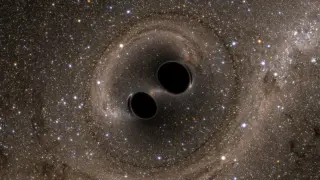
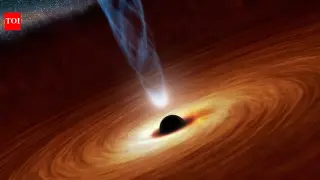
A LIGO detection involving an object lighter than a solar mass challenges standard stellar-black-hole formation, with researchers proposing a primordial black hole created in the early universe as the explanation. If confirmed, PBHs could account for dark matter, but further detections and next‑gen observatories like LISA and Cosmic Explorer are needed to build stronger evidence.
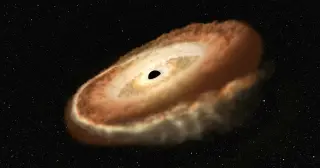
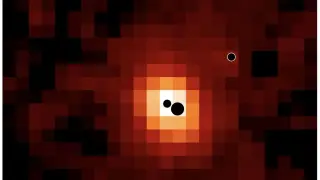
Astronomers connecting the November 2024 gravitational-wave event S241125n with a brief gamma-ray and X-ray flash propose the merger happened inside the accretion disk of a supermassive black hole at the center of a galaxy. If true, the environment would feed rapid accretion and jets, producing light from an event usually expected to be dark, offering a new scenario for how black hole mergers in galactic nuclei might be observed. Further observations and modeling are needed to confirm this explanation.
An international team reports a rare link between a binary black hole merger (GW event S241125n, about 4.2 billion light-years away) and a short gamma-ray burst with an X-ray afterglow, suggesting such mergers can emit detectable light under certain conditions and signaling a new era for combining gravitational waves with electromagnetic observations.
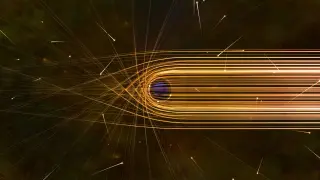
Astronomers have observed a newborn black hole from GW190412 speeding away from its birth site at about 112,000 mph (50 km/s). Using the event’s richer waveform, including higher-order modes, researchers reconstructed both the speed and the escape direction, providing a complete recoil portrait from a single merger. The result confirms that gravitational-wave–driven kicks can eject remnants from their birth environments, such as globular clusters, and shows how the remnant’s motion might influence any light produced as it plows through surrounding gas. Future detections of asymmetric mergers with identifiable higher-order modes will help map remnant motions across environments.
Scientists propose that the ultra-dense interiors of neutron stars could contain quark-gluon plasma—the same state of matter that existed moments after the Big Bang—and by analyzing how tidal forces in binary neutron-star systems imprint oscillation modes on gravitational waves, researchers hope to infer the stars’ interior structure and their equation of state, though current detectors aren’t yet sensitive enough; next‑generation observatories may confirm the presence of this exotic matter.
Astronomers analyzing the GW200105 gravitational-wave signal found an eccentric, precession-lacking orbit for a black hole–neutron star binary just before merger, suggesting it was shaped by gravitational interactions with a third body and not by a quiet, isolated inspiral. Using a new model from Birmingham’s Institute of Gravitational Wave Astronomy, the team says there are likely multiple formation channels for such mixed mergers, and the event revised prior mass estimates (BH ~13 solar masses, NS ~2). The finding expands our understanding of how extreme binaries form and evolve and challenges the assumption of circular, isolated mergers.
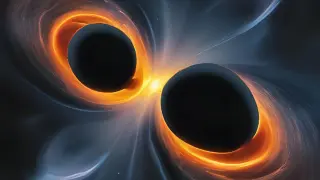
New analysis of the GW200105 gravitational-wave event finds the merging black hole and neutron star in a highly eccentric, oval-shaped orbit, upending the assumption of circular orbits in these binaries and suggesting alternative formation pathways shaped by their environment; future detectors like LISA could reveal more exotic mergers and broaden our understanding of these extreme systems.
The LVK collaboration released Gravitational-Wave Transient Catalog 4.0 (GWTC-4), adding 128 new gravitational-wave candidates detected from 2015–2024, more than doubling the catalog. The expanded set reveals a wider variety of black-hole binaries, including very massive and rapidly spinning systems, enabling tests of general relativity and new measurements of the universe’s expansion (via the Hubble constant). This growth pushes gravitational-wave astronomy into new regions of parameter space and promises deeper insights into black-hole formation and cosmic evolution.
The LVK collaboration’s GWTC-4 catalog adds 128 distant gravitational‑wave sources detected from 2023–2024, expanding beyond the previous 90; the data include heavier, faster black‑hole mergers, some lopsided in mass, and two mixed black hole–neutron star mergers, with detections up to 10 billion light‑years away, underscoring general relativity under extreme conditions and expanding our view of black‑hole populations.
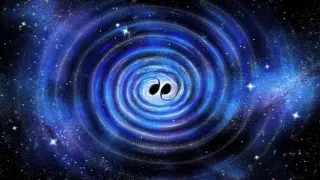
A newly released, expanded catalog of gravitational-wave detections from LIGO, Virgo, and KAGRA more than doubles the known events, revealing a broader population of black holes and neutron-star mergers and enabling stringent tests of Einstein’s general relativity as gravity’s effects on spacetime are probed through mass, spin, and merger dynamics. The dataset deepens our understanding of spacetime warping and paves the way for real-time data releases from the collaboration.
Physicists propose using the faint, unresolved gravitational-wave background from countless distant black-hole mergers as an independent way to measure the expansion rate of the universe (the Hubble constant), potentially helping resolve the Hubble tension. Even without directly detecting this background, current data already place bounds on H0; upcoming detector upgrades could turn this into a precise measurement, offering a new tool for cosmology while highlighting limitations tied to population models and large uncertainties.
Physicists propose using the faint gravitational-wave background produced by countless distant black-hole mergers as a new, gravity-based method to measure the Hubble constant, offering an independent path to addressing the Hubble tension. Current data already constrain H0 by showing the background’s absence rules out low values; future detector upgrades could turn this into a direct measurement, potentially confirming or challenging existing cosmology without relying on electromagnetic distance ladders or the CMB.
A new method uses the faint gravitational-wave background from unresolved distant black hole mergers—the stochastic siren—to constrain the Hubble constant. By linking merger rates to the observable universe’s size, a stronger background would indicate slower expansion; non-detections thus tighten limits, and when combined with data from individually observed mergers, the approach yields a more precise H0. With future, more sensitive detectors the gravitational-wave background could be detected and used to further refine cosmological measurements, potentially helping resolve the Hubble tension.
Scientists propose using the stochastic gravitational-wave background—the faint, background hum from countless distant mergers—to measure the Hubble constant, offering an independent, multi‑messenger approach that could help resolve the long‑standing Hubble tension as gravitational‑wave detectors grow more sensitive.