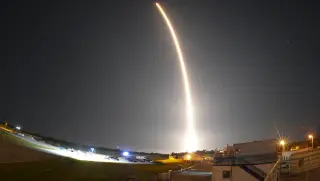
A SpaceX Falcon 9 rocket launched from Cape Canaveral carrying 29 Starlink satellites produced a rare noctilucent, jellyfish-shaped cloud visible along the East Coast for a brief time before it dissipated.
NASA selected 41 proposals from 37 companies under its 2025 Announcement of Collaboration Opportunity to mature more than 40 space technologies for Moon and Mars missions; these no-fund partnerships leverage NASA facilities and about $30 million in agency resources plus $32 million in industry contributions, with 12–24 month performance windows across areas like power, in-space logistics, landing, and dust mitigation.
NASA released the 2026 Civil Space Shortfall Ranking based on 454 external responses, consolidating 187 shortfalls into 32 priority categories and selecting 40 focus areas for FY2026 investments to accelerate lunar infrastructure, surface mobility, logistics, and onboard computing for future Moon and Mars missions, underscoring public-private partnerships to energize the space economy.
SpaceX will launch a Falcon 9 from Cape Canaveral to deliver a Cargo Dragon to NASA's ISS as part of CRS-34; liftoff is scheduled for 7:16 p.m. ET on May 12 on a northeast trajectory, with the first stage aiming to land at LC-40 near the launch site, triggering a sonic boom over Brevard County. Weather forecasts show only a 35% chance of favorable conditions, and a backup liftoff at 6:50 p.m. on May 13 is planned if needed.
Scientists have developed a stretchable, ultra-thin shielding material made from carbon and boron nitride nanotubes that blocks electromagnetic radiation (99.999%) and neutron radiation (72%), and can be 3D-printed. When formed in a honeycomb shape, shielding improves by about 15%. This lightweight, flexible material could protect equipment and astronauts across satellites, space stations, and other space tech, with the study published in Advanced Materials.
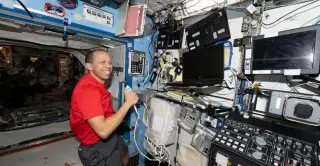
NASA is upgrading the ISS with HP ZBook G9 mobile workstations for Expedition 74, including a NASA-exclusive DC power adapter; the upgrade follows a network-server refresh and will replace older ZBook Fury G2 units, with HP noting over 100 workstations already in use on board as the ISS tech refresh continues ahead of its planned de-orbit around 2030.
Google’s roughly 6.1% stake in SpaceX could be worth about $122 billion if SpaceX hits a $2 trillion valuation in its upcoming IPO, a level that would outsize many public companies; SpaceX’s private value has surged to about $1.25 trillion after its xAI merger, with reports that the IPO could raise around $75 billion at a $1.75 trillion valuation (some outlets rate it at $2 trillion). Alphabet/Google’s stake has shrunk since the 2015 investment with Fidelity, Musk still owns about 40% of SpaceX, and Google also maintains ties to Anthropic, another mega-IPO candidate.
Trump and Prime Minister Takaichi unveil a broader U.S.–Japan partnership to strengthen economic security, supply-chain resilience, and regional deterrence in the Indo-Pacific, including major Japanese investments in power and natural gas, expanded critical minerals cooperation, joint AI/quantum/space initiatives, enhanced missile defense and cloud security, and visa facilitation for business travelers, while reaffirming commitments on Taiwan, North Korea denuclearization, abductee issues, and regional stability.
The race to mine the moon is accelerating with new technological developments and international players, but the legal framework remains outdated and fragmented, raising concerns about equitable benefit-sharing, environmental impact, and potential conflicts. Urgent international cooperation and updated governance are needed to ensure responsible and sustainable lunar resource exploitation.
A Cardiff-based startup, Space Forge, has successfully sent a mini factory into orbit that can produce ultra-pure semiconductors in space, leveraging the vacuum and weightlessness to create higher quality materials than possible on Earth. The company plans to develop larger factories and test re-entry technology, opening new possibilities for manufacturing in space that could benefit electronics and other industries on Earth.
NASA is using a high-tech sensor called AVIRIS-5 aboard its ER-2 aircraft to locate critical minerals in the American West, essential for technologies like batteries and semiconductors, with potential applications in land management and planetary science.
AST SpaceMobile's stock rose over 14% as it prepares to launch its BlueBird 6 satellite, the sixth in a series aimed at providing global cellular coverage from space, with the launch scheduled for December 24, marking a significant step in its satellite deployment plans.
CACI International is acquiring space technology firm ARKA for $2.6 billion to expand its capabilities in space-based sensing and intelligence systems, supporting national security missions and future opportunities in the space domain.
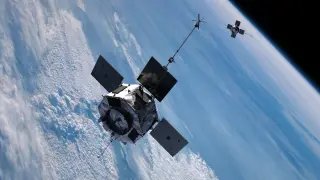
NASA launched the DiskSat technology demonstration, a new flat, disk-shaped small spacecraft platform designed to lower costs and expand capabilities for space missions, into low Earth orbit to test its performance and potential applications for scientific and exploration purposes.
In 2025, NASA made significant strides in space exploration, including preparing for the Artemis II crewed Moon mission, advancing Mars exploration efforts, launching scientific missions, and strengthening international partnerships, all while engaging the public through digital media and educational activities.