
AI-Designed Solar Probe Targets Alpha Centauri for 2029 Launch
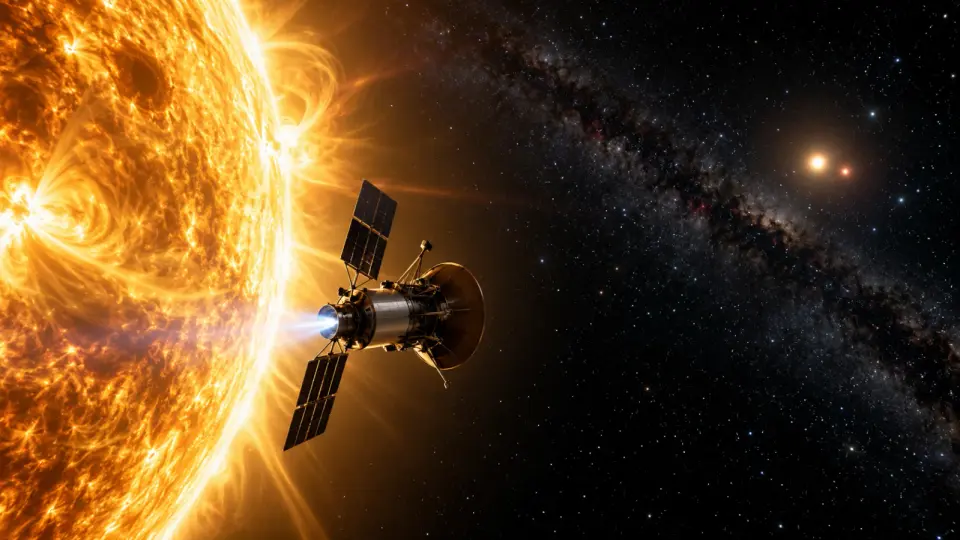
The Fermi Explorer Mission plans to launch a small, solar-electric spacecraft toward Alpha Centauri by late 2029. The probe, designed using AI-assisted orbital mechanics, will take approximately 80,000 years to reach the star system. It aims to be the first human-made object deliberately sent to another star, using existing technology rather than speculative lasers.
Key points
- The Fermi Explorer Mission, a nonprofit, announced plans on September 1 to launch a 100-110 kg spacecraft toward Alpha Centauri before the end of 2029.
- The trajectory was developed by Physical Superintelligence (PSI), an AI physics lab backed by $58 million in seed funding from Breakthrough Energy Ventures.
- The mission uses 'multi-revolution perihelion pumping,' where the craft repeatedly dives close to the Sun to gain speed via solar-electric propulsion before coasting for 98% of the journey.
- The spacecraft will carry at least 1 kg of payload, including scientific data, artistic materials, and a copy of the Golden Record, but will not transmit data back to Earth.
- The total cost is estimated at under $15 million, with the launch contingent on completing propulsion and thermal qualification work.
- The journey will take roughly 73,000 to 80,000 years, passing within 2,600 astronomical units of the Alpha Centauri AB barycenter.
Background
This mission follows the 2016 Breakthrough Starshot initiative, which proposed using Earth-based lasers to send gram-scale probes to Alpha Centauri in 20 years. While Starshot remains a research program without a confirmed launch, Fermi Explorer prioritizes actual launch over speed. Earlier reports in September 2026 confirmed the nonprofit's formation and its reliance on private donations and a 501(c)(3) status to fund the project.
How outlets are covering it
MIT Technology Review highlights the role of AI in discovering the novel trajectory, noting that the system 'Get Physics Done' found a solution the human team had missed. The Brighter Side of News emphasizes the engineering challenges, such as the need to launch from a geostationary transfer orbit rather than low Earth orbit to meet mass budgets. Space Daily provides context on the scale of interstellar travel, comparing the Fermi mission's 80,000-year timeline to the 20-year goal of Starshot and the 165,000-year duration of a space shuttle-speed journey. All sources agree that the mission is a proof-of-concept rather than a near-term arrival, with Johnston of Fermi Explorer acknowledging that future spacecraft will likely overtake it.
Why it matters
The Fermi Explorer Mission represents a shift from speculative interstellar concepts to a launchable, low-cost proof of concept. By using existing solar-electric propulsion and AI-assisted planning, it demonstrates that humanity can begin a deliberate journey to another star without requiring breakthroughs in laser or nuclear technology. The mission also addresses the Fermi Paradox by establishing that Earth is a civilization capable of and willing to reach other stars, potentially narrowing the reasons for the lack of observed extraterrestrial contact.
What to watch
The mission must complete propulsion and thermal qualification work to meet the 2029 launch window. The project is currently seeking private donations to cover the estimated $15 million cost. If launched, the spacecraft will begin its 12-year acceleration phase, followed by an 80,000-year coast. The team expects the probe to be overtaken by faster spacecraft developed in the future, but its launch will mark the first deliberate human trajectory toward another star.
- Humanity could start an 80,000-year journey to Alpha Centauri in 2029 The Brighter Side of News
- Fermi Explorer: Sending A Spacecraft On A 55,000-Mile-Per-Hour Mission To Alpha Centauri To Tackle The Fermi Paradox IFLScience
- How AI plotted an interstellar journey to Alpha Centauri MIT Technology Review
- Nonprofit plans to launch 80,000-year probe to Alpha Centauri by 2029 yahoo.com
- At the space shuttle’s orbital speed of roughly 28,000 kilometres per hour, the journey to Alpha Centauri would take about 165,000 years. Breakthrough Starshot proposes sending a gram-scale chip attached to a metre-wide sail—accelerated by Earth-based la Space Daily
Want the full story? Read the original reporting
Read on The Brighter Side of News