Tag

Interstellar Travel

All articles tagged with #interstellar travel

From the stars to Earth: the engineering hurdles of interstellar travel
science18 hours ago

From the stars to Earth: the engineering hurdles of interstellar travel

An aerospace engineer explains that while physics does not prohibit interstellar travel, the vast distances between stars, energy and fuel requirements, and design trade-offs create immense engineering barriers; beamed propulsion could push a ship without onboard fuel but can’t decelerate, while onboard options like chemical, antimatter, or fusion propulsion face mass, energy, and material challenges, making a visit from an advanced civilization highly unlikely without revolutionary tech and proximity.

Warp Drive: A Realistic Possibility for the Next Century
space1 day ago

Warp Drive: A Realistic Possibility for the Next Century

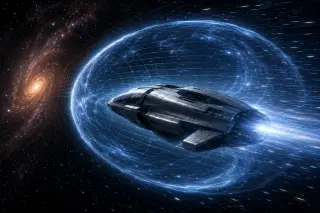
Warp drive has shifted from sci‑fi to a serious physics question. The Alcubierre model envisions a spacecraft riding a bubble of contracted/expanded spacetime, not breaking light locally, but it requires negative energy and exotic matter. While theorists have proposed tweaks to reduce energy needs, major obstacles—quantum-field instabilities at the bubble’s boundary, potential causality paradoxes, and enormous energy or size requirements—remain. Some researchers see future discoveries that could lower the bar or even produce detectable gravitational-wave signatures from warp dynamics, and ideas for hybrid systems (boosting with conventional propulsion before engaging warp) have been proposed. In short, warp drive is a provocative, still-unresolved frontier that could take decades or more to resolve, if ever.

Star Trek Stays Local: The Milky Way, Barriers, and Budget Constraints
entertainment1 month ago

Star Trek Stays Local: The Milky Way, Barriers, and Budget Constraints

The article argues Star Trek mainly stays inside the Milky Way because a fictional galactic barrier at the galaxy’s edge, plus warp-drive limits and narrative economies, make intergalactic travel impractical and expensive to portray. Keeping to one galaxy provides clearer storytelling, humanoid aliens, and production feasibility, with rare out-of-galaxy forays like TNG’s M33 moment explained as exceptions. It also notes real-world distances to nearby galaxies (Canis Major Dwarf, Sag DEG, LMC/SMC, Andromeda) and uses warp-speed math to show how long intergalactic journeys would take, reinforcing that the show’s choice is as much about narrative clarity and budget as it is about in-universe physics.

Laser-Powered Metajets Hint at 20-Year Alpha Centauri Trip
space-and-astronomy1 month ago

Laser-Powered Metajets Hint at 20-Year Alpha Centauri Trip

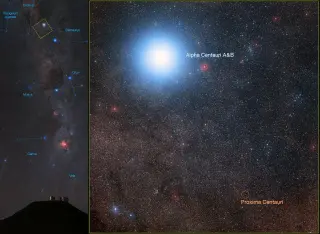
Texas A&M researchers report a lab demonstration of micron-scale metajets with metasurfaces that can be steered in three dimensions by laser light; they say the concept could be scaled to propel larger spacecraft, potentially enabling a 20-year journey to Alpha Centauri, though real-world feasibility and space testing remain to be proven.

Laser-Propelled Metajets Could Shorten Alpha Centauri Trip to 20 Years
space1 month ago

Laser-Propelled Metajets Could Shorten Alpha Centauri Trip to 20 Years

Texas A&M researchers demonstrated micron-scale metajets that use metasurfaces to move in three dimensions when illuminated by laser light, enabling 3D maneuverability that could, in theory, scale to propel larger craft. While the approach could cut a trip to Alpha Centauri to about 20 years, feasibility remains uncertain as tests to date occurred in fluid environments and microgravity space tests are planned to validate practicality and scaling.

Micron-scale Metajets Open Door to 3D Light Propulsion
space1 month ago

Micron-scale Metajets Open Door to 3D Light Propulsion

Texas A&M researchers demonstrated micron-scale metajets—metasurface-based devices that transfer momentum from light to lift and steer objects in 3D without contact—marking a scalable path for light-propulsion and potential interstellar missions to Alpha Centauri, contingent on sufficient optical power and funding; space-testing is the next step after fluid experiments that offset gravity.

Chrysalis: A 1,000-Person, 250-Year Interstellar Ark
space2 months ago

Chrysalis: A 1,000-Person, 250-Year Interstellar Ark

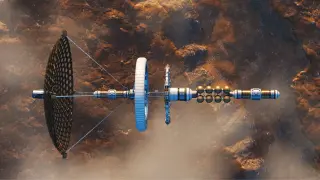
Chrysalis envisions a 36-mile rotating generational spacecraft designed to carry 1,000 people for about 250 years to a neighboring star, treating the vessel as a permanent settlement with a self-contained biosphere, artificial gravity, extensive radiation shielding (notably water), vertical farming, and closed-loop life support. Built as an in-space, Earth–Moon L1 hub assembly project, it combines biology, engineering, and governance to sustain generations, with autonomous robots and potential nuclear-thermal propulsion for propulsion and maintenance.

Chrysalis: A 58-Kilometer, Multi-Generational Starship for a Centuries-Long Voyage
space3 months ago

Chrysalis: A 58-Kilometer, Multi-Generational Starship for a Centuries-Long Voyage

Chrysalis is a concept for a 58-kilometer rotating habitat designed to carry around a thousand to two thousand humans on a 400-year interstellar voyage, using a direct fusion drive and fully closed life support, with generation-spanning governance, education, and knowledge preservation. The project provides a detailed, integration-focused study of how such a ship could be assembled, powered, shielded, and kept socially stable, while honestly outlining remaining unknowns and the enormous technical and ethical challenges involved.

Mystery Object C/2025 V1 Borisov Sparks Interstellar Inquiry
science6 months ago

Mystery Object C/2025 V1 Borisov Sparks Interstellar Inquiry

A new object, C/2025 V1, discovered by Gennady Borisov, is likely a natural object from the Oort cloud and not related to the interstellar object 3I/ATLAS, based on its orbit and non-gravitational acceleration. The article discusses the potential for distinguishing natural from technological origins of such objects through spectroscopic analysis during their close approach to Earth in December 2025.