
ESA's Hera reveals new surface features on Didymos after DART impact
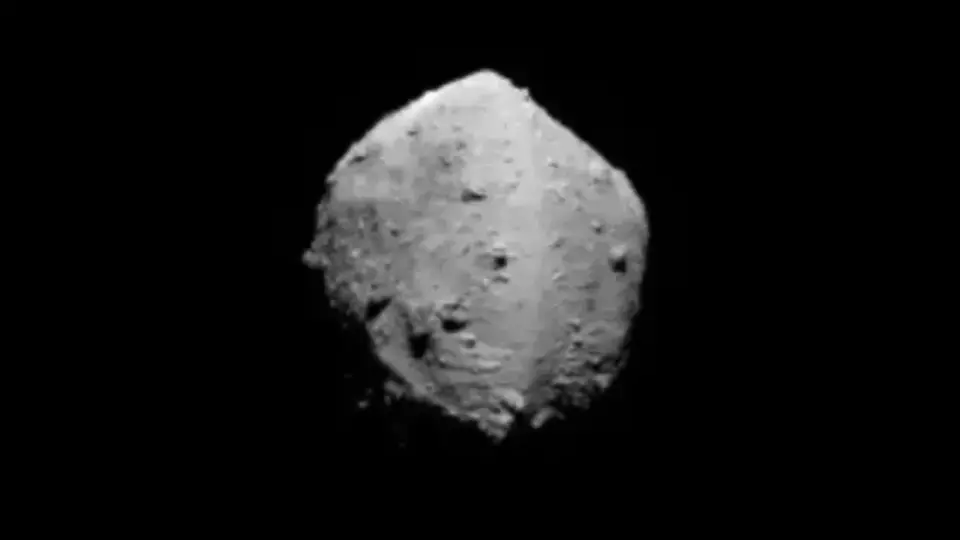
The European Space Agency's Hera probe has released its first close-up image of the Didymos binary asteroid system, revealing significant surface changes following NASA's 2022 DART impact. While the smaller moonlet Dimorphos remains mostly hidden in shadow, the larger Didymos displays new boulders, craters, and ridges, suggesting debris from the collision has altered its surface. These findings aim to validate kinetic impact methods for planetary defense, with detailed images of the impact site scheduled for release on November 25.
Key points
- ESA released the first close-up image of the Didymos system on November 5, 2026, captured by the Hera spacecraft from a distance of 60 km.
- The image shows Didymos, the 780-meter parent asteroid, with new surface features including boulders, craters, and grooves, while Dimorphos is largely obscured by shadow.
- NASA's DART mission impacted Dimorphos in September 2022, reducing its orbital period by 33 minutes and slowing its velocity by 2.7 millimeters per second.
- Scientists suspect that material ejected from the DART impact traveled across the 1 km gap to Didymos, contributing to the observed surface changes.
- ESA plans to release detailed images of both asteroids on November 25 to systematically map the aftermath of the collision.
Background
In September 2022, NASA's DART spacecraft successfully tested planetary defense technology by colliding with Dimorphos, the moonlet of the Didymos binary system. This impact measurably altered Dimorphos's orbit, proving that kinetic impacts could deflect asteroids. ESA's Hera mission, launched in October 2024, was designed to follow up on this experiment by conducting a close-up forensic analysis of the impact site. Recent milestones include Hera's braking maneuvers in October 2026 and the first separate imaging of the two asteroids on October 18, setting the stage for the current close-up observations.
How outlets are covering it
All sources agree on the core facts: the release of the first close-up image on November 5, the distance of 60 km, and the observed surface changes on Didymos. However, they differ in emphasis. Space.com and ESA highlight the scientific significance of the new surface features, such as boulders and craters, and the hypothesis that debris from Dimorphos traveled to Didymos. Popular Science focuses on the practical implications for planetary defense, noting that even small orbital changes could be crucial in a real threat scenario. UA.NEWS provides additional technical details, such as the earlier October 18 imaging milestone and the presence of two CubeSats on the Hera mission. Patrick Michel, Hera's Principal Investigator, is quoted across multiple sources expressing surprise at the new view of Didymos, describing it as a 'whole new world' compared to DART's pre-impact images.
Why it matters
This development is critical for advancing planetary defense strategies. By analyzing the physical changes on Didymos, scientists can better understand how kinetic impacts affect asteroid surfaces and orbits. This data will help refine models for future deflection missions, potentially turning the DART experiment from a one-off test into a reliable, repeatable technique for protecting Earth from asteroid threats. The detailed images scheduled for November 25 will provide further insights into the mass, structure, and orbital dynamics of the binary system.
What to watch
ESA plans to release detailed images of both Didymos and Dimorphos on November 25, 2026. These images will allow scientists to systematically map the changes caused by the DART impact, including the distribution of debris and the structural integrity of the asteroids. Hera will continue its close-up observations, using its 12 payloads and two CubeSats to conduct further studies, including potential landings on Dimorphos. The data collected will contribute to a better understanding of asteroid composition and the effectiveness of kinetic impactors for planetary defense.
- Hera probe gets 1st good look at asteroid system clobbered by NASA's DART mission photo of the day for Nov. 6, 2026 Space
- Hera’s first close-up view of Didymos asteroids ESA
- Hera spacecraft photographs asteroid from 37 miles away Popular Science
- Hera Mission Reveals Hidden Side of Asteroid Didymos After DART Gizmodo
- Hera spacecraft sees asteroid Dimorphos separately for the first time — Space.com UA.NEWS
Want the full story? Read the original reporting
Read on Space