
New Simulations Suggest Europa's Ice Shell May Block Ocean Water From Reaching the Surface
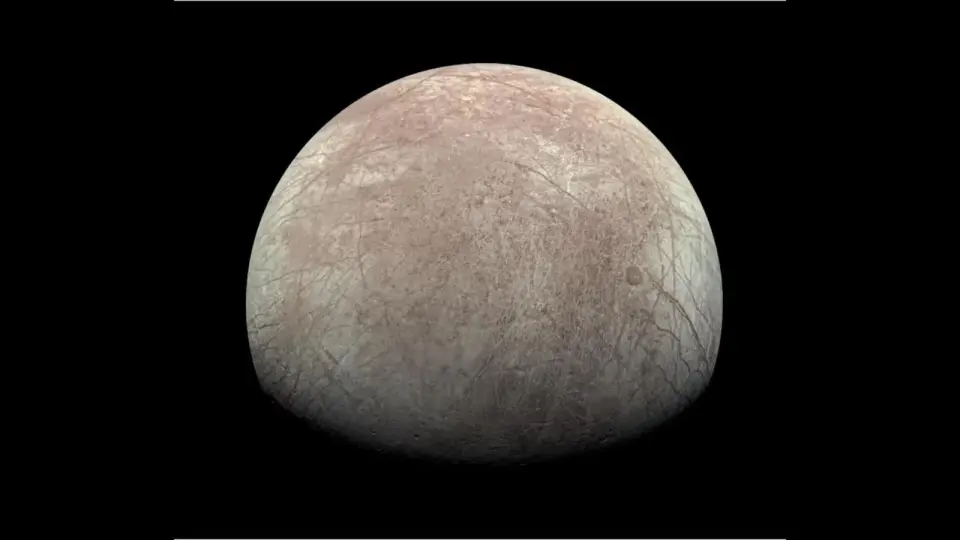
A new study in Nature Astronomy suggests that liquid water from Europa's subsurface ocean likely cannot rise through its ice shell to form shallow surface pockets. Led by Rutgers University scientist Lujendra Ojha, the research indicates that turbulent flow and rapid heat loss cause fractures to freeze shut within hours. This finding complicates the strategy for NASA's Europa Clipper mission, which plans to detect shallow water reservoirs as proxies for the deep ocean. While the moon's ocean remains liquid due to tidal heating, the ice shell may act as a stronger barrier than previously assumed, meaning any detected shallow water might originate from local melting rather than the global ocean.
Key points
- Computer simulations show that water rising from Europa's deep ocean loses heat rapidly due to turbulence, causing fractures to freeze shut within hours.
- The study, published in Nature Astronomy, challenges the assumption that shallow subsurface water pockets are direct windows into the global ocean.
- NASA's Europa Clipper, arriving in 2030, will use radar to detect shallow water, but findings may not represent the chemistry of the deep ocean.
- Europa's ocean is kept liquid by tidal heating from Jupiter, amplified by the Laplace resonance involving Io and Ganymede.
- Shallow water pockets may instead form from localized melting within the ice shell, offering limited insight into the moon's habitability.
Background
Previous coverage established that Europa likely hosts a global ocean beneath its ice shell, potentially containing more water than Earth's oceans. This ocean is sustained by tidal heating from Jupiter's gravity and the Laplace resonance. Missions like Europa Clipper and ESA's JUICE aim to assess habitability by studying the ice shell and detecting shallow water reservoirs, assuming these pockets connect to the deep ocean. The new study adds a critical layer of complexity to this assumption.
How outlets are covering it
Space.com and SciTechDaily emphasize the implications for future missions, noting that detecting shallow water does not guarantee access to the deep ocean. ScienceDaily highlights the physical mechanisms, such as turbulence and frazil ice formation, that prevent water from rising. Space Daily provides broader context on tidal heating and the Laplace resonance, explaining why the ocean remains liquid despite the barrier. All sources agree that the ice shell is a formidable obstacle, but they differ in emphasis: some focus on the mission implications, while others detail the physics of the barrier.
Why it matters
This research affects how scientists interpret data from upcoming missions. If shallow water pockets are not connected to the deep ocean, they may not provide meaningful information about Europa's habitability. This could shift the focus of future missions toward other methods of assessing the moon's potential for life, such as analyzing surface chemistry or detecting plumes.
What to watch
NASA's Europa Clipper is expected to reach Jupiter in April 2030, followed by ESA's JUICE in July 2031. These missions will use radar and other instruments to detect shallow water and map the ice shell. The findings will help determine whether shallow water is a reliable indicator of the deep ocean's chemistry or if it forms independently from local melting.
- Jupiter's moon Europa may have signs of life in its buried ocean — but can we get to them? Space
- Europa is smaller than Earth's Moon, yet the ocean locked beneath its ice contains more liquid water than every ocean on Earth combined — kept from freezing not by sunlight, but by Jupiter's gravity squeezing the moon like a slow, endless fist Space Daily
- Europa’s Hidden Ocean May Be Locked Beneath a Frozen Wall SciTechDaily
- APOD: 1998 January 02 - Europa's Disconnected Surface NASA Science (.gov)
- The search for life on Jupiter's icy moon Europa just got more complicated ScienceDaily
Want the full story? Read the original reporting
Read on Space