
Herschel’s 1789 Discovery of Mimas: From Faint Dot to Death Star
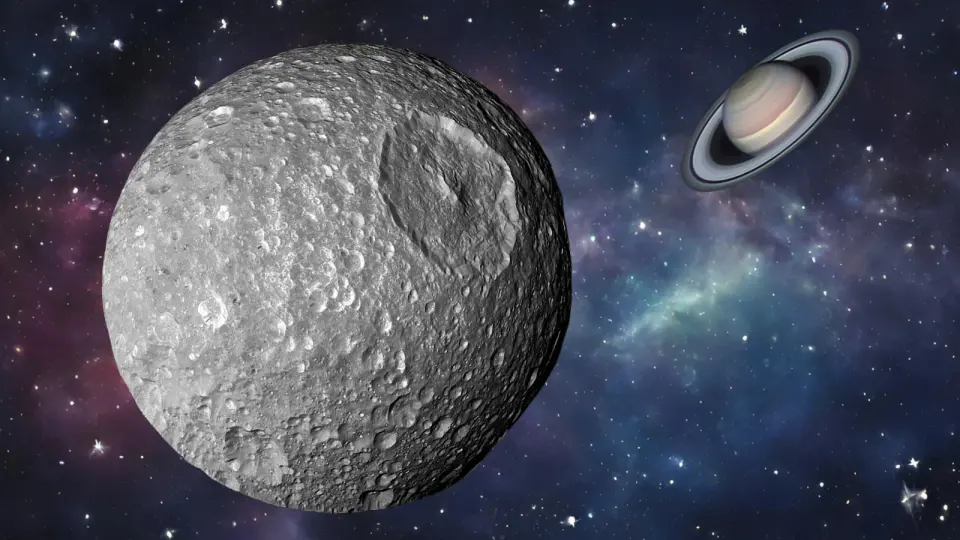
On September 17, 1789, British astronomer William Herschel discovered Saturn’s moon Mimas using a 40-foot reflecting telescope. While it appeared as a mere bright dot for two centuries, later missions revealed its distinctive 'Death Star' appearance and a hidden global ocean.
Key points
- William Herschel discovered Mimas on September 17, 1789, using a large Herschelian reflecting telescope.
- Mimas is the smallest and innermost of Saturn’s major moons, with a diameter of approximately 245 miles (394 kilometers).
- It is the smallest known spherical body in space held together by self-gravitation.
- The moon’s resemblance to the 'Death Star' from Star Wars was only recognized after 1980, when Voyager 1 and 2 provided the first detailed images.
- NASA’s Cassini spacecraft, which orbited Saturn from 2004 to 2017, provided the definitive images that confirmed its cratered, Death Star-like appearance.
Background
Recent reanalyses of Cassini data, reported in August 2026, suggest Mimas may host a global ocean beneath 20–30 km of ice, formed within the last 25 million years. This finding contrasts with its heavily cratered, seemingly inactive surface. Additionally, September 2026 observations of Saturn’s south pole revealed a rare ten-sided atmospheric wave, highlighting ongoing discoveries in the Saturnian system.
Why it matters
Mimas serves as a critical case study for planetary science, demonstrating how small bodies can harbor complex internal structures like oceans despite ancient, cratered surfaces. Its discovery history also illustrates the evolution of observational astronomy, from 18th-century telescopic sightings to modern spacecraft imaging that revealed its unique topography and potential subsurface water.
What to watch
Future missions will be required to confirm the chemistry, depth, and persistence of the suspected ocean beneath Mimas’s ice shell. Continued observation of Saturn’s atmospheric features, such as the newly discovered decagonal wave, may also provide insights into the dynamics of gas giant atmospheres.
Want the full story? Read the original reporting
Read on Space