
JWST Data Reveals Simple Drivers of Weather on Distant Brown Dwarf
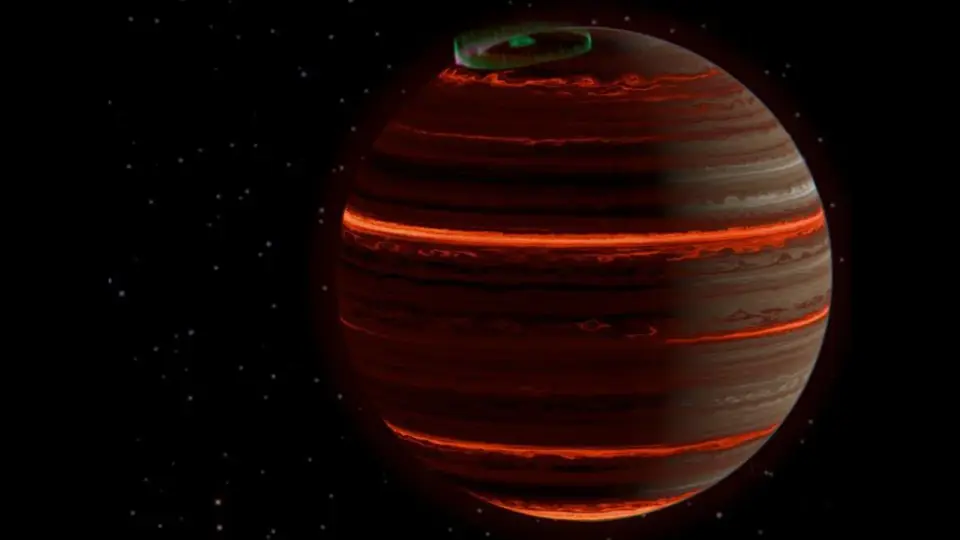
Astronomers have successfully decoded the weather patterns of SIMP 0136, a brown dwarf located 20 light-years from Earth, using data from the James Webb Space Telescope. By applying Principal Component Analysis to infrared observations, researchers identified that the object's atmospheric variability is driven primarily by temperature differences and cloud structure. This method simplifies complex data into three recurring weather states, offering a new, efficient tool for analyzing exoplanet atmospheres without requiring intensive modeling.
Key points
- The study focuses on SIMP 0136, a brown dwarf in the constellation Pisces that is larger and hotter than Jupiter but lacks the mass for hydrogen fusion.
- Researchers used Principal Component Analysis (PCA) to filter noise from JWST data, identifying two main drivers of atmospheric change: temperature and vertical cloud structure.
- The analysis revealed three distinct weather states: hot regions with thin clouds, cooler regions with thin clouds, and cooler regions with thick, vertically extended clouds.
- These weather patterns persisted across more than a dozen rotations of the object, indicating stable atmospheric dynamics despite changing appearances.
- The findings were published in Astronomy & Astrophysics and were led by Merle Schrader of Trinity College Dublin and co-author Johanna Vos.
Background
This development builds on recent JWST missions that have mapped weather on hot Jupiters and identified star-forming regions in the Carina Nebula. While previous studies often relied on computationally intensive atmospheric modeling, this new approach offers a statistical shortcut to identify dominant atmospheric components. The study also aligns with broader JWST objectives to analyze exoplanet atmospheres for chemical signatures that could indicate habitability, a goal that will be further advanced by the upcoming Nancy Grace Roman Space Telescope.
How outlets are covering it
Space.com and Earth.com emphasize the simplicity of the findings, noting that two variables explained 79% of the light variation, effectively reducing complex weather to 'two dials.' Universe Today highlights the technical specifics, detailing the use of JWST's NIRSpec and MIRI instruments under General Observer Program 3548. The Naked Scientists focuses on the practical implications, explaining how brown dwarfs serve as accessible laboratories for studying exoplanet atmospheres because they are not obscured by parent stars. All sources agree that the PCA method is a significant step toward efficient atmospheric analysis, though Earth.com notes that carbon dioxide fluctuations remain unexplained by the current model.
Why it matters
This research provides a scalable method for analyzing the atmospheres of distant worlds, potentially accelerating the search for habitable exoplanets. By identifying universal weather drivers in brown dwarfs, scientists can better predict atmospheric conditions on planets that are too faint to observe directly. This capability is crucial for future missions like the Nancy Grace Roman Space Telescope, which aims to image smaller, Earth-like planets orbiting nearby stars.
What to watch
The research team plans to apply the Principal Component Analysis technique to other brown dwarfs that have not been studied as extensively. If the same two primary drivers (temperature and cloud structure) appear in diverse brown dwarfs, it would suggest universal atmospheric behaviors. Additionally, astronomers are awaiting the operational launch of the Nancy Grace Roman Space Telescope to apply similar techniques to smaller exoplanets orbiting closer to their stars.
- The James Webb Space Telescope is helping astronomers become alien weather forecasters space.com
- Researchers Develop a Way to Check the Weather on a Exoplanet Universe Today
- A world 20 light-years away reveals surprisingly organized, Jupiter-like weather phys.org
- Tracking weather patterns on distant planets The Naked Scientists
- Webb reveals the hidden forces that drive chaotic weather on a distant world Earth.com
Want the full story? Read the original reporting
Read on space.com