Tag

Brown Dwarf

All articles tagged with #brown dwarf

Astronomers Detect Likely Exomoon Orbiting Brown Dwarf, Blurring Boundaries
science24 days ago

Astronomers Detect Likely Exomoon Orbiting Brown Dwarf, Blurring Boundaries

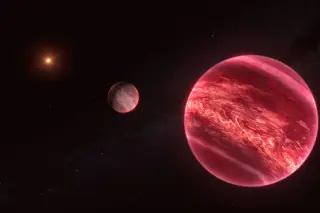
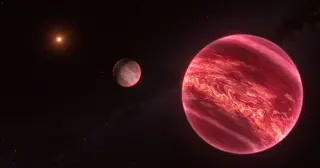
An international team using the ESO Very Large Telescope detected a moonlike body orbiting the brown dwarf CD-35 2722 B about 73 light-years away, with a roughly 170-day orbit and a mass of at least 0.9 Jupiter—about 2.5% of the brown dwarf’s mass. Described as an exosatellite rather than a moon, this is the first satellite evidence around a brown dwarf found via the Doppler method, though its exact classification remains under discussion. The discovery challenges traditional moon definitions and could influence theories of planet formation and tidal heating, with future telescopes potentially revealing smaller exomoons.
Astronomers Signal First Plausible Exomoon, Blurring Moon-Planet Boundaries
science28 days ago

Astronomers Signal First Plausible Exomoon, Blurring Moon-Planet Boundaries

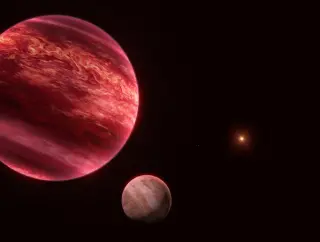
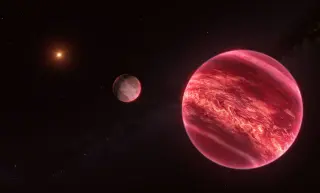
Using ESO's VLT CRIRES+ radial-velocity measurements, scientists report strong evidence for an exosatellite (a Jupiter-sized body) orbiting a brown dwarf in the CD-35 2722 system—a three-body setup that challenges Solar System definitions of moon and planet. If confirmed, it would be the first plausible exomoon detection and could accelerate future exomoon searches, though the terminology remains debated.

Possible exomoon spotted around a brown dwarf, sparking naming debate
science1 month ago

Possible exomoon spotted around a brown dwarf, sparking naming debate

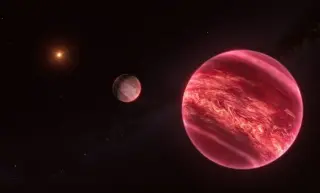
Astronomers using the Very Large Telescope report evidence for a moon-sized object orbiting a brown dwarf in the CD-35 2722 system, an exosatellite that defies simple labeling as either moon or planet; detected via radial-velocity wobble rather than transit, this may mark the first exomoon, with confirmation likely from future observations with the ELT.

Astronomers spot a moon-like world around a brown dwarf, hinting at the first exosatellite beyond our solar system
space1 month ago

Astronomers spot a moon-like world around a brown dwarf, hinting at the first exosatellite beyond our solar system

Astronomers report what could be the first plausible detection of an exosatellite—a planet-mass body orbiting a substellar companion around a brown dwarf rather than a star—found by watching tiny wobbles in the brown dwarf; if confirmed, it would expand our understanding of moons beyond our solar system and was described in a Nature paper.

Doppler-detected exosatellite around a brown-dwarf companion
science1 month ago

Doppler-detected exosatellite around a brown-dwarf companion

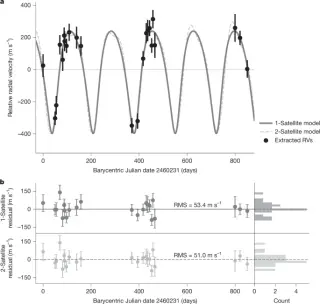
Astronomers using high-resolution infrared radial-velocity measurements from VLT/CRIRES+ detected a periodic signal indicating a planetary-mass exosatellite orbiting CD-35 2722 B, a directly imaged brown-dwarf companion to a star. The best-fit model suggests the satellite has a minimum mass of about 0.9 Jupiter masses with an orbital period of roughly 170 days, marking the first evidence of a satellite around a companion brown dwarf and the first time this RV approach has been used to probe exosatellites. It remains uncertain whether this object meets the formal criteria for an exomoon, but the result demonstrates a promising path toward unambiguous exomoon detections as instrumentation advances; data and code are publicly available.

Weird exomoon candidate sparks debate on what counts as a moon
space1 month ago

Weird exomoon candidate sparks debate on what counts as a moon

Astronomers analyzing the CD-35 2722 system, about 73 light-years away, report a moon‑like object orbiting a brown dwarf—an finding that could be the first exomoon or a case that forces a redefinition of what counts as a moon versus a planet. While the object is clearly moon‑like, the team stresses a definitive exomoon claim would require redefining established terms, since it orbits a body that itself orbits a star. The discovery, published in Nature, underscores the diversity of planetary systems and may be clarified further with observations from the upcoming Extremely Large Telescope (ELT).

Brown Dwarf Skews Exoplanet System, Rewriting Planet-Formation Tales
space2 months ago

Brown Dwarf Skews Exoplanet System, Rewriting Planet-Formation Tales

Astronomers using TESS uncover an improbable exoplanet system around TOI-201: a massive brown dwarf TOI-201 c on a long, highly eccentric 2,881‑day orbit coexisting with a warm Jupiter (TOI-201 b) and a rocky super‑Earth (TOI-201 d). The brown dwarf’s gravity reshapes the inner disk, forcing planets to form at the hot inner edge and causing pronounced transit timing variations during close approaches. Mass confirmation marks TOI-201 c as a rare long‑period transiting brown dwarf, and the findings—published in Nature—challenge standard gas‑giant formation models.

JWST uncovers salty clouds on the cold Pink Planet GJ504b
space2 months ago

JWST uncovers salty clouds on the cold Pink Planet GJ504b

Using the James Webb Space Telescope, astronomers detected salt clouds in the atmosphere of GJ504b, a cold, planetary‑mass companion orbiting a Sun‑like star about 57 light‑years away. With a mass around 25 Jupiter masses and an age of roughly 2.5–4 billion years, the object may be a planet or a brown dwarf, and the salty clouds help explain its atmospheric spectrum and raise questions about its origin.

Milky Way Runaway: 1-Million-MPH Hypervelocity Object Identified by Citizen Scientists
space5 months ago

Milky Way Runaway: 1-Million-MPH Hypervelocity Object Identified by Citizen Scientists

Citizen scientists in NASA's Backyard Worlds project identified CWISE J124909.08+362116.0 traveling at about 1 million miles per hour, fast enough to escape the Milky Way. Its nature is unclear, likely a brown dwarf or low-mass star, possibly ejected by a white-dwarf supernova or a close encounter in a globular cluster. The discovery, reported in Astrophysical Journal Letters, underscores the power of crowdsourced science using NASA's WISE data.