
JWST uncovers the universe’s farthest dormant black hole, 6 billion solar masses
TL;DR
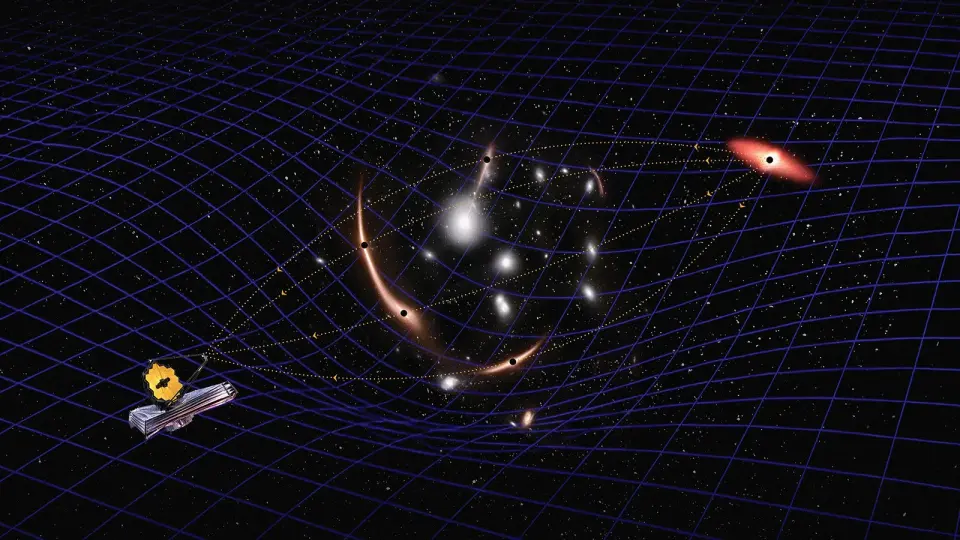
The James Webb Space Telescope identified the most distant dormant black hole in a galaxy more than 10 billion light-years away (MRG-M0138), with a mass of about six billion solar masses. Because the black hole is not accreting, it’s invisible across wavelengths; researchers measured its mass by tracking the motions of stars around it, aided by gravitational lensing that magnified the system. The finding helps illuminate black hole growth in the early universe and how such black holes influence galaxy evolution, with future surveys like Euclid and the Roman Space Telescope expected to find more of these objects.
Topics:sciencespacescience#black-holes#early-universe#galaxy-evolution#gravitational-lensing#james-webb-space-telescope#spacescience
- James Webb telescope detects most distant dormant black hole, invisible in all wavelengths and weighing as much as 6 billion suns Live Science
- A direct black-hole mass measurement in a little red dot at high redshift Nature
- James Webb Space Telescope discovers a black hole that formed before its host galaxy. Scientists aren't sure how Space
- Webb reveals black hole that formed before its galaxy European Space Agency
- JWST proves that black holes really do come before galaxies Big Think
Want the full story? Read the original reporting
Read on Live Science