Tag

Galaxy Evolution

All articles tagged with #galaxy evolution

James Webb uncovers the universe's largest, most detailed map of the cosmic web
astronomy8 days ago

James Webb uncovers the universe's largest, most detailed map of the cosmic web

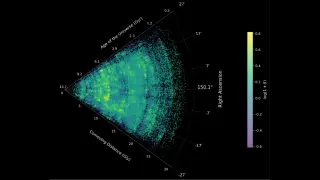
Using JWST’s COSMOS-Web survey, astronomers mapped about 164,000 galaxies over a 255‑hour program to produce the largest, most detailed view of the cosmic web. The map shows how dense regions foster early galaxy growth and eventually quench star formation, revealing the large-scale structure of the universe up to redshift z~7 and refining our understanding of cosmic evolution since the universe’s infancy.

Hubble Captures Active Core in Galaxy IC 486
science1 month ago

Hubble Captures Active Core in Galaxy IC 486

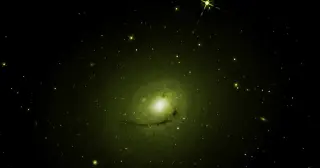
NASA's Hubble Space Telescope captured a striking image of the barred spiral galaxy IC 486, about 380 million light-years away, revealing an active galactic nucleus powered by a supermassive black hole over 100 million solar masses. The AGN outshines much of the galaxy and its accretion disk heats surrounding gas, offering a window into how galaxies grow and evolve and how bars funnel gas to fuel star formation and nuclear activity.

Einstein Cross Lens Hints at Complex Galaxy Growth
space1 month ago

Einstein Cross Lens Hints at Complex Galaxy Growth

Astronomers have identified a rare Einstein Cross gravitational lens in the elliptical galaxy J1453g, enabling precise weighing of the lensing mass. The cross magnifies a distant quasar, revealing a central stellar population in a relatively young galaxy that resembles the Milky Way, challenging the idea that elliptical galaxies form rapidly with predominantly low-mass stars and suggesting a more complex formation history, possibly involving slower growth or past mergers. The findings, published in Nature Astronomy, imply galaxy evolution may be more dynamic than current models predict.

Webb reveals transitional 'Stingray' galaxy linking little red dots to AGN
astronomy1 month ago

Webb reveals transitional 'Stingray' galaxy linking little red dots to AGN

Astronomers using the James Webb Space Telescope have identified a compact galaxy nicknamed the 'stingray' that sits at a crossroads between the mysterious little red dots and compact Type I AGN. The system, which appears distorted due to interaction with a nearby companion, shows signs of accelerated growth and supports the idea that little red dots are short-lived evolutionary phases rather than a distinct galaxy class. While this transitional object strengthens the link between LRDs and AGN, questions about the central black hole mass and the broader implications for galaxy formation remain, underscoring JWST’s power to illuminate early-universe dynamics.

From Frenzy to Freeze: Chandra Maps a 10-Billion-Year Slowdown in Black Hole Growth
science2 months ago

From Frenzy to Freeze: Chandra Maps a 10-Billion-Year Slowdown in Black Hole Growth

NASA’s Chandra X-ray Observatory shows that supermassive black holes grew rapidly in the early universe but have slowed dramatically over more than ten billion years, likely due to dwindling cold gas, fewer galaxy mergers, and feedback processes; the study combines multiple X-ray datasets to provide a comprehensive view of this long-term decline and its implications for how galaxies evolve.

Cosmic predators: active black holes suppress star formation in neighboring galaxies
astronomy3 months ago

Cosmic predators: active black holes suppress star formation in neighboring galaxies

Astronomers using the James Webb Space Telescope found that one of the universe’s brightest quasars appears to quench star formation not only in its host galaxy but also in neighboring galaxies within about a million light-years. The study of quasar J0100+2802 showed reduced ionized oxygen in nearby galaxies, indicating suppressed star birth likely caused by intense radiation and outflows from the active supermassive black hole, suggesting a galactic “ecosystem” where massive black holes influence galaxy evolution beyond their own hosts, especially in the early universe.

JWST unveils a cosmic jellyfish, offering clues to how galaxies evolved in the early universe
astronomy3 months ago

JWST unveils a cosmic jellyfish, offering clues to how galaxies evolved in the early universe

Using the James Webb Space Telescope, astronomers captured ESO 137-001, a jellyfish galaxy in the COSMOS field, showing trailing gas filaments stripped by ram pressure as it moves through a cluster. The image reveals blue, star-forming knots in the tails and places the system at about 8.5 billion years ago (roughly 5.3 billion years after the Big Bang), suggesting harsh cluster environments were already shaping galaxies earlier than thought; researchers plan further JWST studies to deepen understanding of galactic evolution.

Webb maps the universe’s dark matter across 800,000 galaxies
space3 months ago

Webb maps the universe’s dark matter across 800,000 galaxies

Using the James Webb Space Telescope, astronomers built a detailed map of dark matter by analyzing subtle light distortions (weak gravitational lensing) from roughly 800,000 background galaxies in the COSMOS field. The 255-hour NIRCam observations, with MIRI distance measurements and prior Hubble data, yield the most galaxy-dense dark‑matter map to date—about ten times more galaxies than ground-based surveys and twice as many as the Hubble map—providing new insights into how dark matter shapes galaxy growth and the cosmic web.

Gigantic wobbling black-hole jet rewrites galaxy science
space4 months ago

Gigantic wobbling black-hole jet rewrites galaxy science

Astronomers using the Keck Observatory, JWST and the VLA have detected the largest, most extended precessing jet from a supermassive black hole in the disk merger galaxy VV340a, with a jet spanning up to 20,000 light-years and displaying a wobbling, helical structure. The outflow strips gas and suppresses star formation by about 20 solar masses per year, challenging existing ideas about how black holes and their host galaxies co-evolve and suggesting a possible second black hole at VV340a’s center. The findings, published in Science, rely on multi-wavelength data from Keck, JWST, and VLA and signal a new window into galaxy evolution.

A Wobbling Black Hole Jet Could Starve Its Galaxy of New Stars
astronomy4 months ago

A Wobbling Black Hole Jet Could Starve Its Galaxy of New Stars

Astronomers have observed a precessing, high-velocity jet from a supermassive black hole in VV 340a heating and ejecting gas across the galaxy, potentially quenching star formation; the outflow rate is about 19 solar masses per year, and multiwavelength data from JWST, Keck, VLA, and ALMA reveal how such black-hole activity can reshape galactic evolution.

Massive Black Hole Reveals Its Hidden Secrets
science4 months ago

Massive Black Hole Reveals Its Hidden Secrets

Using XRISM's high-resolution instruments alongside ESA's XMM-Newton and NASA's NuSTAR, scientists captured unprecedented details of a supermassive black hole in galaxy MCG–6-30-15, confirming relativistic effects near the event horizon, identifying multiple wind zones, and challenging previous models of distant reflection, thus advancing our understanding of black hole physics and galaxy growth.