
Self-assembled contacts push molecular devices toward near-perfect yields
TL;DR
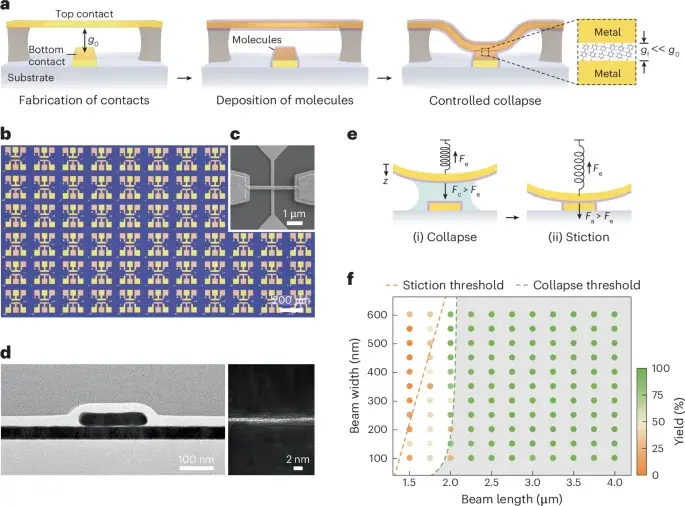
Researchers introduce self-assembled contacts that convert standard semiconductor-fabricated device structures into pristine molecule–metal interfaces, enabling over 1,000 electrically active metal–molecule–metal devices with yields up to 99% and stability across 10^5 measurement cycles, even for layers thinner than 1 nm. In situ Raman confirms molecular integrity, and the platform scales to system-level use, demonstrated by vector–matrix multiplication in a crossbar array of self-rectified molecular memory devices, bridging self-assembly with top-down manufacturing for scalable molecular electronics.
Topics:sciencetechnology#device-fabrication#molecular-electronics#nanotechnology#neuromorphic-computing#self-assembly#technology
Want the full story? Read the original reporting
Read on Nature