
SpaceX Captures Starship Upper Stage in Historic First, Despite Booster Loss
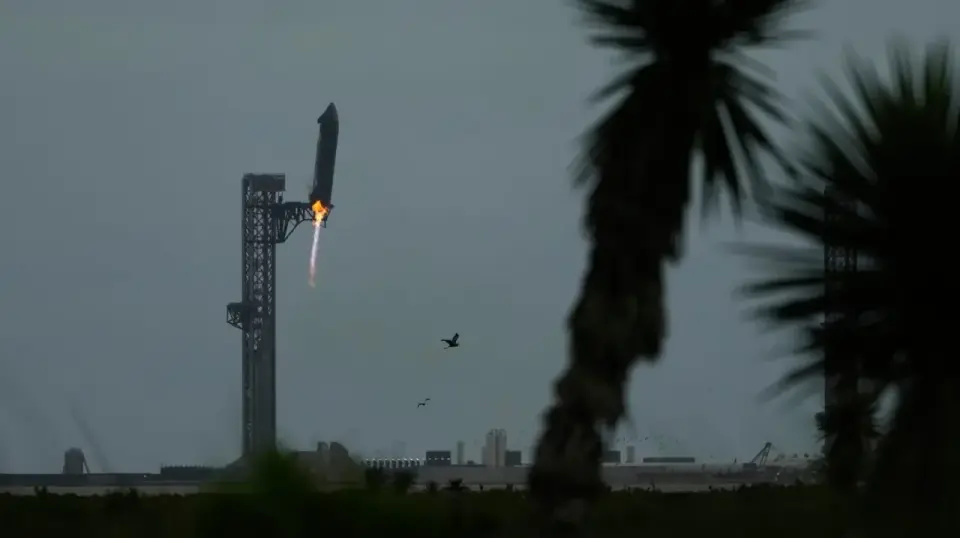
SpaceX achieved a historic milestone on November 14, 2026, by successfully catching its Starship upper stage with mechanical arms at its Starbase facility in South Texas. This was the first time an orbital rocket upper stage was recovered from space. The 15th test flight, which launched on November 13, deployed 26 Starlink V3 satellites and completed 14 orbits. While the upper stage was successfully caught, the Super Heavy booster failed to land and splashed down in the Gulf of Mexico due to a guidance issue. The achievement drew bipartisan praise from Washington officials and NASA, marking a significant step toward fully reusable rockets.
Key points
- SpaceX successfully caught the Starship upper stage with the 'Mechazilla' launch tower arms on November 14, 2026, marking the first time an orbital rocket upper stage was recovered from space.
- The 15th test flight launched on November 13 from Starbase, Texas, and deployed 26 Starlink V3 satellites into orbit.
- The Super Heavy booster failed to land and splashed down in the Gulf of Mexico due to a detected guidance problem, preventing a 'double catch.'
- The flight completed 14 orbits around Earth before the upper stage returned to the launch site, making it the longest Starship mission to date.
- NASA Administrator Jared Isaacman called the catch 'almost magic,' and bipartisan lawmakers praised the achievement as a significant engineering milestone.
Background
SpaceX has been developing the Starship system for full reusability, with previous Falcon 9 rockets only recovering their boosters. The company had attempted orbital flights in September 2026, but this was the first successful catch of the upper stage. NASA is relying on Starship technology for its Artemis III lunar mission, which is planned for 2027.
How outlets are covering it
The Hill emphasized the bipartisan political reaction, noting praise from both Democratic and Republican lawmakers. CNN focused on the technical challenges, including the decision to proceed to orbit despite an engine shutdown and the risks of orbital reentry. The New York Times highlighted the significance of the catch as a key milestone in SpaceX's vision of fully reusable rockets. Fox Business noted the booster's explosion over the Gulf of Mexico and the broader implications for launch costs and future missions to Mars and the Moon.
Why it matters
The successful catch of the Starship upper stage is a critical step toward achieving full reusability, which could significantly reduce launch costs and enable more frequent space missions. It also supports SpaceX's Starlink internet expansion and NASA's Artemis III lunar mission, which relies on Starship technology for propellant transfer and lunar landings.
What to watch
SpaceX plans to test in-orbit cryogenic propellant transfers in early 2027, a key requirement for lunar missions. The company is also investigating the cause of the booster's guidance failure. NASA is working with SpaceX to ensure Starship is ready for the Artemis III mission, which aims to return astronauts to the moon.
- SpaceX catches Starship for first time, drawing praise in Washington The Hill
- Highlights: SpaceX Starship soars in orbit, still aiming for ship catch in unprecedented test flight CNN
- SpaceX Makes History With Successful Rocket Catch in Texas The New York Times
- SpaceX makes history as Starship spacecraft caught by launch tower for first time Fox Business
- SpaceX Starship Flight 15 live updates: Starship lands from orbit for 1st time Space
Want the full story? Read the original reporting
Read on The Hill