
Arecibo’s Sudden Collapse: A Look Back at the End of an Iconic Telescope
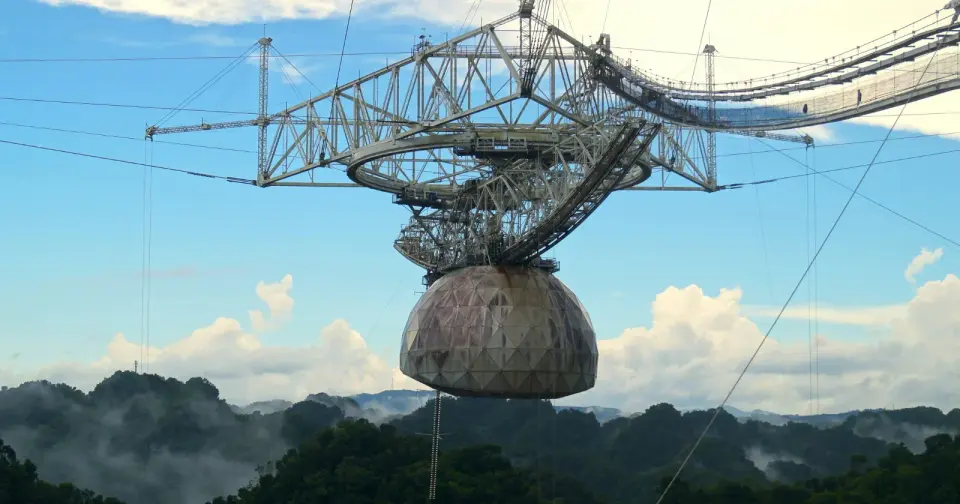
The Arecibo Observatory, a 305-meter radio telescope in Puerto Rico, collapsed in December 2020 after its 900-ton instrument platform fell through the dish. Originally built in 1963 for Cold War missile defense, it became a vital tool for astronomy, discovering the first exoplanets and binary pulsars. The collapse followed a series of cable failures in 2020, leading to an uncontrolled demolition that destroyed the structure. The National Science Foundation has since converted the site into a STEM education center called Arecibo C3.
Key points
- The Arecibo Observatory collapsed on December 1, 2020, when its 900-ton instrument platform fell through the 305-meter dish in a process that took approximately 30 seconds.
- The telescope was built in 1963 by Cornell University for the Advanced Research Projects Agency to study upper atmosphere interference with missile tracking, but later became a major astronomical tool.
- Key discoveries made at Arecibo include the first binary pulsar in 1974, the first confirmed exoplanets in 1992, and the first repeating fast radio burst.
- The collapse was preceded by an auxiliary cable failure in August 2020 and a main cable snap in November 2020, leading the National Science Foundation to announce decommissioning on November 19, 2020.
- The National Science Foundation decided not to rebuild the telescope but instead invested over $5.5 million to convert the site into the Arecibo C3 STEM education center, which began operating in 2024.
Background
The Arecibo Observatory was a landmark in radio astronomy, operating for 57 years before its collapse. Its history reflects the evolution of scientific infrastructure, from Cold War defense projects to astronomical research. The collapse highlighted the challenges of maintaining aging scientific equipment and the impact of sudden infrastructure failure on the scientific community. The site's transformation into an education center represents a shift in how such facilities are repurposed after their primary function ends.
Why it matters
The collapse of the Arecibo Observatory serves as a case study in the lifecycle of scientific infrastructure, illustrating how long-standing facilities can fail suddenly despite decades of use. It underscores the importance of maintenance and the emotional and scientific loss when iconic structures are destroyed. The decision to repurpose the site into an education center reflects a broader trend in science policy to adapt and reuse existing infrastructure for new purposes, ensuring that the legacy of such facilities continues in different forms.
What to watch
The Arecibo C3 STEM education center, which began operating in 2024, will continue to use the site for educational purposes. The National Science Foundation has not indicated any plans to rebuild the telescope, focusing instead on the educational mission of the new center. The site's future will likely involve ongoing efforts to leverage the heritage of Arecibo for science education and outreach.
Want the full story? Read the original reporting
Read on Space Daily