
Voyager 1 Crosses One Light-Day Mark, Extending Communication Delays to 48 Hours
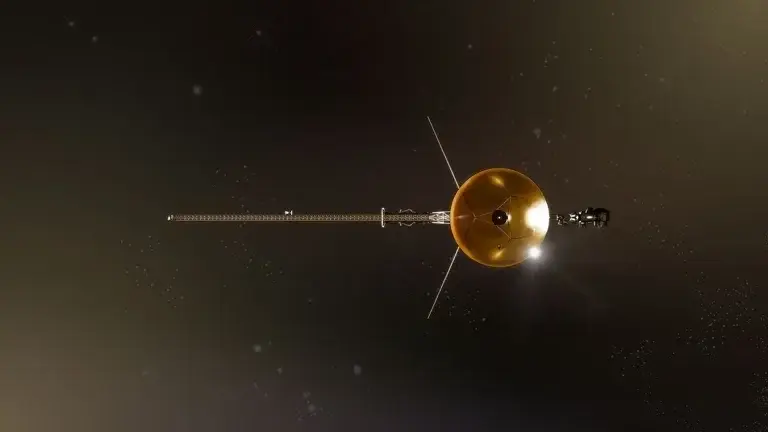
NASA’s Voyager 1 became the first human-made object to reach a distance of one light-day from Earth on Nov. 18, 2026. The milestone, confirmed by the Jet Propulsion Laboratory, marks a point where radio signals take 24 hours to reach the probe and another 24 hours to return. While the spacecraft has not transmitted science data since Nov. 14, it continues to send a carrier signal, allowing engineers to track its trajectory. NASA celebrated the achievement with a global event inviting the public to flash the probe’s call sign in Morse code. The probe, launched in 1977, is now over 16 billion miles away, traveling at 38,000 mph. Although its plutonium power source is depleting, engineers have successfully swapped instruments to extend its operational life into the 2030s.
Key points
- Voyager 1 reached one light-day from Earth on Nov. 18, 2026, at 5:16 a.m. EST, a distance of approximately 16.1 billion miles.
- The milestone means a round-trip communication exchange now takes roughly 48 hours, as signals travel at the speed of light.
- NASA confirmed the achievement using the probe’s carrier signal and trajectory calculations, as science and engineering data have not been received since Nov. 14.
- The spacecraft is currently operating with only two active science instruments due to the gradual depletion of its plutonium power source.
- NASA hosted a global event called 'Shine Bright for Voyager’s Light-Day,' encouraging participants to flash the probe’s call sign, V-G-R, in Morse code.
Background
Voyager 1 launched on Sept. 5, 1977, as part of a mission to explore the outer planets. It entered interstellar space in 2012, becoming the first human-made object to cross the heliopause. The probe has previously faced communication glitches and power constraints, leading to the shutdown of certain instruments to conserve energy. Its twin, Voyager 2, is expected to reach a similar distance milestone in 2035.
How outlets are covering it
NASA and the Jet Propulsion Laboratory emphasized the historic nature of the milestone, highlighting the engineering challenges of maintaining communication with a probe that is nearly 50 years old. Joe Westlake, director of the Heliophysics Division at NASA, noted that Voyager’s contributions to planetary science and heliophysics remain central to the agency’s missions. Scientific American focused on the broader context of space exploration, comparing Voyager’s milestone to recent achievements by SpaceX and the BepiColombo mission, while noting that the probe may go dark by 2036 due to power depletion. Live Science highlighted the symbolic nature of the milestone, focusing on Voyager’s past discoveries, such as the first images of volcanic eruptions on Jupiter’s moon Io and the 'Pale Blue Dot' image of Earth. AccuWeather reported on the global celebration event, detailing how participants could use smartphone apps or flashlights to send the probe’s call sign in Morse code.
Why it matters
The one light-day milestone underscores the vastness of interstellar space and the challenges of long-duration space missions. It highlights the ingenuity required to maintain communication with aging spacecraft and the importance of conserving power to extend their operational life. The milestone also serves as a reminder of humanity’s curiosity and the enduring legacy of Voyager’s contributions to our understanding of the solar system and beyond.
What to watch
NASA engineers will continue to monitor Voyager 1’s carrier signal and trajectory to ensure its continued operation. The agency is expected to announce further milestones, including another distance achievement later in November 2026. Long-term, the probe is expected to remain operational until at least the 2030s, after which it may go dark as its power source depletes. Scientists hope to continue studying the interstellar environment until the probe’s final signal.
- Voyager 1 reaches a light-day from Earth in golden milestone AccuWeather
- NASA’s Voyager 1 Makes History Reaching One Light-Day from Earth NASA Jet Propulsion Laboratory (JPL) (.gov)
- Three space milestones that sound like science fiction Scientific American
- Voyager 1's light-day milestone: 50 years of amazing solar system discoveries in photos Live Science
- A New Milestone for Life on Earth The Atlantic
Want the full story? Read the original reporting
Read on AccuWeather