
New Hampshire Clouds Dim Perseid Peak as Cooler Air Arrives
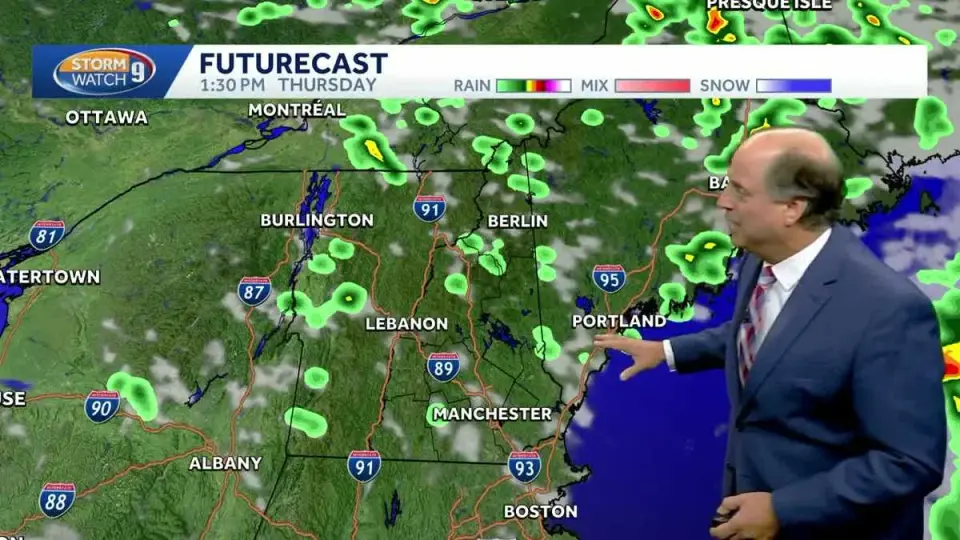
The Perseid meteor shower peaked overnight on August 12-13, 2026, but New Hampshire viewers faced partial cloud cover. WMUR reported lows in the 50s and scattered storms on Thursday, while ABC7 noted a partial solar eclipse occurred earlier that day. Cooler Canadian air is expected to clear skies by Friday.
Key points
- WMUR meteorologist Mike Haddad reported New Hampshire experienced some clouds during the Perseid peak, with lows in the 50s overnight.
- Thursday in New Hampshire was forecast to be humid with scattered showers or storms and highs in the low 80s.
- ABC7 reported a partial solar eclipse occurred on August 12, with 9% of the sun obscured in the New York area, while Spain experienced a total eclipse.
- WMUR predicted a major weather pattern change by the end of the week, bringing significantly cooler air from Canada to New Hampshire.
- ABC7 noted that the Perseid shower coincided with a new moon, which is ideal for viewing, and a planetary alignment visible in the predawn sky.
Background
The Perseid meteor shower, caused by debris from Comet Swift-Tuttle, typically peaks in mid-August. Previous archive coverage noted that the 2026 peak coincided with a new moon, offering optimal viewing conditions with up to 100 meteors per hour in dark locations. New Hampshire had previously been advised to look for dark, open skies away from city lights, with best viewing hours between 2 and 4 a.m.
How outlets are covering it
WMUR emphasized local weather challenges, noting clouds and potential storms in New Hampshire that could hinder meteor viewing, while highlighting an upcoming shift to cooler, drier air. ABC7 focused on the broader celestial trifecta, including the partial solar eclipse and planetary alignment, noting that the new moon provided ideal conditions for meteor viewing despite local weather variations. WSTM suggested that clearer skies were likely for Thursday and Friday nights, offering better viewing opportunities than the previous night. Space.com’s content was largely obscured by website interface code, but its title implied perfect skies for the peak, contrasting with WMUR’s cloud forecast for New Hampshire.
Why it matters
The Perseid meteor shower is one of the most reliable and popular annual astronomical events, drawing millions of viewers. Weather conditions significantly impact visibility, making forecasts crucial for enthusiasts. The concurrent solar eclipse and planetary alignment added to the astronomical interest, though local weather varied by region. The upcoming cooler air mass in New Hampshire signals a seasonal shift, affecting both weather patterns and stargazing conditions.
What to watch
New Hampshire is expected to experience cooler temperatures and lower humidity by the end of the week, with highs in the 70s to near 80s. Clearer skies may improve conditions for any remaining Perseid viewing, though the peak has passed. The planetary alignment may remain visible in the predawn sky for a short period.
- Video: Some clouds as meteor shower peaks; Storms possible Thursday WMUR
- Perseid meteor shower peaks under perfect skies tonight — here's what to expect Space
- The Perseids, Summer’s Strongest Meteor Shower, Will Peak Tonight The New York Times
- Solar eclipse, Perseid meteor shower, planet parade: What NYC will see Wednesday ABC7 New York
- Want to view the Perseid meteor shower? Much better conditions ahead to do so! WSTM
Want the full story? Read the original reporting
Read on WMUR