
Blocking ZMYND8 Reverses T Cell Exhaustion by Restoring IL-2 Signaling
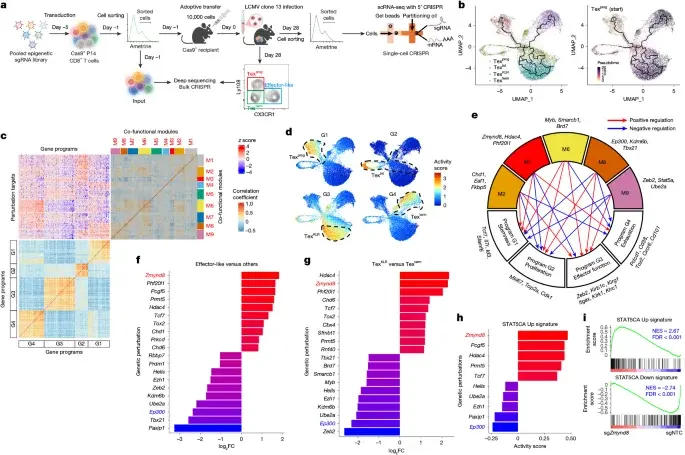
Researchers identified ZMYND8 as a key epigenetic factor that drives CD8+ T cell exhaustion by suppressing IL-2 receptor signaling. Blocking ZMYND8 restores T cell function and enhances anti-tumor and anti-viral responses, particularly when combined with IL-2 therapy or checkpoint inhibitors.
Key points
- Chronic antigen exposure upregulates the chromatin reader ZMYND8 in CD8+ T cells, which suppresses the high-affinity IL-2 receptor (IL-2R) and STAT5 signaling, leading to terminal exhaustion.
- ZMYND8 binds to active enhancer regions of the Il2ra gene locus and inhibits the histone acetyltransferase p300, thereby reducing IL-2R expression and promoting a hypofunctional state.
- Deleting ZMYND8 in T cells shifts differentiation from terminally exhausted cells to intermediate and killer cell lectin-like receptor-expressing (KLR) exhausted states, which exhibit stronger cytotoxic activity.
- ZMYND8-deficient T cells show improved antiviral and anti-tumor efficacy, especially when combined with IL-2 therapy or immune checkpoint blockade, suggesting a new therapeutic target for enhancing immunotherapy.
- The study used in vivo single-cell CRISPR screens in mice infected with lymphocytic choriomeningitis virus to identify ZMYND8 as a top regulator of T cell exhaustion and IL-2 signaling attenuation.
Background
This finding builds on prior research into T cell memory and exhaustion, such as the 2026 discovery that T cells sense tissue rigidity to shape immune memory and the role of galectin-1 in lung CD8+ memory. It also relates to recent studies on peripheral dendritic cell priming driving tau neurodegeneration and gut infections training brain-resident T cells, highlighting the complex interplay between epigenetic regulation, tissue environment, and immune cell differentiation in chronic infections and cancer.
Why it matters
Understanding the epigenetic mechanisms behind T cell exhaustion is crucial for improving cancer immunotherapies and treating chronic viral infections. Targeting ZMYND8 offers a new strategy to reinvigorate exhausted T cells and enhance their ability to fight tumors and viruses, potentially overcoming current limitations of checkpoint inhibitors and IL-2 therapy.
What to watch
Future research will likely focus on translating ZMYND8 inhibition into clinical applications, testing its efficacy in human patients with cancer or chronic infections, and exploring its combination with existing immunotherapies like checkpoint inhibitors and IL-2 therapy to improve treatment outcomes.
Want the full story? Read the original reporting
Read on Nature