
Nikon Re-Evaluates Microscopy Prize After AI Watermark and Biological Errors Surface
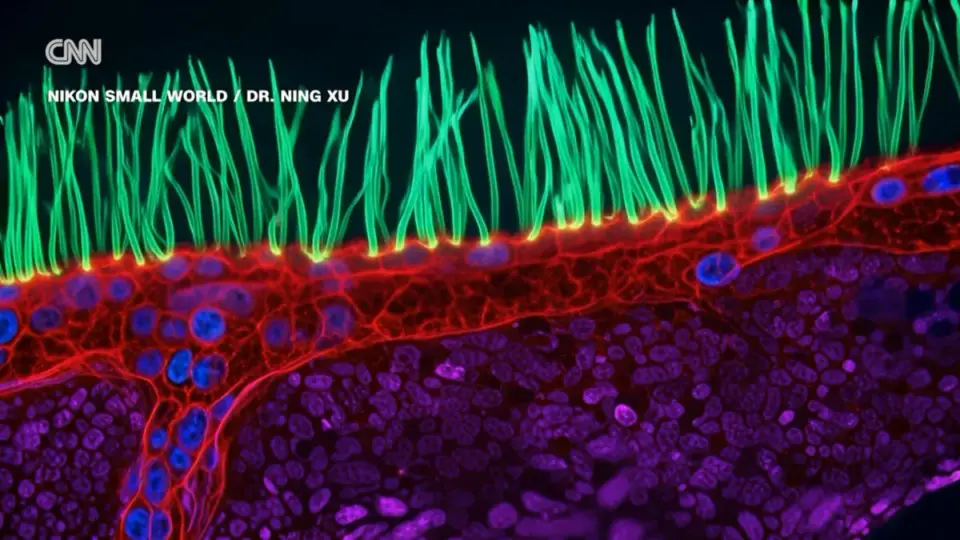
Nikon is re-reviewing the 2026 Small World in Motion winner after scientists identified AI-generated artifacts and biological impossibilities in Dr. Ning Xu’s video of cilia. While Xu claims AI was only used for post-processing colorization, critics point to a SynthID watermark and structures that do not exist in human biology. Nikon has not yet confirmed if rules were violated, but the incident highlights the growing tension between artistic visualization and scientific integrity in microscopy.
Key points
- Ning Xu’s video of cilia in lung tissue won the 16th annual Nikon Small World in Motion contest in September 2026.
- Critics, including University of Florida researcher Edward Phelps, noted that purple structures resembling mitochondria do not occur in biology and that cilia appeared to 'pop in and out of existence.'
- UT Southwestern Medical Center student Ian Donovan identified a SynthID watermark in the video, a marker pioneered by Google DeepMind for AI-generated content.
- Xu stated that AI was used only to distinguish and color features in reconstructed grayscale data, not to generate the cilia or their motion, and that no anatomical claims were made about the rendered features.
- Nikon confirmed Xu is 'respectfully complying' with their review and has provided technical documentation, but has not yet issued a final ruling on whether contest rules were broken.
Background
This controversy follows a broader trend in 2026 where AI tools are increasingly integrated into scientific workflows, raising questions about data integrity. Earlier in September, Google launched Gemini 3.8 Live with Live Avatar, which uses SynthID watermarks to ensure transparency in AI-generated video. The current dispute mirrors concerns raised in our October 1 coverage, where Nikon began investigating Xu’s entry after similar biological errors were flagged. The incident also occurs against the backdrop of U.S. government efforts to accelerate AI development, including President Trump’s 'AI Force' initiative, which emphasizes rapid adoption while attempting to safeguard against misuse.
How outlets are covering it
Gizmodo and CNN emphasize the scientific community’s alarm over the biological inaccuracies in the video, citing Edward Phelps’s critique that the structures shown are impossible in human biology. The BBC highlights the ethical dimension, quoting fifth-place winner Patrick Hickey, who argues that the prestige of the award outweighs the $3,000 prize and that AI alteration would be unfair to other entrants. The Telegraph’s coverage was inaccessible due to a security block, but its earlier reporting (via Gizmodo) noted that former judge Andrew Moore compared the entry to an AI-restored family photo, suggesting that while the result may look nice, it is unsettling if it misrepresents reality. All sources agree that Nikon is currently 'carefully re-reviewing' the submission, but they differ on the severity of the breach: Gizmodo and CNN frame it as a potential violation of the ban on generative AI, while the BBC notes that Nikon has not yet confirmed any rules were broken.
Why it matters
This case sets a precedent for how scientific institutions will handle AI-assisted visualization in competitive and peer-reviewed contexts. If Xu’s entry is disqualified, it may lead to stricter guidelines for AI use in microscopy contests and journals. Conversely, if it is upheld, it could normalize AI post-processing as a valid form of scientific communication, provided it is disclosed. The incident also underscores the limitations of current AI detection tools, as the presence of a SynthID watermark is not always definitive proof of fabrication, and many AI detectors fail without such watermarks. For researchers, the key takeaway is the need for clear disclosure of all processing steps to maintain trust in scientific data.
What to watch
Nikon is expected to issue a final decision on the status of the 2026 Small World in Motion winner in the coming weeks. Xu has promised to publish a detailed description of the optical system and quantitative analysis of the ciliary motion, which may clarify whether the AI processing altered the underlying data. The scientific community will likely debate the boundaries between artistic visualization and scientific data, potentially leading to updated guidelines in microscopy journals and contests. If the entry is disqualified, Nikon may need to re-award the prize, which could impact the careers and reputations of the other finalists.
- Contest-Winning Microscope Video Is Full of AI Confabulations, Scientists Say Gizmodo
- Winner of Nikon microscopy photo contest faces criticism over AI usage CNN
- Tiny image sparks big backlash in Nikon photo contest bbc.com
- On closer inspection, microscope photo contest winner is ‘AI fake’ The Telegraph
- Nikon re-reviews video contest winner after complaints about AI use USA Today
Want the full story? Read the original reporting
Read on Gizmodo