
CERN’s LHCb Detects Ultra-Rare Decay, Opening Window to the 'Zeptoverse'
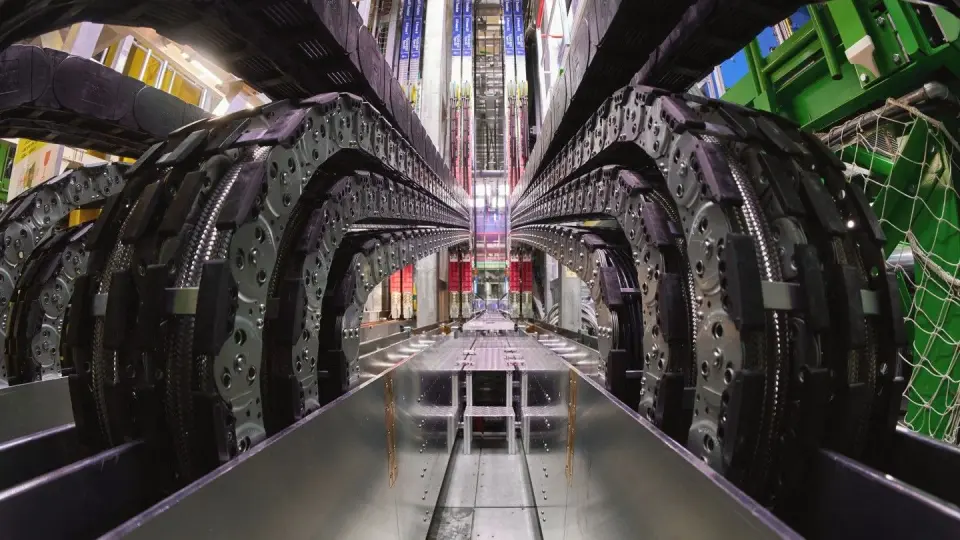
Physicists at CERN’s Large Hadron Collider have reported the first evidence of an exceptionally rare particle decay, marking the initial exploration of the 'zeptoverse'—a scale 100 billion times smaller than an atom. This breakthrough, achieved after a 40-year search, offers a new method to test the Standard Model and probe for dark matter, though future progress is threatened by UK funding cuts.
Key points
- CERN’s LHCb experiment detected the first evidence of the B0 to mu+ mu− decay, a process occurring in only 1 in 10 billion beauty quark interactions.
- The discovery, announced Nov. 3, 2026, represents the first observation of activity at the 'zeptoverse' scale, defined as less than a hundred-trillionth of a wavelength of visible light.
- A 2024 upgrade to LHCb, utilizing machine learning to suppress background noise, allowed researchers to record in one year what previously took a decade.
- Current results align with Standard Model predictions, but the precision measurements provide a new avenue to search for new physics, including dark matter and matter-antimatter asymmetry.
- Future upgrades planned for the 2030s are jeopardized by recent UK funding withdrawals, raising concerns about the continuity of this research line.
Background
This development follows a four-decade search for rare beauty quark decays, previously described in our archive as a 'golden channel' for new physics. Earlier reports from November 2026 highlighted the statistical significance of 3.2 sigma and the reliance on upgraded detectors. The current findings confirm the initial detection but emphasize the ongoing challenge of funding for next-generation upgrades.
How outlets are covering it
Live Science and Technology Org emphasize the milestone nature of the detection, highlighting the 40-year search and the role of the 2024 upgrade. The New European offers a more critical view, noting that the statistical significance (3.2 sigma) is below the standard 5-sigma threshold for discovery and that the results currently match Standard Model predictions, offering no immediate new physics. Roar News focuses on the scale of the 'zeptoverse' and the implications for understanding the Big Bang, while all sources agree on the threat posed by UK funding cuts to future LHCb upgrades.
Why it matters
This detection provides the first experimental window into the 'zeptoverse,' a scale where new particles might explain dark matter and the dominance of matter over antimatter. While current results confirm the Standard Model, the precision of these measurements sets a baseline for future deviations that could reveal new physics. The finding also underscores the importance of sustained funding for large-scale scientific infrastructure, as the next phase of research depends on upgrades that are currently at risk.
What to watch
Researchers aim to upgrade LHCb in the 2030s to increase data collection rates by an order of magnitude, allowing for precision measurements that could reveal cracks in the Standard Model. However, the future of this upgrade is uncertain due to recent UK funding withdrawals. In the interim, physicists will continue to analyze existing data to refine measurements of the rare decay and search for any deviations from Standard Model predictions.
- CERN physicists measure universe at smallest scale ever, catching 1 in 10 billion particle interaction Live Science
- Physicists knock at the door of the zeptoverse Technology Org
- The biggest mysteries of the universe just got a whole lot smaller The New European
- CERN’s rare Bd decay: LHCb reports 3.03σ evidence NeoTeo
- We are one step closer to exploring the zeptoverse after forty years Roar News
Want the full story? Read the original reporting
Read on Live Science