Tag

Standard Model

All articles tagged with #standard model

Counting Particles Reveals 995.5 Degrees of Freedom in the Standard Model
science26 days ago

Counting Particles Reveals 995.5 Degrees of Freedom in the Standard Model

The article explains that counting elementary particles isn’t straightforward: textbooks list 17, but including antiparticles, color charges, chirality, and polarization expands the tally; a 2011 theorem shows the Standard Model’s effective degrees of freedom total 995.5, meaning the true count depends on energy scale and how one defines particles.

science1 month ago

CERN's LHCb Hints at New Physics in B-Meson Decays (4-Sigma Tension)

Researchers at CERN's LHCb observed ~650 billion B-meson decays and found a four-sigma discrepancy with Standard Model predictions in rare penguin-like decays, a potential hint of new physics. If confirmed, explanations could involve a Z' boson or leptoquarks; further analysis of data since 2018 and upgrades planned for the 2030s are expected to clarify whether this is genuine new physics or a statistical fluctuation.

LHC hints at new physics through rare B meson decays
science1 month ago

LHC hints at new physics through rare B meson decays

CERN’s LHCb reports a four-sigma deviation from Standard Model predictions in a rare penguin decay of B mesons to a kaon, a pion and two muons, suggesting possible undiscovered physics. The independent CMS results earlier in 2025 strengthen the case, but five-sigma confirmation is not yet reached; future LHC upgrades and larger datasets are planned to verify or refute the deviation.

Rare B-meson decays spark potential new physics beyond the Standard Model
science2 months ago

Rare B-meson decays spark potential new physics beyond the Standard Model

LHCb’s study of a rare penguin decay—B mesons decaying to a kaon and two muons—shows angular distributions that differ from Standard Model predictions at about 4 sigma, hinting that new particles could enter the decay loop. Possible explanations include a heavier Z’ boson or leptoquarks, with CMS hinting at a compatible but less significant signal. The analysis uses ~650 billion decays from 2011–2018, making this one of the most intriguing LHC anomalies, though it could still be affected by charming-penguin effects. Further data are needed to confirm any new physics.

Muon g-2 Mystery Reconciled as Standard Model Gains Ground
science2 months ago

Muon g-2 Mystery Reconciled as Standard Model Gains Ground

A long-standing puzzle about the muon's anomalous magnetic moment (g-2) is resolved by a new, ultra-precise lattice QCD calculation that aligns the Standard Model prediction with experimental measurements within half a standard deviation. The result removes the need for a hypothetical fifth force and reinforces quantum field theory as the foundation of particle physics, though it may still leave a narrow window for new physics to appear in future experiments.

Muon mystery solved: precision calc keeps the Standard Model intact
science2 months ago

Muon mystery solved: precision calc keeps the Standard Model intact

A Nature paper using lattice QCD and hybrid simulations shows the muon's anomalous magnetic moment is consistent with the Standard Model within about half a standard deviation and 11 decimal places. The result suggests the earlier discrepancy hinting at a fifth force was a calculation artefact, not new physics, while tightening constraints on possible beyond‑SM explanations through a precise treatment of hadronic vacuum polarization.

LHCb hints at physics beyond the Standard Model in rare B meson decays
science2 months ago

LHCb hints at physics beyond the Standard Model in rare B meson decays

New results from CERN’s LHCb show a rare electroweak penguin decay of B mesons that disagrees with Standard Model predictions at about four standard deviations, hinting at possible new physics. The finding is supported by earlier CMS results and comes from analyzing roughly 650 billion B decays (2011–2018). Although intriguing, it does not reach the five-sigma discovery threshold; further data and upgrades planned for the 2030s could confirm whether this points to new particles or remains a heavy overlap within the current theory.

CMS measures W boson mass with record precision at 13 TeV
science3 months ago

CMS measures W boson mass with record precision at 13 TeV

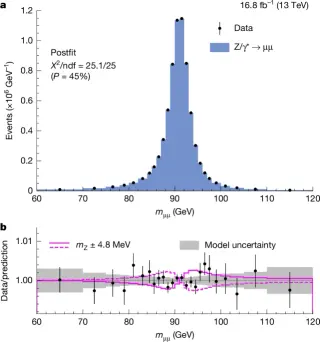
CMS analyzed over 100 million W→μν decays from 2016 pp collisions at 13 TeV to extract mW using a highly granular, in-situ template fit of the muon pT, eta and charge distributions, aided by state-of-the-art NNLO+N3LL theory and data-driven PDFs; the result mW = 80,360.2 ± 9.9 MeV agrees with the Standard Model and helps address the prior CDF tension, with an additional W+ vs W− mass difference measurement of 57.0 ± 30.3 MeV. The analysis validates via Z-boson mass checks and a W-like mZ cross-check, and features robust muon momentum scale and hadronic recoil calibrations.

Particle Physics at a Crossroads: Hard Questions, New Paths
science5 months ago

Particle Physics at a Crossroads: Hard Questions, New Paths

More than a decade after the Higgs discovery, particle physics has yet to find new physics beyond the Standard Model, prompting a crisis about the field’s direction. Proposals for big next-gen machines (the Future Circular Collider, muon colliders) and smaller-scale tests (axions, hidden valleys) mingle with advances in AI-assisted data analysis, but there’s no discovery guarantee and talent is drifting toward other fields. In short, particle physics isn’t dead, but it’s hard—and the path forward remains uncertain.

Standard Model Remains Unsolved as 2025 Closes
science6 months ago

Standard Model Remains Unsolved as 2025 Closes

As 2025 concludes, the Standard Model of particle physics and cosmology remains robust despite numerous puzzles and challenges, with recent experiments reinforcing its predictions and no definitive evidence yet for physics beyond it. Key mysteries like dark matter, dark energy, and the matter-antimatter asymmetry persist, but current data strongly support the existing framework, emphasizing the need for continued investment in experimental and observational science to uncover deeper truths.