
Electric Fields Reverse Phonon Chirality in Barium Titanate
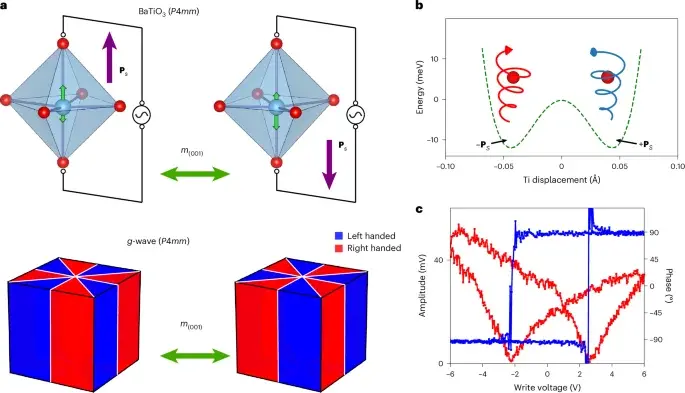
Researchers have demonstrated the first reversible, electric-field control of phonon angular momentum in barium titanate (BaTiO3). Using resonant inelastic X-ray scattering, they showed that switching the ferroelectric polarization of the material also flips the chirality of its lattice vibrations. This establishes a new 'gyroelectric' effect where the handedness of phonons can be deterministically manipulated, offering a potential pathway for phonon-based information processing and energy technologies.
Key points
- Chiral phonons, which carry angular momentum, were previously difficult to control deterministically. This study shows that their handedness can be switched by reversing the ferroelectric polarization in BaTiO3.
- The experiment utilized circularly dichroic resonant inelastic X-ray scattering (RIXS) to directly measure the angular momentum transfer between X-rays and the lattice. The technique confirmed that phonon chirality is non-volatile and switches with the applied electric field.
- The observed dichroism matched first-principles density functional theory calculations, validating the theoretical model that broken inversion symmetry in the tetragonal phase of BaTiO3 creates non-degenerate chiral modes.
- The effect is described as a robust gyroelectric phenomenon, analogous to optical activity in chiral materials but occurring in reciprocal space. It allows for the control of phonon populations, which could be leveraged for non-volatile memory or neuromorphic computing.
- The study used free-standing 80-nm thick BaTiO3 membranes to avoid strain effects. A voltage of 3.5 V was sufficient to switch the polarization, while a holding voltage of 0.2 V maintained the state during measurements.
Background
This work builds on recent advances in controlling lattice dynamics. In July 2026, researchers demonstrated cross-axis ferroelectric switching in Bi4Ti3O12, showing that electric fields could manipulate polarization in different directions. Additionally, in August 2026, scientists observed room-temperature quantum heat waves in boron arsenide, highlighting the growing interest in controlling phonon transport for thermal management. The current study extends this by showing that the fundamental handedness of phonons, not just their propagation, can be electrically tuned.
Why it matters
Controlling phonon chirality provides a new degree of freedom for manipulating matter, distinct from controlling frequency or amplitude. Since BaTiO3 is already widely used in low-power electronics and non-volatile memories, this discovery could lead to new device architectures where information is stored or processed via the angular momentum of lattice vibrations. This could enable ultrafast magnetic switching and novel energy technologies that rely on the interplay between lattice, electronic, and magnetic degrees of freedom.
What to watch
Future research will likely focus on integrating these chiral phonon states with magnetic layers to create hybrid platforms for neuromorphic computing. Researchers also plan to explore ultrafast switching using terahertz pulses to drive phonon modes, potentially reshaping the free-energy landscape of ferroelectric materials. Further studies may investigate how nonlinear phononic interactions can transiently modulate energy barriers, allowing for even faster control of chiral states.
Want the full story? Read the original reporting
Read on Nature