
Astronomers capture first direct evidence of a star merging with its companion in Andromeda
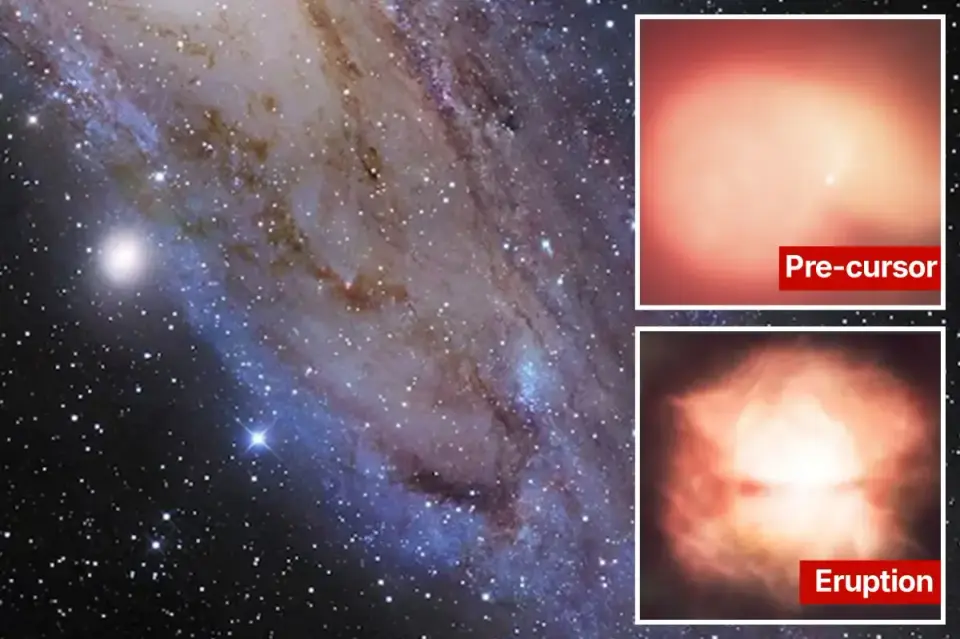
Astronomers have documented the first direct observation of a star engulfing its companion, a process known as common envelope evolution. The event, designated AT 2025abao, occurred in the Andromeda galaxy, where a smaller star spiraled into a red giant, causing a seven-year brightening phase before a violent eruption in October 2025. Data from the James Webb Space Telescope confirmed the merger and provided the first empirical constraints on the efficiency of this stellar process.
Key points
- The event, nicknamed 'Bao,' involved a red giant star in the Andromeda galaxy swallowing a smaller companion star, marking the first direct observation of common envelope evolution.
- Astronomers detected a gradual brightening of the star from 2018 to 2025, followed by a sudden eruption in October 2025, which was confirmed by the James Webb Space Telescope.
- The merger resulted in the ejection of about 10% of the star's outer gas, with the companion star spiraling into the core of the primary star.
- The findings, published in Nature, provide the first empirical constraints on the efficiency of common envelope evolution, a process previously only theorized.
- Future telescopes, such as the Nancy Grace Roman Space Telescope and the Vera Rubin Observatory, are expected to discover more such events.
Background
This discovery builds on earlier observations of stellar interactions, such as the 2026 confirmation that Betelgeuse's dimming was linked to a companion star orbiting within its atmosphere. The current finding provides the first direct evidence of a star merging with its companion, a process that had only been theorized for decades.
How outlets are covering it
The New York Post emphasizes the 'cosmic cannibalism' aspect of the discovery, highlighting the dramatic nature of the event. The Nature article focuses on the scientific implications, providing detailed data on the merger and its implications for understanding stellar evolution. Science News highlights the collaborative effort of the research team and the significance of the discovery for future astronomical observations. NASA's perspective focuses on the role of the James Webb Space Telescope in confirming the merger and the potential for future discoveries with upcoming telescopes.
Why it matters
This discovery provides the first direct evidence of a process that had only been theorized for decades, offering new insights into the evolution of binary star systems. The findings could help astronomers better understand the formation of compact stellar binaries and the dynamics of stellar mergers, potentially leading to new discoveries in the field of astrophysics.
What to watch
Astronomers will continue to monitor the binary system to determine its final state after the eruption. They also plan to use upcoming telescopes, such as the Nancy Grace Roman Space Telescope and the Vera Rubin Observatory, to search for more examples of common envelope evolution and stellar mergers.
- Insane real space images shows a star ‘eating’ its companion in scientific first: ‘Absolutely flabbergasted’ New York Post
- An inspiral of a star inside a common envelope with its giant companion Nature
- Two stars in the Andromeda galaxy merged before astronomers’ eyes Science News
- Andromeda Star Merger (Artist’s Concept) NASA Science (.gov)
- Astronomers witness a star eating its companion in 1st-of-its-kind observation Space
Want the full story? Read the original reporting
Read on New York Post