Tag

Andromeda Galaxy

All articles tagged with #andromeda galaxy

Astronomers capture first real-time view of a giant star swallowing its companion in Andromeda
science4 days ago

Astronomers capture first real-time view of a giant star swallowing its companion in Andromeda

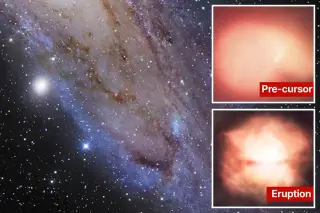
Astronomers have documented the first real-time observation of a giant star engulfing its smaller companion, a process known as common envelope evolution. The event, designated AT 2025abao, occurred in the Andromeda galaxy. After a seven-year brightening phase, the system erupted in October 2025, likely resulting in a stellar merger. Data from the James Webb Space Telescope and other observatories confirmed the merger, providing the first direct evidence of this long-theorized phenomenon.
Astronomers capture first real-time view of a giant star swallowing its companion in Andromeda
science4 days ago

Astronomers capture first real-time view of a giant star swallowing its companion in Andromeda

A team led by Viraj Karambelkar at Columbia University has documented the first real-time observation of a common envelope evolution, a process where a giant star engulfs a smaller companion. The event, designated AT 2025abao or 'Bao,' occurred in the Andromeda Galaxy. After seven years of slow brightening, the system erupted in October 2025, likely resulting in a stellar merger. Data from the James Webb Space Telescope and other observatories confirmed the merger, providing the first direct evidence of this long-theorized phenomenon.
Astronomers capture first direct evidence of a star merging with its companion in Andromeda
science5 days ago

Astronomers capture first direct evidence of a star merging with its companion in Andromeda

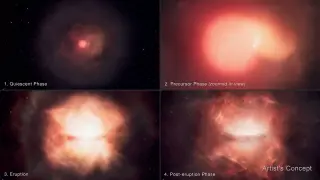
Astronomers have documented the first direct observation of a star engulfing its companion, a process known as common envelope evolution. The event, designated AT 2025abao, occurred in the Andromeda galaxy, where a smaller star spiraled into a red giant, causing a seven-year brightening phase before a violent eruption in October 2025. Data from the James Webb Space Telescope confirmed the merger and provided the first empirical constraints on the efficiency of this stellar process.

Astronomers capture first direct evidence of a star engulfing its companion in Andromeda
science6 days ago

Astronomers capture first direct evidence of a star engulfing its companion in Andromeda

A team led by Viraj Karambelkar has reported the first direct observation of a star engulfing its companion, a process known as common envelope evolution. The event, designated AT 2025abao or 'Bao,' occurred in the Andromeda galaxy. A smaller star spiraled into the outer layers of a massive red giant, causing a seven-year brightening phase before a violent eruption in October 2025. Data from the James Webb Space Telescope, captured 47 days after the peak, confirmed the merger and provided the first empirical constraints on the efficiency of this stellar process.

Swift Observatory Ends 22-Year Mission with Final Image of Andromeda
space16 days ago

Swift Observatory Ends 22-Year Mission with Final Image of Andromeda

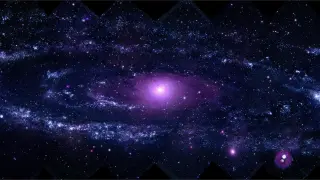
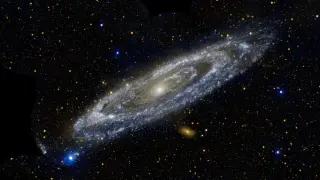
NASA’s Neil Gehrels Swift Observatory re-entered Earth’s atmosphere on November 4, 2026, ending a 22-year mission that lasted 11 times longer than planned. The telescope, which studied gamma-ray bursts and other cosmic events, burned up over Indonesia after a failed commercial rescue attempt. Its final legacy includes a detailed ultraviolet image of the Andromeda galaxy, revealing thousands of stars invisible to ground-based telescopes.

Naked-Eye Viewing of Andromeda Galaxy Peaks in Early November 2026
science18 days ago

Naked-Eye Viewing of Andromeda Galaxy Peaks in Early November 2026

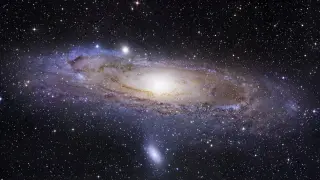
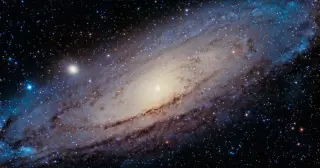
The Andromeda Galaxy (M31) is currently visible to the naked eye from the Northern Hemisphere, offering a rare opportunity to observe light that has traveled 2.5 million years. Early November 2026 provides optimal conditions due to a new moon on November 9, minimizing light pollution. While M31 appears as a faint, elongated smudge rather than the detailed spiral seen in photographs, it remains the closest giant galaxy to the Milky Way. Observers are advised to use star-hopping techniques from the Great Square of Pegasus or Cassiopeia to locate it. Binoculars and averted vision techniques can enhance visibility, especially in areas with light pollution. The Triangulum Galaxy (M33) is technically farther but less practical for naked-eye viewing. This week also offers opportunities to view the Double Cluster and the Northern Taurid meteor shower, though rates are low.

Astronomer Reveals How Software, Not Photoshop, Cleans Andromeda Galaxy Images
science1 month ago

Astronomer Reveals How Software, Not Photoshop, Cleans Andromeda Galaxy Images

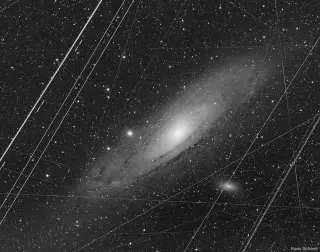
NASA's Astronomy Picture of the Day features a before-and-after comparison of the Andromeda galaxy, demonstrating how long-exposure images taken from Earth suffer from artifacts like satellite trails and cosmic ray streaks. The 'after' image was not created using Photoshop but through specialized software that removes these terrestrial imperfections to reveal the galaxy's true appearance.

Why Andromeda's Glow Hides Its Planets: The Physics of Extragalactic Detection
astronomy2 months ago

Why Andromeda's Glow Hides Its Planets: The Physics of Extragalactic Detection

While the Andromeda galaxy is visible to the naked eye due to the combined light of over a trillion stars, detecting an Earth-like planet within it remains impossible with current technology. The planet would appear 10 billion times fainter than its host star and separated by only 1.3 microarcseconds, a gap far smaller than the resolution limits of the James Webb Space Telescope. Direct imaging requires a hypothetical 100-kilometer aperture, while indirect methods like microlensing offer limited statistical insights but no atmospheric data.

Hubble Data Shows Andromeda’s Star Birth Rate Has Collapsed in Last 40 Million Years
astronomy3 months ago

Hubble Data Shows Andromeda’s Star Birth Rate Has Collapsed in Last 40 Million Years

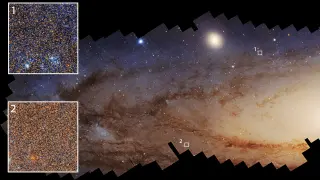
A new analysis of Hubble Space Telescope data reveals that the Andromeda Galaxy (M31) has significantly slowed its rate of star formation over the past 500 million years, with a sharp decline in the last 40 million years. Researchers mapped approximately 200 million stars across two-thirds of Andromeda’s disk, finding that current star formation is roughly one-fifth of a solar mass per year, down from one solar mass per year half a billion years ago. The slowdown is most pronounced on the side of Andromeda facing the compact satellite galaxy M32, which is suspected to have interacted with Andromeda’s disk. While the exact cause remains unproven, M32 is considered the leading suspect. Future observations by the Nancy Grace Roman Space Telescope are expected to provide a more complete picture of this galactic evolution.

Hubble Data Suggests M32 Galaxy May Have Stifled Andromeda's Star Formation
astronomy3 months ago

Hubble Data Suggests M32 Galaxy May Have Stifled Andromeda's Star Formation

Astronomers using Hubble Space Telescope data have determined that the Andromeda Galaxy's star formation rate has dropped sharply over the last 40 million years. The decline, which is most pronounced on the side of Andromeda closest to the smaller galaxy M32, suggests that M32 may have interfered with Andromeda's ability to create new stars, though a direct causal link remains unproven.

Hubble data reveals Andromeda’s star birth rate has collapsed over 500 million years
science3 months ago

Hubble data reveals Andromeda’s star birth rate has collapsed over 500 million years

A new study using Hubble data shows that star formation in the Andromeda galaxy has declined for 500 million years, with a sharp drop in the last 40 million years. The research, published in The Astrophysical Journal, analyzed 200 million stars to map this slowdown, which is linked to a fading gas ring and potential interactions with a nearby satellite galaxy.

Harvard’s human computer unlocked the universe’s scale
science5 months ago

Harvard’s human computer unlocked the universe’s scale

Henrietta Leavitt, a Harvard College Observatory 'human computer' paid a pittance, discovered the period-luminosity relation for Cepheid variables, enabling the cosmic distance ladder used to measure faraway galaxies. By linking a Cepheid’s pulsation period to its true brightness, Leavitt laid the groundwork for determining distances, anchoring the scale of the universe and underpinning Hubble’s finding that Andromeda is a separate galaxy. Modern analyses continue to refine and reassess her method, keeping Leavitt’s contribution central to cosmology.