
Astronomers Trace 8-Minute Radio Pulses to White Dwarf in Rare Sun-Like Binary System
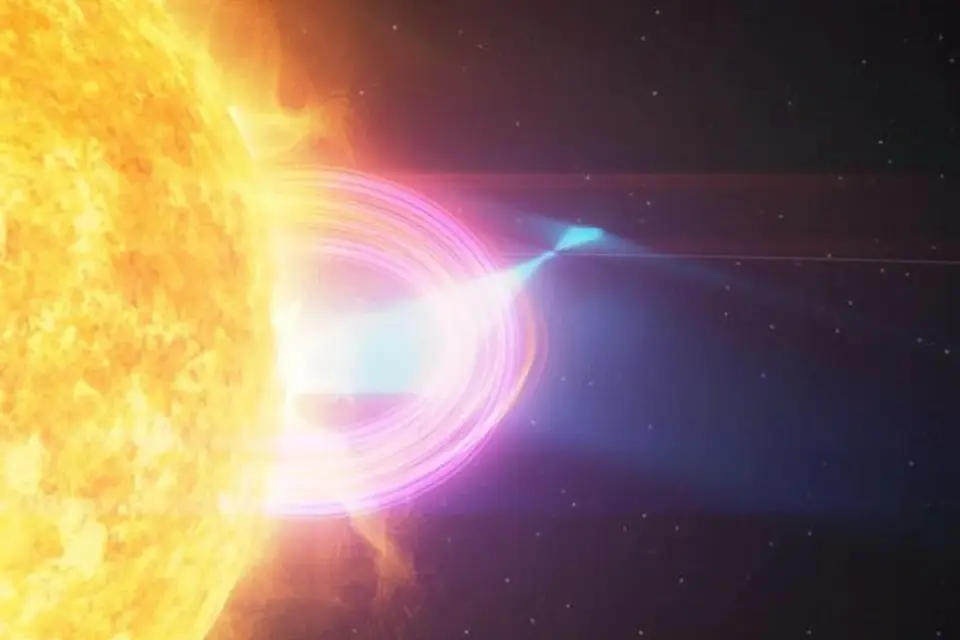
Astronomers have identified the source of mysterious radio pulses in a distant binary star system, GPM J071507−114153, located approximately 5,000 light-years from Earth. The system consists of a low-mass white dwarf and a G-type star similar to the Sun. The white dwarf emits radio signals every 7.9 minutes, a pattern previously observed only in systems with cooler red dwarf companions. This discovery, published in Nature Astronomy, marks the first time such long-period transient signals have been linked to a Sun-like companion, offering new insights into stellar magnetic interactions and the nature of these rare cosmic objects.
Key points
- The radio pulses originate from a white dwarf in a binary system with a G-type star, a configuration previously unobserved in long-period transients.
- The system, designated GPM J071507−114153, is located about 5,000 light-years away and was detected using the Murchison Widefield Array and confirmed with the MeerKAT telescope in South Africa.
- The pulses are modulated by a longer orbital period of approximately 1.3 days, indicating the white dwarf's motion around its companion.
- The discovery allows for the detection of stellar flares and magnetic loops on the Sun-like companion star, providing insights into magnetic interactions in binary systems.
- This is the first time such clear pulses have been observed from a white dwarf in a system with a G-type star, helping to clarify the source of long-period transient signals.
Background
Long-period transients (LPTs) are a recently recognized class of radio sources that emit periodic pulses with intervals ranging from minutes to hours. The first LPT was discovered in 2021, and since then, around a dozen similar systems have been identified. Most previously known LPTs involve white dwarfs paired with cooler red dwarf stars, but the source of the pulses was often unclear. This new discovery adds to the growing catalog of LPTs and helps resolve previous uncertainties about the nature of these objects. The background also includes earlier coverage of this specific discovery, confirming the white dwarf as the source of the 8-minute pulses in a Sun-like binary system.
How outlets are covering it
The Independent and Space emphasize the rarity of the Sun-like companion in such a system, highlighting that previous LPTs involved cooler red dwarfs. Nature provides a more technical perspective, noting that the radio pulses are modulated by a longer orbital period of about 1.3 days and that the G-type star does not fill its Roche lobe. ScienceAlert offers a broader context on LPTs, questioning whether all such objects are white dwarfs or if other mechanisms, such as neutron stars, could be responsible. The Independent and Space also note the detection of stellar flares on the companion star, while Nature focuses on the magnetic interactions and Faraday rotation effects. All sources agree on the significance of this discovery for understanding LPTs, but they differ in their emphasis on the technical details versus the broader implications for astrophysics.
Why it matters
This discovery helps resolve a long-standing mystery about the source of long-period transient radio signals. By confirming that a white dwarf in a Sun-like binary system can produce such pulses, astronomers gain a better understanding of the physical mechanisms behind these rare cosmic objects. The ability to detect stellar flares and magnetic loops on the companion star also provides new insights into magnetic interactions in binary systems, which could have implications for understanding stellar activity and evolution. Furthermore, this discovery may pave the way for future observations with the Square Kilometre Array, which could reveal more such systems and provide a more detailed view of their signals.
What to watch
Astronomers will likely continue to search for more long-period transients using existing and future telescopes, such as the Square Kilometre Array. The discovery of this system may lead to targeted searches for similar objects, helping to build a larger catalog of LPTs and uncover patterns in their behavior. Additionally, further analysis of the magnetic interactions and stellar flares in this system could provide deeper insights into the physics of binary star systems and the mechanisms behind radio emission in white dwarfs.
- Rare star system is emitting radio signals at 8-minute intervals, scientists announce. Here’s what it means The Independent
- A long-period transient with a Sun-like companion Nature
- A dead star is flashing radio waves every 8 minutes, and its partner looks a lot like the sun Phys.org
- Astronomers trace mystery radio signals back to cosmic odd couple of white dwarf and sun-like star Space
- A Mysterious Object in Space Pulsed Every 62 Minutes. Then It Vanished. ScienceAlert
Want the full story? Read the original reporting
Read on The Independent