Tag

Binary Stars

All articles tagged with #binary stars

Astronomers Spot the Tiniest Packed Quadruple Star System
space-and-spaceflight1 month ago

Astronomers Spot the Tiniest Packed Quadruple Star System

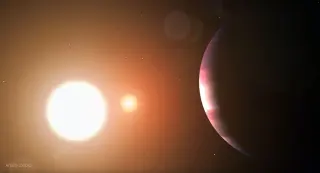
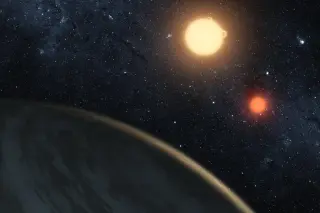
Using NASA’s TESS data from 2019–2024, astronomers identified TIC 120362137 as the most compact 3+1 quadruple star system: an eclipsing binary eclipsed by a third star, plus a distant fourth star with a 1,045.5‑day orbit—the shortest outer period observed in such a configuration. The inner three stars are packed within Mercury’s orbital distance while the outer companion sits near Jupiter’s orbit. The team’s models suggest the inner trio will merge into a white dwarf in ~300 million years, leaving a double white-dwarf system with a ~44‑day orbit.

Longest Gamma-Ray Burst Rewrites Rules on Cosmic Explosions
space2 months ago

Longest Gamma-Ray Burst Rewrites Rules on Cosmic Explosions

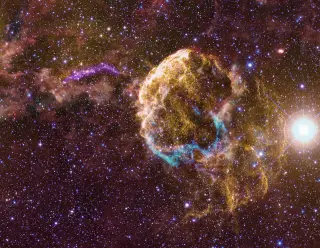
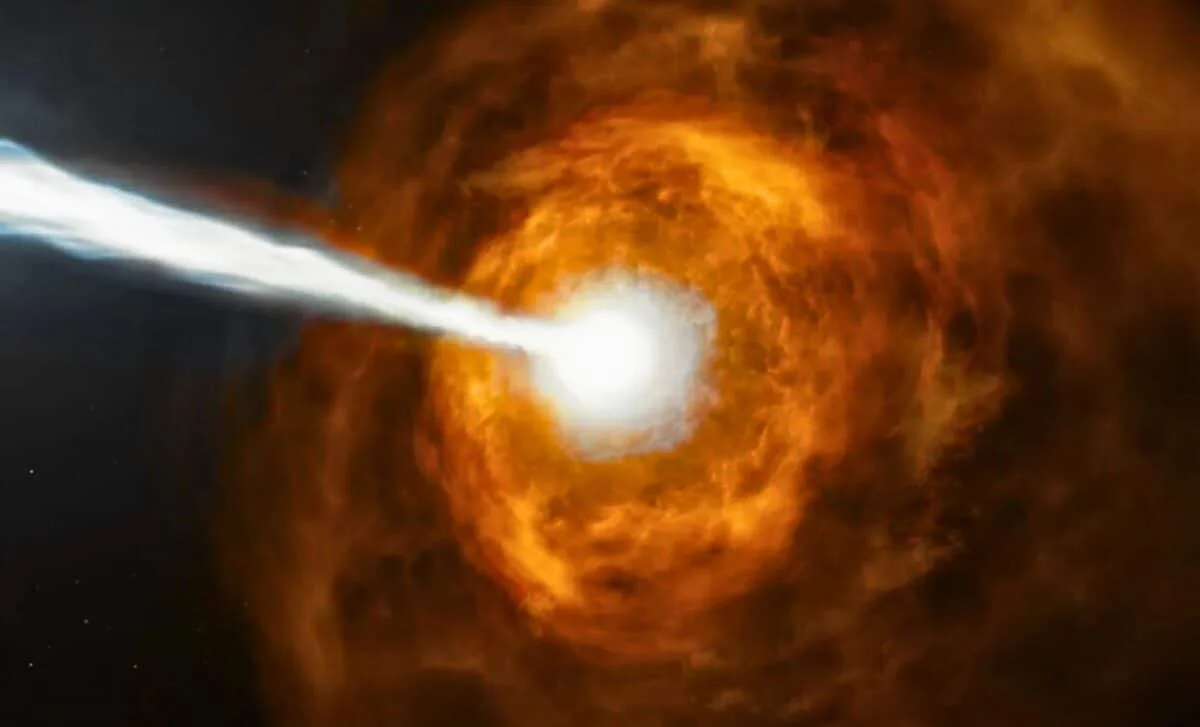
Astronomers detected GRB 250702B, a gamma-ray burst lasting about 25,000 seconds (roughly seven hours)—the longest on record—observed by multiple space-based telescopes since mid-2025; its sustained, evolving profile challenges standard GRB classifications and may point to a helium-star merger with a stellar-mass black hole, while no redshift or host galaxy has been identified yet. The finding highlights potential detection biases against long, lower-brightness bursts and has spurred plans to revise criteria for future missions like NASA/ESA’s COSI and to re-examine archival data for overlooked events.

Quiet White Dwarf Sparks Mysterious Bow Shock
space2 months ago

Quiet White Dwarf Sparks Mysterious Bow Shock

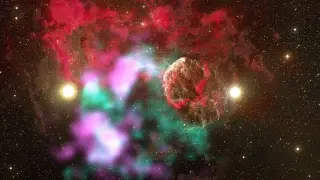
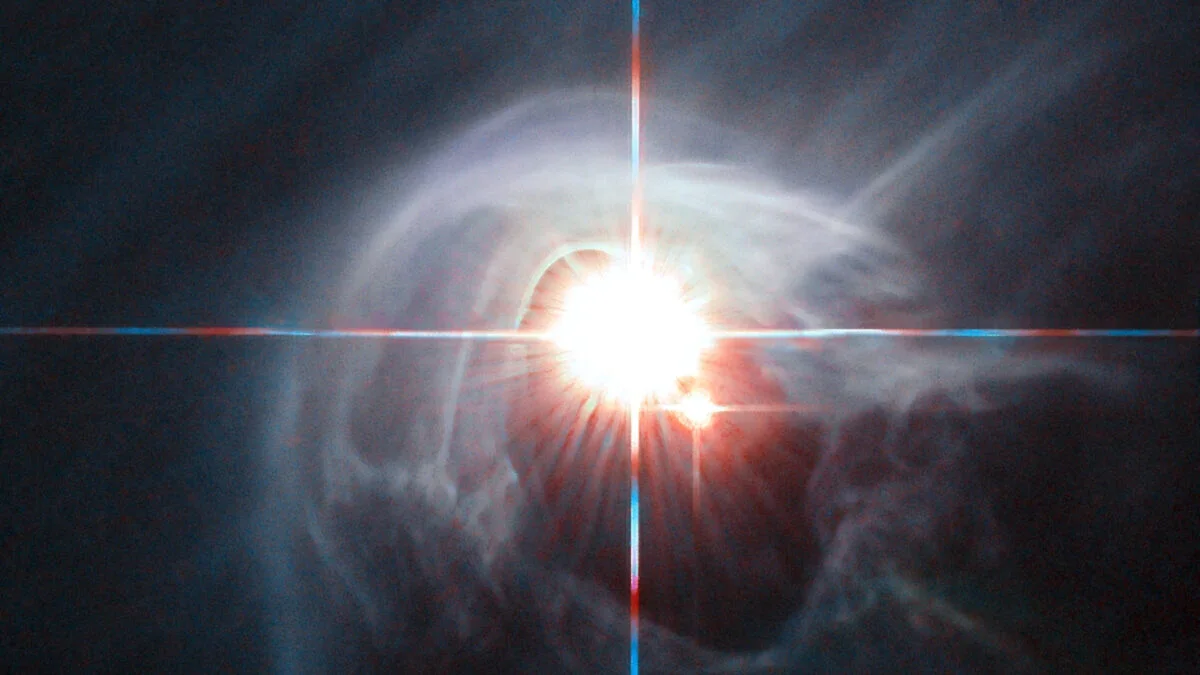
Astronomers using ESO’s Very Large Telescope observed a glowing bow shock around the white dwarf RXJ0528+2838 in a binary system, even though the star shows no accretion disc or obvious outflow. The shock, visible in red, green, and blue, appears to have been powered for about 1,000 years, challenging standard models of how matter moves in such systems. A strong magnetic field could be funneling material from the companion directly onto the dead star without forming a disc, but this mechanism, if real, would only partly explain the phenomenon, leaving the exact origin of the outflow a mystery as reported in Nature Astronomy.

Revealing the Hidden Companion of Betelgeuse
science6 months ago

Revealing the Hidden Companion of Betelgeuse

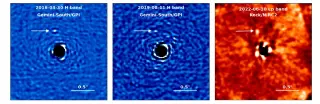
Astronomers from Carnegie Mellon University have confirmed that Betelgeuse has a hidden companion star, nicknamed 'Betelbuddy,' which is a young solar-sized star. This discovery, made using NASA's Chandra X-ray Observatory and the Hubble Space Telescope, helps explain Betelgeuse's six-year brightness cycle and challenges existing models of binary star formation due to the significant mass difference between the two stars.

Astronomers Find One of the Galaxy's Largest Binary Stars
science7 months ago

Astronomers Find One of the Galaxy's Largest Binary Stars

Astronomers have discovered one of the most massive binary star systems in our galaxy, NGC 3603-A1, with two stars weighing 93 and 70 times the Sun's mass, orbiting each other every 3.8 days. This discovery, aided by archival Hubble data and new observations, provides valuable insights into stellar evolution and the origins of binary black holes, highlighting the dynamic and extreme conditions in star-forming regions like NGC 3603.

White Dwarf-Main Sequence Pairs: Unlocking Cosmic Secrets
science1 year ago

White Dwarf-Main Sequence Pairs: Unlocking Cosmic Secrets

The discovery of white dwarf-main sequence binary star systems offers new insights into stellar evolution, star formation, and galactic processes. These systems help bridge the gap between early and late stages of binary evolution, shedding light on phenomena like supernovae and gravitational waves. Researchers used machine learning to analyze data from the Gaia mission, 2MASS, and Pan-STARRS1 surveys, identifying these binaries in star clusters. This breakthrough has significant implications for understanding cosmic events and the universe's fundamental processes.

New Binary Star Discoveries Illuminate Stellar Evolution
science1 year ago

New Binary Star Discoveries Illuminate Stellar Evolution

Astronomers at the University of Toronto have discovered the first pairs of white dwarf and main sequence stars in young star clusters, providing new insights into stellar evolution. This breakthrough helps bridge the gap between the early and final stages of binary star systems, potentially explaining phenomena like supernovae and gravitational waves. Using machine learning, researchers identified 52 such binaries across 38 clusters, offering a unique opportunity to study the common envelope phase, a critical yet mysterious stage in stellar evolution.

"Reviving Retro: The Resurgence of Binary Stars"
astronomy2 years ago

"Reviving Retro: The Resurgence of Binary Stars"

Binary stars, once neglected in astrophysics, are experiencing a renaissance in research thanks to the Gaia space telescope's decade of cosmic data, which has revealed a wealth of new information about these systems. Around 50% of stars like the sun exist with a binary partner, offering insights into stellar evolution and exotic astrophysical phenomena. Gaia's data has also improved estimations of binary star distances and revealed previously unseen phenomena, sparking renewed interest in understanding how these systems form and evolve.

astronomy2 years ago

"Galactic Cannibalism: Corpses Discovered Near Predator Stars"

Astronomers at Georgia State University's CHARA Array have discovered the faint glow of cannibalized stars near their predatory stellar companions, shedding light on the mysterious life trajectories of close binary stars. The research focuses on B-emission line stars, rapidly spinning stars born from intense interactions between close pairs, some of which engage in cannibalism.