
August 12, 2026: A Rare Convergence of Total Eclipse, Meteor Shower, and Planetary Alignment
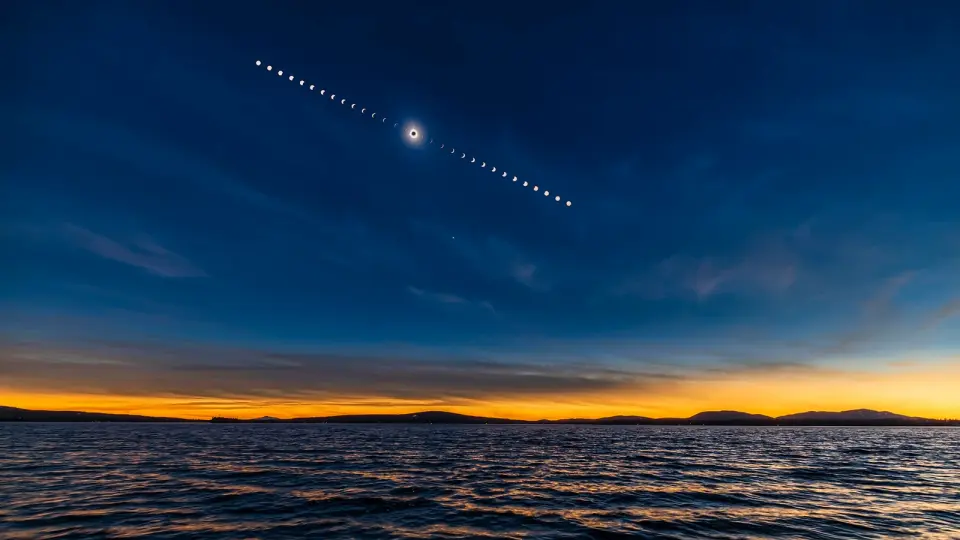
August 12, 2026, offers a rare celestial trifecta: a total solar eclipse visible across parts of Greenland, Iceland, and Spain; the peak of the Perseid meteor shower under moonless skies; and a six-planet alignment. Later in the month, a near-total lunar eclipse and the full 'Sturgeon Moon' provide additional viewing opportunities.
Key points
- A total solar eclipse will occur on August 12, 2026, with a path of totality crossing eastern Greenland, western Iceland, and northern Spain, lasting up to two minutes.
- The Perseid meteor shower peaks on August 12-13, offering over 100 meteors per hour under dark, moonless skies.
- A six-planet alignment (Mercury, Mars, Jupiter, Saturn, Neptune, Uranus) will be visible pre-dawn on August 12.
- A near-total lunar eclipse will occur on August 27-28, with 96% of the moon covered by Earth's shadow.
- The full 'Sturgeon Moon' will peak on August 28, coinciding with the lunar eclipse.
Background
August 2026 is a significant month for skywatching, following July's optimal Milky Way viewing. Previous coverage highlighted the total solar eclipse's path and the Perseid meteor shower's peak, as well as travel plans to Spain for the eclipse. This briefing synthesizes multiple sources to provide a comprehensive overview of August's celestial events.
How outlets are covering it
Live Science emphasizes the 'greatest single day and night for skywatching' on August 12, highlighting the total eclipse, Perseids, and Milky Way. WTOP focuses on the partial solar and lunar eclipses visible in the D.C. region, providing detailed viewing tips and local events. National Geographic highlights the total solar eclipse, Perseids, and the return of northern lights, while also noting planet groupings. Popular Science focuses on the planetary alignment, the total solar eclipse, and the Perseids, as well as the 'Summer Triangle' and the 'Sturgeon Moon.'
Why it matters
August 12, 2026, is a rare convergence of celestial events, offering a unique opportunity for skywatchers to observe a total solar eclipse, the Perseid meteor shower, and a planetary alignment. These events provide valuable data for astronomers and a memorable experience for the public.
What to watch
Skywatchers should prepare for the total solar eclipse on August 12, using proper eclipse glasses and dark skies. The Perseid meteor shower will peak on August 12-13, and the near-total lunar eclipse will occur on August 27-28. The full 'Sturgeon Moon' will peak on August 28.
- Mark your calendars: Aug. 12 could be the greatest single day and night for skywatching for years Live Science
- Eyes to the Skies: August features partial eclipses of the sun and moon WTOP
- 9 night sky events to see in August, from a total solar eclipse to the return of the northern lights nationalgeographic.com
- August stargazing: A planet parade, two eclipses, and one scary star Popular Science
- What’s Up: August 2026 Skywatching Tips from NASA NASA Science (.gov)
Want the full story? Read the original reporting
Read on Live Science