
Bianfu Cave Fossils Reveal Denisovan Lifestyle in Southwestern China
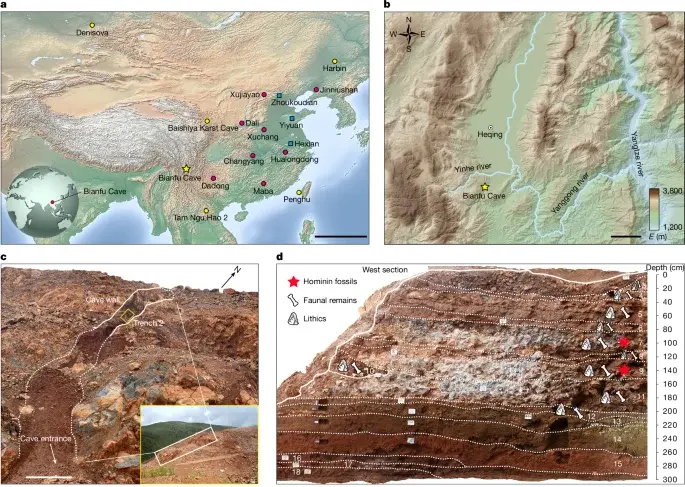
Researchers identified Denisovan fossils at Bianfu Cave in Yunnan, China, dating to 167,000–134,000 years ago. The site offers the first direct link between Denisovan remains and their tools, revealing a subsistence strategy based on hunting large prey and using expedient stone and bone technologies in a conifer forest environment.
Key points
- Fossils including four teeth, two skull fragments, and a radius were identified as Denisovan using proteomic analysis and dental morphology, as no DNA survived due to the warm climate.
- The cultural sequence spans 190,000 to 70,000 years ago, representing one of the longest continuous records for the species, while the fossils themselves date to 167,000–134,000 years ago.
- Analysis of over 60,000 bone fragments indicates the inhabitants specialized in hunting medium-to-large prey like water buffalo, gaur, and deer.
- Tool use involved expedient core reduction and pervasive use of unmodified bones, suggesting a flexible adaptation strategy rather than intensive tool manufacture.
- The discovery expands the known geographic range of Denisovans to subtropical southwestern China, complementing previous finds in Siberia and the Tibetan Plateau.
Background
Prior to this discovery, Denisovan knowledge was limited to isolated fragments from Siberia and the Tibetan Plateau, with the 'Dragon Man' skull identified in 2025 providing the first facial reconstruction. Earlier archive coverage highlighted the significance of proteomic screening in identifying these remains and the broader implications for understanding Denisovan distribution in Asia.
How outlets are covering it
Nature emphasizes the comprehensive nature of the find, linking fossils to a 120,000-year cultural sequence and highlighting the 'expedient' technological strategy. CNN focuses on the rarity of finding fossils in direct association with cultural remains, noting that previous Denisovan finds often had uncertain provenance. National Geographic highlights the physical morphology of the skull fragments and the radius, suggesting Denisovans may have had stronger arm twisting capabilities than modern humans. Scientific American notes the implications for identifying other unknown hominins as Denisovans based on dental comparisons and the limited DNA preservation due to the warm climate.
Why it matters
This discovery provides the first robust evidence of Denisovan behavior, technology, and ecology in eastern Asia, moving beyond genetic traces to physical evidence of their daily lives. It helps explain how Denisovans adapted to diverse environments and contributes to understanding their genetic legacy in modern Southeast Asian and Oceanian populations.
What to watch
Researchers plan to test cave sediments for hominin DNA to confirm that Denisovans were the sole occupants of the site during the identified period. Further analysis of the radius and skull fragments may provide more insights into Denisovan physical capabilities and morphology.
- Denisovans from southwestern China and their subsistence strategies Nature
- Fossil remains unearthed in China offer new clues about how Denisovans lived CNN
- Researchers Discover Rare Denisovan Bones in a Cave in China National Geographic
- Scientists unlock new clues to what Denisovans, a mysterious ancient human ancestor, looked like Scientific American
- Fossil bones and tools from mysterious ancient human unearthed in China ABC News & Headlines – Australian Broadcasting Corporation
Want the full story? Read the original reporting
Read on Nature