Tag

Paleoanthropology

All articles tagged with #paleoanthropology

Ancient Face, Connected Africa: Little Foot’s Reconstruction Rewrites Hominin History
science28 days ago

Ancient Face, Connected Africa: Little Foot’s Reconstruction Rewrites Hominin History

Scientists digitally rebuilt the distorted face of Little Foot, a 3.67‑million‑year‑old Australopithecus from South Africa, using high‑resolution scans. The resulting features show Little Foot’s face resembles East African fossils more than a younger South African counterpart, suggesting Africa was a connected evolutionary landscape and facial evolution 4–3 million years ago may have been more complex than regional models imply. The study highlights orbital (eye region) evolution and notes the face is only part of the story, with other skull parts still deformed and awaiting digital reconstruction.

Outsiders Targeted: Neanderthals’ 41,000-Year-Old Cannibalism at Goyet, Belgium
science1 month ago

Outsiders Targeted: Neanderthals’ 41,000-Year-Old Cannibalism at Goyet, Belgium

A decade-long study of Neanderthal bones from Belgium’s Troisième caverne de Goyet reveals selective cannibalism of outsiders, including adult women and children, dating to about 41,000–45,000 years ago. Cut marks and bone processing resemble those used on animal remains, suggesting food consumption rather than ritual activity. Genetic analyses indicate the individuals were outsiders to the local group, pointing to intergroup conflict during a time of Neanderthal decline and Homo sapiens’s increasing presence in the region.

Greek Skull Rewritten: A 300,000-Year-Old Relic Belongs to Homo Heidelbergensis
science1 month ago

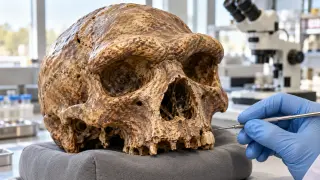
Greek Skull Rewritten: A 300,000-Year-Old Relic Belongs to Homo Heidelbergensis

A 300,000-year-old skull found cemented in a Greek cave (the Petralona cranium) has been dated to at least 286,000 years old via uranium-series dating of the surrounding calcite, placing it with Homo heidelbergensis rather than Homo sapiens or Neanderthals. This suggests a widespread Middle Pleistocene population in Europe that coexisted with Neanderthals for over 100,000 years. No DNA can be recovered due to the long warm history of the fossil, and the find adds complexity to how scientists categorize early human relatives.

New Human Species 'Homo juluensis' Discovered in China
science1 year ago

New Human Species 'Homo juluensis' Discovered in China

Scientists have identified a new hominin species, Homo juluensis, which lived in eastern Asia between 300,000 and 50,000 years ago. This discovery, led by researchers from the University of Hawai‘i and the Chinese Academy of Sciences, adds complexity to the understanding of human evolution during the Late Quaternary period. Homo juluensis is characterized by features similar to Neanderthals, modern humans, and Denisovans, and its identification helps clarify the classification of Middle Pleistocene hominin fossils, challenging traditional evolutionary models.

Mysterious New Human Species with Large Brains Discovered
science1 year ago

Mysterious New Human Species with Large Brains Discovered

Scientists have identified a potential new human species, Homo juluensis, which lived in eastern Asia from about 300,000 to 50,000 years ago. This discovery, led by Professor Christopher J. Bae, suggests that Homo juluensis may include the Denisovans, known primarily through DNA evidence. The research highlights the unexpected diversity of hominin fossils in Asia and contributes to a clearer understanding of human evolution. The findings, published in Nature Communications, open new avenues for studying ancient human populations and their interactions.

Ancient 'Big Head' Human Species Discovered in Asia
science1 year ago

Ancient 'Big Head' Human Species Discovered in Asia

Scientists have identified a potential new species of ancient human, Homo julurensis, characterized by an abnormally large skull, which lived in China between 300,000 and 50,000 years ago. This species, dubbed the 'big head people,' may have had a larger brain than any known hominin, including modern humans. Researchers argue that these fossils, previously grouped with other hominins like Denisovans, display unique features warranting classification as a separate species. The discovery challenges the simplicity of the human evolutionary tree in Asia, suggesting more complex interbreeding and shared ancestry among ancient hominins.

Newly Discovered 'Big-Headed' Human Species Found in Asia
science1 year ago

Newly Discovered 'Big-Headed' Human Species Found in Asia

A new study published in Nature Communications by Xiujie Wu and Christopher Bae suggests the existence of a previously unknown group of large-headed humans, termed Homo Juluensis, who lived in eastern Asia over 100,000 years ago. These humans had larger brains than any known human species of their time. The researchers propose that these fossils, previously attributed to Denisovans, represent a distinct group with mixed ancestry from various ancient Asian populations. This discovery adds complexity to the human ancestry tree, highlighting the diversity of hominin fossils in eastern Eurasia.

Discovery of 'Homo juluensis' reshapes human evolutionary history
science1 year ago

Discovery of 'Homo juluensis' reshapes human evolutionary history

Researchers have identified a new species of ancient humans, Homo juluensis, based on large skull fossils found in China. This discovery, dating from 220,000 to 100,000 years ago, adds to the understanding of hominin variation during the Middle Pleistocene epoch. The fossils exhibit a mix of Neanderthal, modern human, and Denisovan traits, suggesting hybridization played a role in human evolution in eastern Asia. The classification of H. juluensis is debated, with some experts suggesting it may align more closely with H. longi.

Ancient Footprints Reveal Coexistence of Human Ancestors in Kenya
science1 year ago

Ancient Footprints Reveal Coexistence of Human Ancestors in Kenya

Scientists have discovered 1.5-million-year-old footprints in Kenya, revealing that two different species of human ancestors, Homo erectus and Paranthropus boisei, walked the same path within hours of each other. This finding, published in Science, provides the first evidence of these species coexisting in the same habitat, offering new insights into human evolution and interactions. The study utilized advanced 3D imaging to analyze the footprints, highlighting the significance of trace fossils in understanding ancient human behavior.