
Euclid telescope’s first major data release catalogs 900 million galaxies and 15,000 gravitational lenses
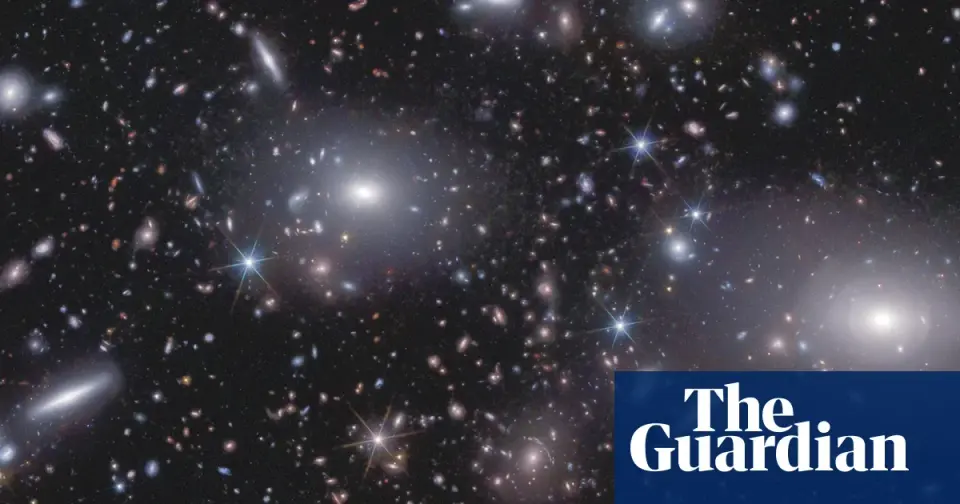
The European Space Agency’s Euclid telescope released its first major dataset, DR1-Foundation, on November 12, 2026. This release catalogs over 900 million galaxies and 60 million quasars, covering 14% of the telescope’s total survey area. The data includes 15,000 strong gravitational lensing candidates, which scientists hope will help determine the nature of dark matter and dark energy.
Key points
- The Euclid mission, launched in July 2023, aims to create the largest 3D map of the universe, covering one-third of the sky and spanning 10 billion years of cosmic history.
- The DR1-Foundation dataset contains approximately 2.5 trillion pixels and 1.7 million gigabytes of data, covering an area 9,500 times the size of the full moon.
- The release includes 15,000 strong gravitational lensing candidates, a significant increase from the roughly 1,000 known previously, with an estimated 170,000 expected by the end of the mission.
- Strong gravitational lensing allows scientists to 'weigh' galaxies and study the distribution of dark matter, potentially ruling out different theories about its nature.
- The next major data release is expected in summer 2026, focusing on weak gravitational lensing and galaxy distribution to map dark matter across the universe.
Background
Euclid’s release follows the DESI survey, which in 2026 produced a 47-million-galaxy map that challenged standard cosmological models by suggesting potential issues with the cosmological constant. While DESI focused on spectroscopic data, Euclid emphasizes high-resolution imaging and gravitational lensing to probe dark matter and dark energy. The 'cosmic latte' finding from 2026, which determined the average color of the universe, highlights the ongoing effort to characterize the cosmos’s large-scale properties.
How outlets are covering it
The Guardian emphasizes Euclid’s technological leap in combining high resolution with wide-field coverage, noting that no previous survey matched its detail and information content. Phys.org highlights the statistical power of Euclid’s data, with Leiden University researchers stressing that billions of galaxies are needed to test the laws of gravity on cosmic scales. ESA focuses on the sheer scale of the data, describing it as the largest space-based survey of its kind and a milestone for European technology. Space underscores the potential for dark matter breakthroughs, particularly through the 15,000 strong lensing candidates, which Natalie Lines of the University of Portsmouth calls a 'monumental' step in weighing galaxies and studying dark energy.
Why it matters
Euclid’s data provides unprecedented detail for understanding the 95% of the universe composed of dark matter and dark energy. The 15,000 strong lensing candidates offer a new way to test theories about dark matter’s properties, while the vast galaxy catalog will help map the cosmic web and study the accelerated expansion of the universe. This release sets a new standard for cosmology, with future analyses expected to refine our understanding of fundamental physics.
What to watch
The next major data release is expected in summer 2026, focusing on weak gravitational lensing and galaxy distribution. Cosmological analyses combining Euclid’s observations are anticipated in June 2027, with results on dark energy and gravity tests to follow. Scientists will continue to explore the 15,000 strong lensing candidates and the 900 million galaxies in the current dataset, with an estimated 170,000 lenses expected by the end of the six-year mission.
- European survey reveals 900m galaxies – and possibly secrets of ‘dark universe’ | Astronomy The Guardian
- Space telescope Euclid sets the new standard for cosmology Phys.org
- Zoom into Euclid’s 500 gigapixel mosaic of the Universe ESA
- Astronomers’ cosmic findings could unlock secrets of the universe The Times
- Dark matter breakthrough coming? Euclid space telescope unveils its 1st look into the dark universe (video) Space
Want the full story? Read the original reporting
Read on The Guardian