
North Dakota Discovery: First Adult T. rex Trackway Reveals Slow, Human-Paced Walk
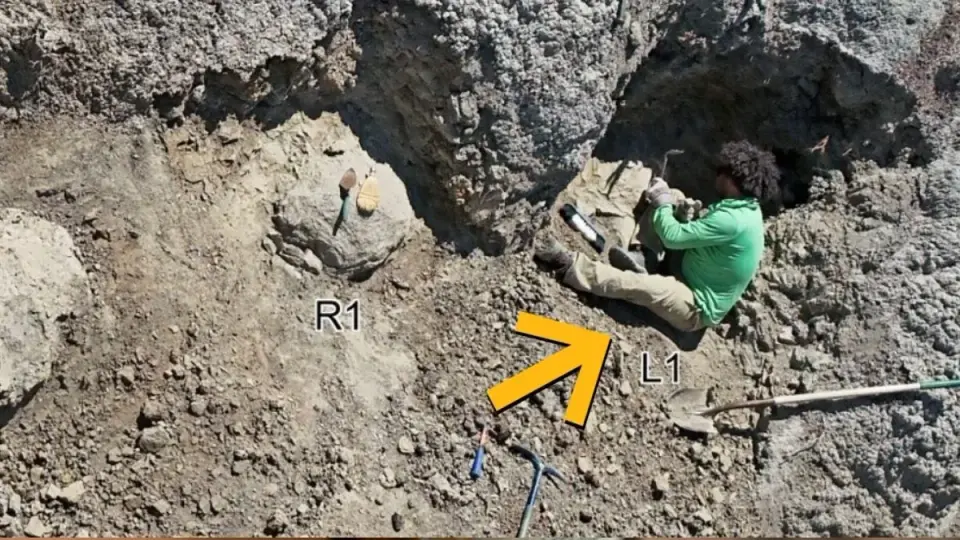
Researchers have confirmed the first known trackway of an adult Tyrannosaurus rex, discovered in 2025 in North Dakota. The 23-foot sequence of four footprints, dated to 66.5 million years ago, indicates the dinosaur was walking at a slow pace of 3.5 to 4.5 mph, offering rare behavioral data.
Key points
- The trackway was found on U.S. Forest Service land near Marmarth, North Dakota, by science teacher Kent Hups in July 2025.
- The four footprints are approximately 3 feet long and 2.6 feet wide, with a stride length of about 13 feet.
- Analysis suggests the animal was walking at 3.5 to 4.5 mph, a pace comparable to a brisk human walk.
- The prints are dated to 66.5 million years ago, near the end of the Cretaceous period.
- Three of the footprints are scheduled to be airlifted to the Denver Museum of Nature & Science for preservation.
Background
This discovery follows a series of recent paleontological findings regarding T. rex, including evidence of small, cat-sized hatchlings and evolutionary explanations for its limb structure. While skeletal remains are common, trackways are rare because they require specific preservation conditions and are easily destroyed by other animals. Previous isolated T. rex footprints were found in New Mexico and Montana, but this is the first confirmed sequence showing movement.
How outlets are covering it
ScienceAlert emphasizes the rarity of the find, noting that 'footprints capture a moment of behavior' unlike bones. CBS News highlights the logistical details, such as the 3D scanning by Denver Museum researchers and the remote analysis by lead author Peter Falkingham in England. Space Daily focuses on the biomechanical implications, contrasting the slow walking speed with previous debates about T. rex's locomotion. Good News Network provides a general overview but lacks specific scientific details compared to the other outlets.
Why it matters
This trackway provides the first direct evidence of adult T. rex locomotion, confirming that the animal walked at a slow, efficient pace rather than running. It offers a unique behavioral snapshot from the final moments of the Cretaceous period, just before the asteroid impact that ended the non-avian dinosaurs.
What to watch
Three of the four footprints will be airlifted to the Denver Museum of Nature & Science this fall. Further excavation is unlikely due to the steep 'gumbo' butte overburden at the site, but the 3D scans and digital models will allow for continued study and visualization.
- Scientists Find First Adult T. Rex Trackway – And The Footprints Are Human-Sized ScienceAlert
- First-ever adult Tyrannosaurus rex trackway discovered in North Dakota badlands CBS News
- How an Unlikely Fossil Hunter Found a Tyrannosaurus Trail National Geographic
- Four giant three-toed prints found in 2025 near Marmarth, North Dakota turned out to be the first trackway ever attributed to an adult T. rex, and the 66.5-million-year-old sequence records a 13-foot stride — the predator was strolling at 3.5 to 4.5 mph, about the Space Daily
- Massive Footprints Reveal First Ever Adult T Rex Trackway, a 66-Million-Year-old Walk Through North Dakota Good News Network
Want the full story? Read the original reporting
Read on ScienceAlert