
First Adult T. rex Trackway Found in North Dakota, Revealing a Slow, 66.5-Million-Year-Old Walk
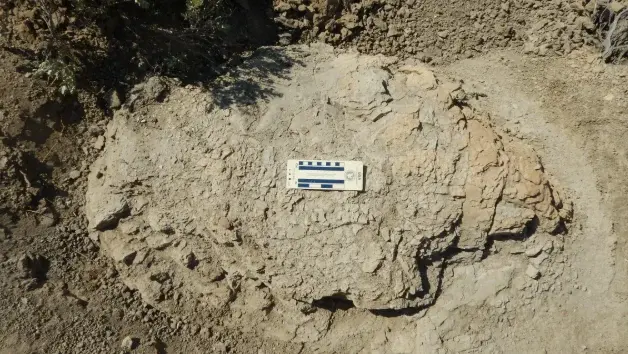
Paleontologists have identified the first known trackway of a full-grown Tyrannosaurus rex in the Hell Creek Formation of southwestern North Dakota. Discovered in 2025 near Marmarth, the 23-foot sequence consists of four three-toed footprints dating to 66.5 million years ago. Analysis indicates the animal walked at 3.5 to 4.5 mph, providing the first direct behavioral evidence of adult T. rex locomotion.
Key points
- The trackway, found on U.S. Forest Service land near Marmarth, consists of four footprints, each approximately 3 feet long, with a stride of about 13 feet.
- Researchers estimate the animal moved at 3.5 to 4.5 mph, a pace consistent with a brisk human walk, despite the animal weighing over seven tons.
- The discovery was made in 2025 by Kent Hups, a high school teacher and volunteer, during a dig led by the Denver Museum of Nature & Science.
- Three of the four footprints are scheduled to be airlifted by helicopter to the Denver Museum of Nature & Science this fall.
- The findings were published in the Journal of Vertebrate Paleontology, with lead author Peter Falkingham analyzing 3D scans without visiting the site in person.
Background
Prior to this discovery, only two isolated adult T. rex footprints had been confirmed globally, one in New Mexico and one in Montana, neither of which provided data on movement. Other tyrannosaur trackways found in Canada and Wyoming were attributed to juveniles or smaller related species. The current find complements the 2022 discovery of a juvenile T. rex specimen nicknamed 'Teen Rex' in the same badlands, offering a rare behavioral snapshot from the final moments of the Cretaceous period.
How outlets are covering it
All sources agree on the core facts: the trackway is the first of its kind for an adult T. rex, located in North Dakota, and dates to 66.5 million years ago. KOCO and The Guardian emphasize the discovery by a volunteer teacher, highlighting the role of amateur paleontology. Space Daily focuses on the biomechanical implications, noting that the slow pace confirms long-debated theories about T. rex locomotion, contrasting with the 'running predator' image popularized by media. Sci.news provides technical detail on the preservation method, noting the prints are hardened sandstone casts with limited fine anatomical detail due to weathering. The outlets differ in emphasis: KOCO and The Guardian highlight the human element and museum logistics, while Space Daily and Sci.news focus on the scientific significance of the gait and preservation challenges.
Why it matters
This discovery provides the first direct evidence of how an adult T. rex moved, resolving long-standing debates about its locomotion. It confirms that the animal walked at a moderate pace, supporting biomechanical models that suggest running would have been inefficient for such a large predator. The find also underscores the importance of amateur paleontology and the value of 3D scanning technology in preserving and analyzing fragile fossil sites.
What to watch
Three of the four footprints will be airlifted to the Denver Museum of Nature & Science for further study and display. Researchers will continue to analyze the 3D scans to refine estimates of the animal's speed and gait. The discovery may prompt further surveys of the Hell Creek Formation for additional trackways or related fossils.
- First-ever adult Tyrannosaurus rex trackway discovered in North Dakota badlands KOCO
- One giant step: first known adult T rex footprints found in North Dakota The Guardian
- Four giant three-toed prints found in 2025 near Marmarth, North Dakota turned out to be the first trackway ever attributed to an adult T. rex, and the 66.5-million-year-old sequence records a 13-foot stride — the predator was strolling at 3.5 to 4.5 mph, about the Space Daily
- Paleontologists Discover First-Ever Adult Tyrannosaurus rex Trackway sci.news
- T. Rex Footprints Are a Discovery Newser
Want the full story? Read the original reporting
Read on KOCO