
First adult T. rex trackway reveals a 66-million-year-old stroll at human walking speed
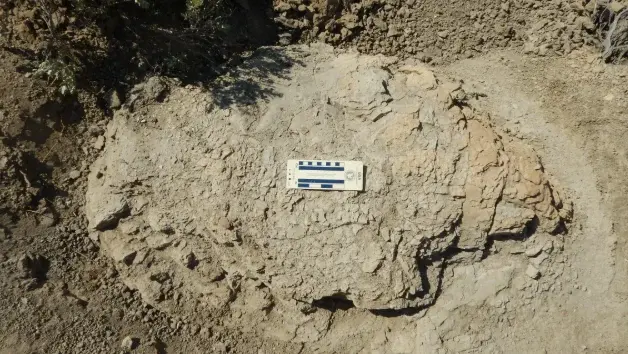
Researchers have identified the first known trackway of a full-grown Tyrannosaurus rex in the Hell Creek Formation of southwestern North Dakota. The 23-foot sequence of four footprints, dating to 66.5 million years ago, indicates the animal was walking at a brisk human pace of 3.5 to 4.5 mph. Discovered in 2025 by a volunteer teacher, the find offers the first direct behavioral evidence of adult T. rex locomotion, complementing previous isolated footprints and skeletal remains.
Key points
- The trackway consists of four three-toed footprints, each approximately 3 feet long, with a stride of about 13 feet.
- The prints were found in 2025 on U.S. Forest Service land near Marmarth, North Dakota, by high school teacher and volunteer Kent Hups.
- Analysis of the stride and footprint size suggests the animal, weighing over seven tons, was walking at 3.5 to 4.5 mph.
- The discovery was published in the Journal of Vertebrate Paleontology, with lead author Peter Falkingham analyzing 3D scans without visiting the site.
- Three of the four footprints are scheduled to be airlifted to the Denver Museum of Nature & Science this fall.
Background
Prior to this discovery, only two isolated adult T. rex footprints had been confirmed globally, one in New Mexico and one in Montana, neither of which provided data on movement. Additionally, a juvenile specimen nicknamed 'Teen Rex' was found in the same North Dakota badlands in 2022. This new trackway provides the first continuous sequence of footprints attributed to an adult, filling a gap in understanding how the species moved in its final moments before the Cretaceous extinction.
How outlets are covering it
All four sources agree on the core facts: the location, the 23-foot length, the 3.5-4.5 mph speed estimate, and the 66.5-million-year age. WESH and The Guardian emphasize the discovery by amateur volunteer Kent Hups and the logistical plan to airlift the prints to Denver. Space Daily highlights the scientific significance of the 'unhurried gait' confirming biomechanical models that T. rex was a walker, not a runner, and notes the remote analysis by Falkingham. Sci.News focuses on the preservation method, noting the prints are hardened sandstone casts with limited fine anatomical detail due to weathering, but sufficient for size and stride analysis.
Why it matters
This discovery provides the first direct evidence of adult T. rex behavior, moving beyond skeletal reconstruction to actual locomotion data. It confirms that the apex predator moved at a relaxed, human-like walking pace, resolving long-standing debates about its speed and efficiency. The find also underscores the value of amateur contributions to paleontology and the potential of 3D scanning to analyze fragile or remote fossil sites without physical extraction.
What to watch
Three of the four footprints will be recovered by helicopter this fall and transported to the Denver Museum of Nature & Science for further study and display. Researchers will continue to analyze the 3D scans to refine estimates of the animal's gait and behavior, potentially offering new insights into the biomechanics of large theropods.
- First-ever adult Tyrannosaurus rex trackway discovered in North Dakota badlands WESH
- One giant step: first known adult T rex footprints found in North Dakota The Guardian
- Four giant three-toed prints found in 2025 near Marmarth, North Dakota turned out to be the first trackway ever attributed to an adult T. rex, and the 66.5-million-year-old sequence records a 13-foot stride — the predator was strolling at 3.5 to 4.5 mph, about the Space Daily
- Paleontologists Discover First-Ever Adult Tyrannosaurus rex Trackway Sci.News
- T. Rex Footprints Are a Discovery newser.com
Want the full story? Read the original reporting
Read on WESH