
Mars Volcano Alba Mons Shows Signs of Active Magma via Hydrogen Chloride Gas
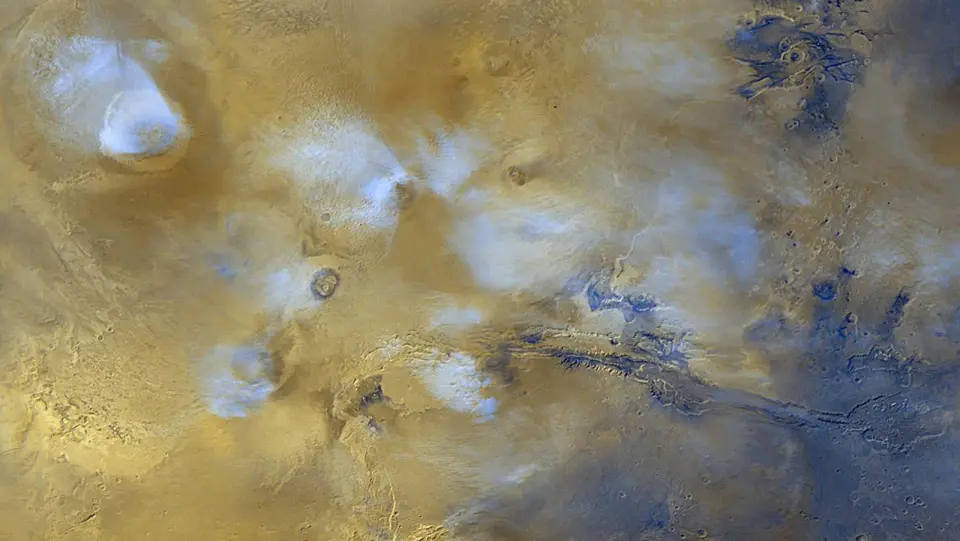
A new study published in Science Advances suggests that Mars may still possess active magma beneath its surface. European Space Agency data from the ExoMars Trace Gas Orbiter detected unexpected bursts of hydrogen chloride gas near the Alba Mons volcano. This finding supports the hypothesis that Mars is not geologically dead but may host subsurface environments similar to Earth's hydrothermal vents, potentially offering conditions suitable for microbial life.
Key points
- The ExoMars Trace Gas Orbiter detected hydrogen chloride gas in the Martian atmosphere near the Alba Mons volcano, the largest volcano on Mars by surface area.
- The gas emissions were observed in the northern hemisphere during winter, a period when such activity is not expected from seasonal ice sublimation, suggesting a subsurface volcanic source.
- The study, published in Science Advances on November 4, 2026, provides complementary evidence to previous seismic data from NASA's InSight lander, which detected marsquakes indicating fluid movement.
- Researchers identified specific fissures on the northern flank of Alba Mons, approximately 100 meters long, which may serve as vents for gas escaping from underlying magma.
- While not definitive proof of current eruptions, the findings suggest Mars may retain enough internal heat to support dormant volcanism and potentially habitable hydrothermal environments.
Background
This discovery follows earlier seismic evidence from NASA's InSight lander, which detected marsquakes in 2018 suggesting fluid movement beneath the surface. It also relates to the ongoing debate about Mars's geological activity, with some lava flows appearing to be only a few million years old. The canceled Mars Sample Return program has left questions about retrieving potential biosignatures, making atmospheric and orbital evidence increasingly important for understanding Mars's habitability.
How outlets are covering it
Live Science emphasizes the potential for life-friendly environments similar to Earth's hydrothermal vents, highlighting the complementary nature of the atmospheric and seismic evidence. National Geographic focuses on the 'stinky' nature of hydrogen chloride and the ongoing debate about whether the gas originates from magma or other chemical processes, noting that the evidence is not definitive. BBC Sky at Night Magazine stresses the significance of the discovery for the search for Martian life, suggesting that active hydrothermal systems could shield microorganisms from the harsh surface environment. All sources agree that while the evidence is promising, it remains a hypothesis requiring further confirmation.
Why it matters
The detection of hydrogen chloride gas near Alba Mons provides the strongest evidence yet for ongoing volcanic activity on Mars. If confirmed, this could indicate that Mars still has subsurface environments capable of supporting microbial life, similar to hydrothermal vents on Earth. This finding has significant implications for astrobiology and future Mars exploration missions, potentially guiding the search for biosignatures in specific regions. It also challenges the assumption that Mars is geologically dead, suggesting that the planet may still have active internal processes.
What to watch
Further research is needed to confirm the volcanic origin of the hydrogen chloride gas. Scientists plan to conduct targeted measurements during specific seasons to verify the gas emissions. Future missions may focus on the Alba Mons region to investigate the fissures and potential hydrothermal systems. The findings could influence the design of future Mars exploration missions, particularly those aimed at searching for signs of life.
- Mars may host an environment similar to hydrothermal vents on Earth, where life first arose Live Science
- Something Weird is Seeping Out of Mars National Geographic
- European orbiter detects fresh hints of volcanic activity on Mars Phys.org
- Pungent gas above Martian fissures hints at ongoing volcanism Reuters
- Mars volcano images show signs of activity – new detection could be a huge clue in the search for Martian life BBC Sky at Night Magazine
Want the full story? Read the original reporting
Read on Live Science