
First Adult T. rex Trackway Found in North Dakota Confirms Slow Walking Pace
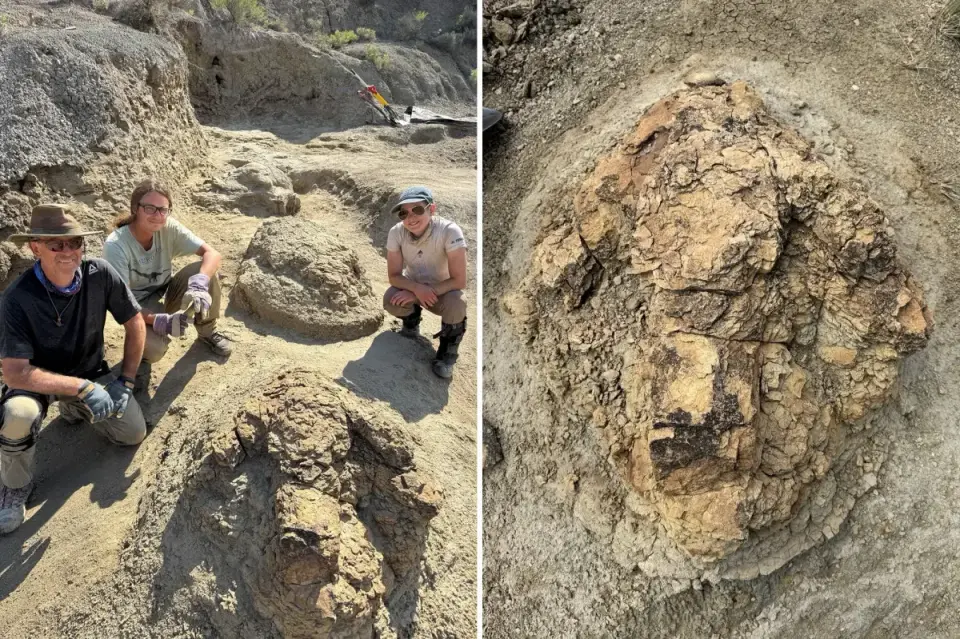
Researchers have confirmed the first known trackway of an adult Tyrannosaurus rex, discovered in North Dakota's Hell Creek Formation. The 23-foot sequence of four footprints, dating to 66.5 million years ago, indicates the predator was walking at a brisk human pace of 3.5 to 4.5 mph. Found by a schoolteacher, the fossils are being airlifted to the Denver Museum of Nature & Science for study.
Key points
- The trackway consists of four three-toed footprints, two left and two right, spanning 23 feet with a 13-foot stride.
- The prints were found in 2025 on U.S. Forest Service land near Marmarth, North Dakota, by Colorado schoolteacher Kent Hups.
- Analysis suggests the animal moved at 3.5 to 4.5 mph, supporting biomechanical models that T. rex preferred walking over running.
- Three of the prints are scheduled to be airlifted by helicopter to the Denver Museum of Nature & Science this fall.
- The discovery was published in the Journal of Vertebrate Paleontology by researchers from Denver and Liverpool John Moores University.
Background
Prior to this discovery, paleontologists had only found isolated T. rex footprints or tracks from juveniles and related species. While bones provided anatomical data, they could not confirm locomotion behavior. This find offers the first direct evidence of an adult T. rex's movement, resolving long-standing debates about whether the dinosaur ran or walked.
How outlets are covering it
The New York Post emphasizes the rarity of the find and the role of the schoolteacher who discovered it. Space Daily highlights the scientific significance of the walking speed, noting that the 3.5 to 4.5 mph pace aligns with biomechanical predictions and contradicts the 'running' hypothesis. The Guardian focuses on the international collaboration between U.S. and U.K. researchers and the use of 3D scanning technology. All sources agree on the basic facts but differ in emphasis: Post on the discovery story, Space Daily on the locomotion science, and Guardian on the technical methodology.
Why it matters
This discovery provides the first direct behavioral evidence of an adult T. rex, confirming that the apex predator likely walked rather than ran. It validates decades of biomechanical modeling and offers a rare glimpse into the daily life of a dinosaur just before the mass extinction event 66 million years ago.
What to watch
Three of the four footprints will be recovered by helicopter and transported to the Denver Museum of Nature & Science for further study and display. Researchers will continue analyzing the 3D scans to refine estimates of the animal's speed and gait.
- US archaeologists unearth first footprints of running T-Rex: ‘Incredibly rare’ New York Post
- How an Unlikely Fossil Hunter Found a Tyrannosaurus Trail National Geographic
- Four giant three-toed prints found in 2025 near Marmarth, North Dakota turned out to be the first trackway ever attributed to an adult T. rex, and the 66.5-million-year-old sequence records a 13-foot stride — the predator was strolling at 3.5 to 4.5 mph, about the Space Daily
- Massive Footprints Reveal First Ever Adult T Rex Trackway, a 66-Million-Year-old Walk Through North Dakota Good News Network
- One giant step: first known adult T rex footprints found in North Dakota The Guardian
Want the full story? Read the original reporting
Read on New York Post