
Hubble Reveals Evolving Ten-Sided Storm at Saturn's South Pole
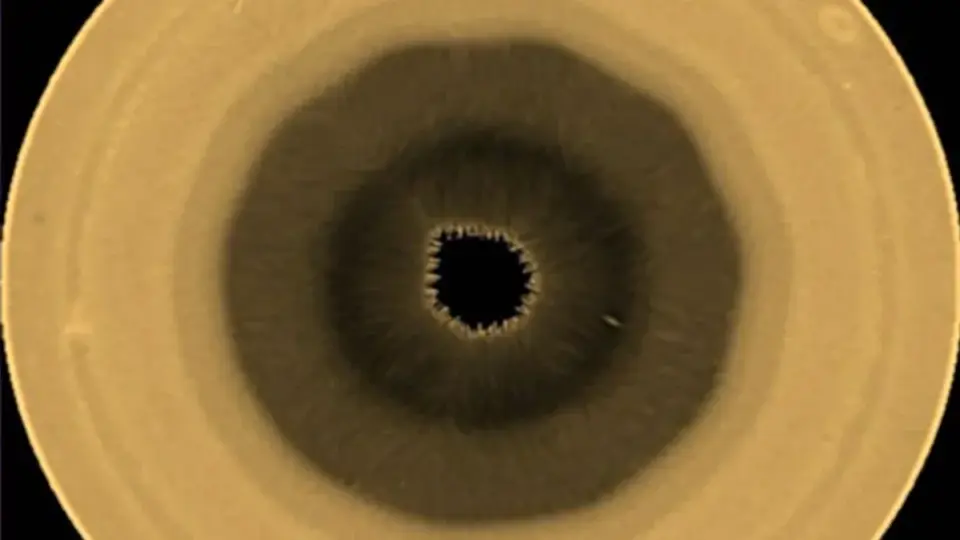
Astronomers have identified a new, ten-sided storm pattern at Saturn's south pole, mirroring the long-standing hexagonal vortex at the north pole. Unlike the stable northern feature, this southern decagon appears to be a transient, evolving wave that has grown significantly between 2023 and 2025. The discovery, detailed in a recent paper, suggests that planetary storms can form through different dynamical mechanisms, offering fresh insights into atmospheric behavior on gas giants.
Key points
- Hubble Space Telescope images captured a growing decagonal (10-sided) wave structure around Saturn's south pole, first noticed in October 2023 and fully developed by 2025.
- The southern storm contrasts with the north pole's hexagon, which has remained stable for over 40 years since its initial observation by Voyager in 1980.
- The decagon's vertices shift back and forth on a 32-day cycle, indicating it is likely a meandering atmospheric wave rather than a rigid structure.
- Researchers used shallow-water model simulations to suggest the shape may have emerged from repeating disturbances along a jet stream or a nearby counterclockwise-rotating vortex.
- The southern hemisphere was not visible from Earth until 2023 due to Saturn's axial tilt, delaying the discovery of this feature for decades.
Background
Saturn's north pole hexagon has been a subject of scientific curiosity since Voyager's 1980 flyby, with Cassini later providing detailed views of its 20,000 to 25,000-mile width. While scientists expected a similar stable wave in the southern hemisphere, none was detected until the southern pole became visible from Earth in 2023. This new finding adds to broader planetary science efforts, such as recent JWST observations of shared molecular features on Titan and Pluto, to understand atmospheric and surface dynamics across the solar system.
Why it matters
The discovery of a transient, evolving decagonal storm at Saturn's south pole challenges the assumption that polar vortices on gas giants are always stable and long-lived. It highlights the dynamic nature of planetary atmospheres and provides a new case study for how storms form and dissipate, potentially improving models of atmospheric dynamics on other worlds.
What to watch
Researchers plan to continue monitoring the southern decagon to determine if it is a temporary phenomenon or if it will stabilize over time. Future observations may also help clarify whether the storm is driven by a nearby vortex or repeating jet stream disturbances, offering deeper insights into the mechanisms governing planetary weather.
Want the full story? Read the original reporting
Read on Gizmodo