
Saudi Arabia Stone Points Hint at 125,000-Year-Old Poisoned Weapons
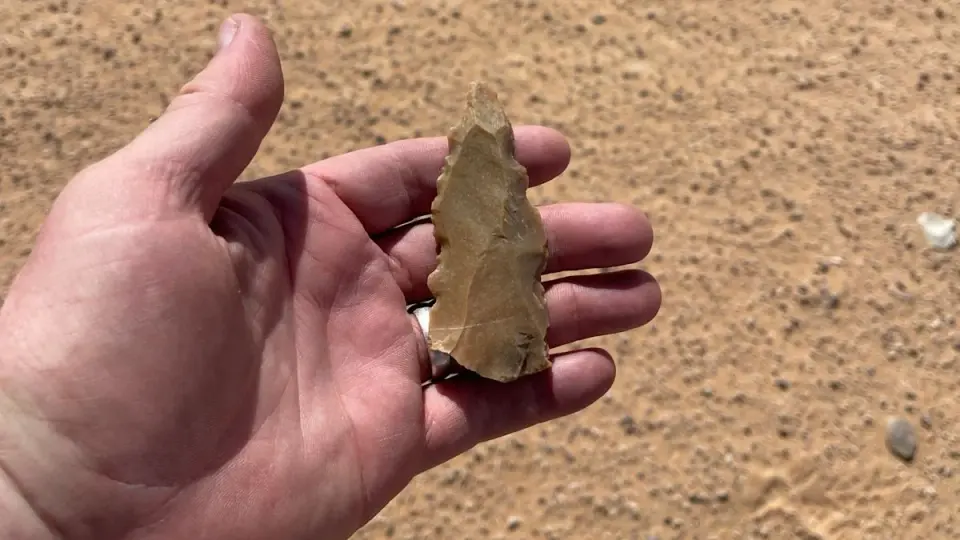
Researchers discovered over 5,500 stone artifacts at the 125,000-year-old site of 'Uruq Aljelibah in southern Saudi Arabia. Chemical analysis reveals residues from the arrow poison tree, Acokanthera schimperi, on several stone points. These findings suggest early humans used complex, composite hunting weapons to target large animals like hippos and buffalo. The discovery predates similar findings in South Africa by 65,000 years and indicates sophisticated toolmaking in an ancient lakeshore environment.
Key points
- The site, located in the Empty Quarter, was once a 130-square-mile freshwater lake supporting diverse fauna including hippos and buffalo.
- Stone points show impact damage and microscopic animal tissue, confirming their use in hunting large game.
- Chemical traces of Acokanthera schimperi, a plant used historically for its toxins, were found on the stone points.
- The artifacts were found clustered near animal bones, suggesting the lakeshore was a focal point for hunting and processing game.
- The site dates to 125,000 years ago, but the tools themselves were collected from the surface, making the date a maximum age rather than a precise measurement.
Background
Previous discoveries in South Africa identified poisoned arrowheads dating to around 60,000 years ago. This new finding in Saudi Arabia predates those by 65,000 years. The Arabian Peninsula is known as a migration corridor for Homo sapiens, and wetter climatic periods in the past likely facilitated human movement and settlement in the region.
How outlets are covering it
While all sources agree on the discovery of stone points with poison residues, they differ in their emphasis. Yahoo News and Smithsonian Magazine highlight the potential for these to be the world's oldest poisoned weapons, noting the significant age gap compared to South African finds. Archaeology News Online Magazine provides a more cautious perspective, emphasizing that the tools were collected from the surface and thus only have a maximum age. Additionally, while Yahoo News and Smithsonian Magazine focus on the sophistication of the tools, Archaeology News Online Magazine notes the uncertainty regarding how hunters avoided poisoning themselves when consuming the game.
Why it matters
This discovery challenges the assumption that early humans in the Arabian Peninsula were merely passing through the region. It suggests that they settled in and exploited the environment in sophisticated ways, using a range of technologies and resources. The findings also highlight the importance of preserving organic materials in archaeological sites, as they provide a more complete picture of ancient technological systems.
What to watch
Researchers plan to return to the site to find more fossils, including human remains, and to push chemical and functional analyses further to determine exactly which substances were used and how they were prepared. Future research may also focus on finding stone artifacts sealed in lake beds to provide more precise dating.
- 125,000-year-old stone points discovered in Saudi Arabia may be world’s oldest poisoned weapons Yahoo
- When the Saudi desert was green: A 125,000-year-old lakeside reveals how early humans lived Phys.org
- Ancient Humans May Have Hunted Hippos With Poisoned Spear Tips on the Arabian Peninsula 125,000 Years Ago Smithsonian Magazine
- A Lost World of Hippos and Ancient Humans Emerges From the Arabian Desert SciTechDaily
- 125,000-year-old poisoned stone points found beside an ancient lake in the Saudi Arabian desert Archaeology News Online Magazine
Want the full story? Read the original reporting
Read on Yahoo