Tag

Paleolithic

All articles tagged with #paleolithic

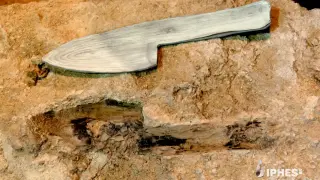
Half-a-million-year-old timber reveals earliest deliberate woodwork at Kalambo Falls
science8 days ago

Half-a-million-year-old timber reveals earliest deliberate woodwork at Kalambo Falls

Luminescence dating of the sediment at Kalambo Falls (Zambia) places a paired timber fragment, once thought to be driftwood, at least 476,000 years old, showing that early humans deliberately shaped and joined wood—perhaps for a platform or walkway—though the full structure and responsible hominin species remain unknown.

Tiny ivory birds illuminate Ice Age artistry in a German cave
archaeology29 days ago

Tiny ivory birds illuminate Ice Age artistry in a German cave

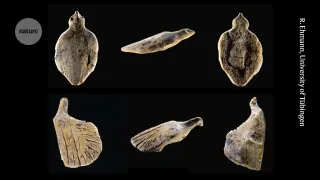
Archaeologists in Germany’s Hohle Fels cave uncovered two thumbnail-sized bird figurines carved from mammoth ivory dating to about 40,000 years ago, bringing the site’s total bird carvings to three. One bird appears brooding on the ground, the other with spread wings, suggesting careful observation of nature and skilled miniaturist ivory carving by Aurignacian people. The carvings reinforce that early modern humans in Europe engaged in art and symbolic expression; the artifacts are on display at the Museum of Prehistory and Ice Age Art in Blaubeuren through April 4, 2027.

Tiny ivory birds illuminate the cognitive leap behind Ice Age Europe’s expansion
science1 month ago

Tiny ivory birds illuminate the cognitive leap behind Ice Age Europe’s expansion

Archaeologists at Hohle Fels Cave in Germany uncovered 40,000-year-old mammoth-ivory bird figurines and vulture-bone flute fragments, joining the Venus of Hohle Fels and Lion Man as evidence of Aurignacian artistry; the craftsmanship and symbolism suggest cognitive and cultural advances that may have helped early Homo sapiens flourish across Ice Age Europe, with sediment DNA tests planned to explore the drivers of this artistic flowering.

Lower cancer rates in poorer nations spark a debate over Western diets
health1 month ago

Lower cancer rates in poorer nations spark a debate over Western diets

A LADbible feature relays a Diary of a CEO discussion with Thomas Seyfried and Steven Bartlett, arguing that traditional, less-processed lifestyles in poorer countries may explain their very low cancer rates, while affluent nations’ diet and exposure to ultra-processed foods and carcinogens could drive higher cancer risk; the piece emphasizes staying away from a 'red zone' processed-food pattern and favoring natural, plant-based options.

400,000-year-old cave finds trace complex pre-human life in Israel
science2 months ago

400,000-year-old cave finds trace complex pre-human life in Israel

Archaeologists near Fureidis, northern Israel, uncovered a cave with Acheulo-Yabrudian tools and animal bones dating to about 400,000 years ago, suggesting large groups of hominins hunted and used fire there and indicating a complex, rich camp life that predates Neanderthals and modern humans. The site is of global importance, and researchers plan extensive, multi-year studies, though no human remains have yet been found.

science-and-archaeology2 months ago

Ancient DNA Surfaces on Cave Walls, Illuminating Ice Age Humans

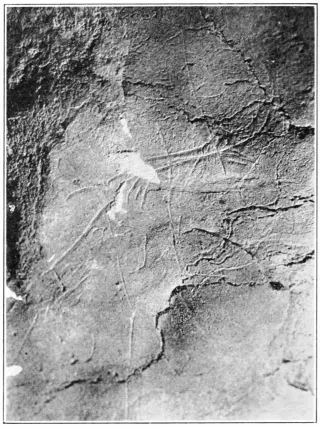
Researchers analyzing cave-wall samples from Altamira, Escoural, and Covarrón found ancient human DNA preserved on pigment crusts and even unpigmented areas. Of 54 samples, five yielded authentic mitochondrial DNA (three women, one man, one unidentified), with some nuclear DNA linking individuals to Western Hunter-Gatherers. Preservation was rare (1 of 24 panels), suggesting cave walls can archive genetic traces of prehistoric visitors and offering a new, noninvasive way to study who touched the walls and how far Ice Age people ventured.

125,000-Year-Old Neanderthal Bone-Grease Factory Found in Germany
archaeology5 months ago

125,000-Year-Old Neanderthal Bone-Grease Factory Found in Germany

Researchers at Neumark-Nord, Germany, uncovered a multi-step Neanderthal bone-grease operation dating to about 125,000 years ago, including breaking bones, grinding fragments, and boiling them to render fat from at least 172 mammals. The site suggests deliberate, landscape-scale resource management with caching and transport of carcass parts, revealing advanced subsistence planning well before modern industry.

German Cave Symbols Suggest Writing Existed 40,000 Years Ago
archaeology6 months ago

German Cave Symbols Suggest Writing Existed 40,000 Years Ago

New findings from Germany’s Swabian Jura uncover 40,000-year-old engraved symbol sequences on Paleolithic figurines and tools. The signs are highly repetitive and show information density similar to early proto-cuneiform, implying an early, non-language form of symbolic communication that predates formal writing by tens of thousands of years, challenging views on the linear rise of writing.

Ancient Aurignacian Marks Hint at a 40,000-Year-Old Pre-Writing System
science6 months ago

Ancient Aurignacian Marks Hint at a 40,000-Year-Old Pre-Writing System

A statistical study of 260 Aurignacian artifacts (43,000–34,000 years ago) identified over 3,000 marks arranged in deliberate, repeatable sequences with object-type–dependent patterns. The information-density patterns remained stable for about 10,000 years, suggesting a shared symbolic system used to store and organize information—an early precursor to writing, but not a direct representation of spoken language like protocuneiform. Researchers emphasize the exact meanings are unknown, yet the work implies complex symbolic communication by early hunter-gatherers long before true writing emerged.

430,000-year-old wooden tools unearthed at Greek lake site
science7 months ago

430,000-year-old wooden tools unearthed at Greek lake site

Two artifacts found at a lake shore in Greece have been identified as the oldest wooden tools uncovered to date, dating to about 430,000 years ago. One is a roughly 80-centimeter digging stick, while the other is a smaller handheld piece of willow or poplar wood that may have been used to shape stone tools. The tools come from a wet, well-preserved context in the Megalopolis basin, and although the exact users aren’t known, they could have been Neanderthals or other early human ancestors. Wood tools are rarely preserved, making this discovery a rare glimpse into early technology, with more finds expected at the site.

Ancient elephant-bone retoucher reveals 480,000-year-old European toolmaking prowess
science7 months ago

Ancient elephant-bone retoucher reveals 480,000-year-old European toolmaking prowess

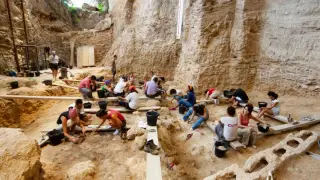
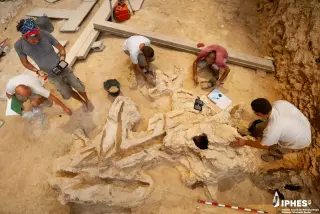
A 4.3 by 2.3 inch elephant bone tool from Boxgrove, in southern England, has been identified as a retoucher used to knap and sharpen lithic hand axes about 480,000 years ago. This makes it the oldest known elephant-bone tool found in Europe and highlights early humans’ sophisticated material knowledge and craftsmanship, likely belonging to Homo heidelbergensis or early Neanderthals.