
White Dwarf HS 0209+0832 Accretes 'Second-Generation' Planet Formed from Stellar Ashes
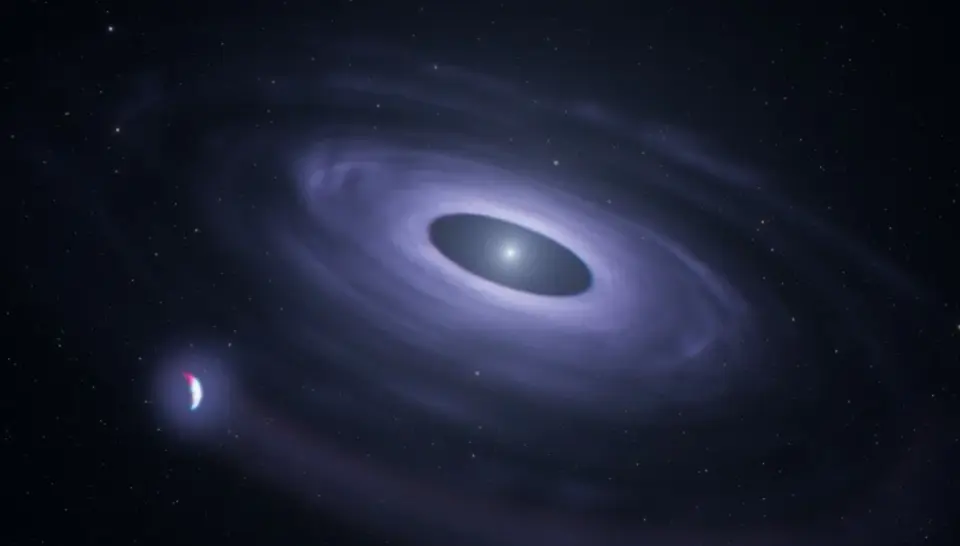
Astronomers have identified a white dwarf, HS 0209+0832, that is accreting material from a 'second-generation' planet. This planet formed not from the original protoplanetary disk, but from the ejected envelope of the star's red giant phase. The composition of the accreted material, rich in s-process elements like niobium and depleted in rock-forming elements, confirms this unique origin.
Key points
- The white dwarf HS 0209+0832 has an effective temperature of approximately 35,800 K and a cooling age of about 5 million years.
- Its atmosphere is enriched in trans-iron elements such as zinc, copper, and niobium, but depleted in silicon and iron, which are typical of rocky bodies.
- The high abundance of s-process elements, particularly niobium, indicates the material originated from the asymptotic giant branch (AGB) wind of the progenitor star.
- TESS data reveals a sinusoidal photometric period of 4.399 days, suggesting a close-in giant planet is evaporating and feeding material to the white dwarf.
- This is the first confirmed instance of a second-generation planet orbiting a white dwarf, distinct from first-generation planets formed in the original protoplanetary disk.
Background
Recent studies have highlighted the dynamic nature of stellar evolution, including simulations suggesting the Sun's red giant phase could destabilize the outer solar system within a billion years. Additionally, research on Earth's formation has emphasized the role of local material in the inner solar system, contrasting with the exotic, recycled material found in this new discovery.
How outlets are covering it
The primary source, The Register, highlights the novelty of the 'new matter recipe' and the formation after a red giant phase. The Nature article provides the detailed scientific analysis, confirming the chemical signatures of s-process elements and the mechanism of photo-evaporation. CNN frames the discovery as a planet born from a 'dead star's ashes,' emphasizing the dramatic nature of the origin. Space.com describes the finding as 'completely unexpected,' focusing on the surprise of a planet forming from stellar ejecta rather than a traditional disk.
Why it matters
This discovery expands our understanding of planetary formation by demonstrating that planets can form from the recycled material of a dying star, not just from the original protoplanetary disk. It provides a new class of exoplanets to study and offers insights into the nucleosynthesis processes occurring in asymptotic giant branch stars.
What to watch
Researchers plan to identify more second-generation planet candidates by observing high carbon abundances and s-process element enhancements in the ultraviolet spectra of other hot white dwarfs. This will help establish a larger sample to study the formation and evolution of these unique planetary systems.
- Scientists find planet made on new matter recipe, and it formed after a Red Giant ate a solar system The Register
- Discovery of a second-generation planet candidate accreting onto a white dwarf Nature
- ‘Phoenix planet’ may have formed from a dead star’s ashes CNN
- 'Completely unexpected' Phoenix planet was born from the ashes of a dying star Space
- Dead star likely birthed a new planet, in astronomical first Popular Science
Want the full story? Read the original reporting
Read on The Register