Tag

Nucleosynthesis

All articles tagged with #nucleosynthesis

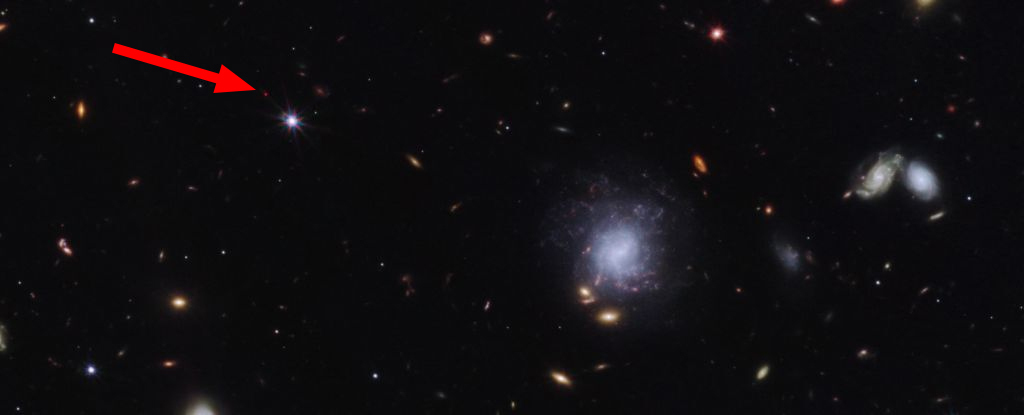
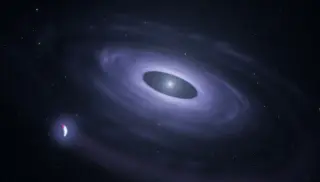
White Dwarf HS 0209+0832 Accretes 'Second-Generation' Planet Formed from Stellar Ashes
science3 days ago

White Dwarf HS 0209+0832 Accretes 'Second-Generation' Planet Formed from Stellar Ashes

Astronomers have identified a white dwarf, HS 0209+0832, that is accreting material from a 'second-generation' planet. This planet formed not from the original protoplanetary disk, but from the ejected envelope of the star's red giant phase. The composition of the accreted material, rich in s-process elements like niobium and depleted in rock-forming elements, confirms this unique origin.
First 'Second-Generation' Planet Found Orbiting a White Dwarf
science3 days ago

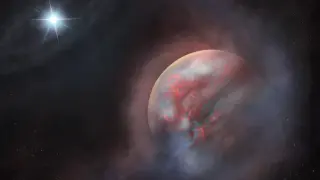
First 'Second-Generation' Planet Found Orbiting a White Dwarf

Astronomers have identified the first known 'second-generation' planet orbiting a white dwarf, a world formed from the ejected material of a dying star rather than the original protoplanetary disk. The discovery, centered on the white dwarf HS 0209+0832, reveals a gas giant whose atmosphere is being stripped by intense radiation, feeding heavy elements back into the star. This finding challenges previous assumptions about planetary formation around stellar remnants and offers a new method to detect similar systems.

White Dwarf Feeds on Planet Born from Stellar Ashes
science4 days ago

White Dwarf Feeds on Planet Born from Stellar Ashes

Astronomers have identified a white dwarf star, HS 0209+0832, that is accreting material from a 'second-generation' planet. This planet likely formed from the ejected envelope of the star’s progenitor after it died, rather than from the original protoplanetary disk. The discovery, published in Nature, marks the first evidence of such post-stellar planetary formation around a white dwarf.

New measurements sharpen how exploding stars forge the universe’s building blocks
science1 month ago

New measurements sharpen how exploding stars forge the universe’s building blocks

Two papers in Physical Review Letters reveal that massive-star explosions forge and spread elements, with titanium-44 production about 35% higher than previously thought and the nickel-copper cycle playing only a small role in Type I X-ray bursts, enabling more accurate models of how stars create and distribute the universe’s building blocks.

Cosmic Gold Rush: How Neutron-Star Collisions Forge the Universe’s Heaviest Element
science2 months ago

Cosmic Gold Rush: How Neutron-Star Collisions Forge the Universe’s Heaviest Element

Astronomers increasingly link most of the universe’s gold to the rapid neutron-capture process in violent neutron‑star mergers, whose kilonovae briefly outshine hundreds of millions of suns. While the 2017 GW170817 event confirmed mergers can produce heavy elements, the exact gold yield is model‑dependent and debated, with some studies suggesting additional stellar explosions also contribute to the Milky Way’s gold inventory.

Ancient Neutron-Star Merger Left a Rain of Radioactive Stardust on Earth
space3 months ago

Ancient Neutron-Star Merger Left a Rain of Radioactive Stardust on Earth

A deep-sea ferromanganese crust study found plutonium-244 and curium-247 patterns inconsistent with recent supernovae, pointing to an ancient r-process event—likely a kilonova from a neutron-star merger over 100 million years ago. The absence of curium-247, alongside iron-60 data, suggests the event predates more recent stellar explosions. Dust from this event has since dispersed through the galaxy, and Earth is still sampling remnants as it moves through space. This helps map the Milky Way’s explosive history and Earth’s heavy-element origins, though it’s unclear whether such ancient events affected life on our planet.

Nuclear Clues Map How Gold Emerges in Cosmic Cataclysms
science7 months ago

Nuclear Clues Map How Gold Emerges in Cosmic Cataclysms

UT nuclear physicists, with CERN ISOLDE data, report three key findings on the rapid neutron-capture (r-process) path that forges gold: (1) first measurement of neutron energies in beta-delayed two-neutron emission, (2) the long-predicted single-particle neutron state in tin-133, and (3) a non-statistical population of that state. Together, these results refine models of heavy-element formation during extreme stellar events and imply the need for new theoretical approaches for exotic nuclei.

"Unraveling the Origins of Cerium in the Universe: A Scientific Investigation"
science2 years ago

"Unraveling the Origins of Cerium in the Universe: A Scientific Investigation"

Scientists at CERN's Neutron Time-of-Flight facility have conducted a study to investigate the production of cerium in stars. Their findings, published in Physical Review Letters, reveal discrepancies between theoretical models and observational data, indicating a need to revise the mechanisms responsible for cerium production in the universe. The study's results have significant astrophysical implications, suggesting a 20% reduction in the contribution of certain processes to the abundance of cerium in the universe and requiring a paradigm shift in the theory of cerium nucleosynthesis.

"James Webb Telescope Discovers Cosmic Gold Forge in Neutron Star Merger"
astronomy2 years ago

"James Webb Telescope Discovers Cosmic Gold Forge in Neutron Star Merger"

The James Webb Space Telescope and Hubble have observed a super-long gamma-ray burst resulting from the collision of two dense neutron stars, producing pure gold and other heavy elements. This discovery challenges conventional understanding of gamma-ray bursts and sheds light on the formation of heavy elements in the universe, providing valuable insights into nucleosynthesis and the origins of the cosmos.

"James Webb Space Telescope Discovers Thrilling Evidence of Neutron Star Mergers Creating Gold in the Cosmos"
astronomy2 years ago

"James Webb Space Telescope Discovers Thrilling Evidence of Neutron Star Mergers Creating Gold in the Cosmos"

The James Webb Space Telescope and Hubble Space Telescope observed a gamma-ray burst (GRB) originating from the collision of two neutron stars, confirming that these mergers create elements like gold. This discovery challenges previous theories about the origins of long GRBs and sheds light on the process of nucleosynthesis, where heavier elements are forged. The research, published in Nature, provides new insights into the cosmic alchemy of neutron star mergers and the creation of heavy elements in the universe.

Unprecedented Explosion: Ancient Giant Star Defies Expectations
astronomy2 years ago

Unprecedented Explosion: Ancient Giant Star Defies Expectations

Astronomers have discovered a strange star in the Milky Way, J0931+0038, with a chemical composition indicating it was formed from the remnants of a massive star that exploded billions of years ago. This contradicts existing theories, as such a massive star should have collapsed into a black hole rather than exploding. The star's composition is rich in elements close to iron, but low in odd-numbered elements, and the abundances of elements heavier than iron are unusually high. This discovery challenges current models of element formation and raises questions about the processes that led to the star's formation.

Unprecedented Discovery: Witnessing Cosmic Nuclear Fission for the First Time
science2 years ago

Unprecedented Discovery: Witnessing Cosmic Nuclear Fission for the First Time

Scientists have discovered the first evidence of nuclear fission occurring among the stars, supporting the theory that when neutron stars collide, they create "superheavy" elements that then undergo nuclear fission to produce elements like gold. This discovery provides insight into the origin of heavy elements in the universe and confirms a theory proposed several years ago. The research also suggests that elements with atomic masses greater than 260 may exist around neutron star collisions.

Unprecedented Discovery: Cosmic Nuclear Fission Witnessed for the First Time
science2 years ago

Unprecedented Discovery: Cosmic Nuclear Fission Witnessed for the First Time

Scientists have discovered the first evidence of nuclear fission occurring among the stars, supporting the theory that when neutron stars collide, they create superheavy elements that then undergo nuclear fission to produce elements like gold. This discovery provides insight into the origin of heavy elements in the universe. The research team found a correlation between light precision metals and rare earth nuclei in stars, confirming the occurrence of nuclear fission. The study suggests that elements with atomic masses greater than 260 may exist around neutron star mergers. This finding confirms a theory proposed several years ago and sheds light on the process of nucleosynthesis in extreme stellar environments.

Unprecedented Discovery: Cosmic Nuclear Fission Witnessed for the First Time
science2 years ago

Unprecedented Discovery: Cosmic Nuclear Fission Witnessed for the First Time

Scientists have discovered the first evidence of nuclear fission occurring among the stars, supporting the theory that when neutron stars collide, they create superheavy elements that then undergo nuclear fission to produce elements like gold. This discovery provides insight into the origin of heavy elements in the universe. The research team found a correlation between light precision metals and rare earth nuclei in stars, confirming the occurrence of nuclear fission. The study suggests that elements with atomic masses greater than 260 may exist around neutron star mergers. This finding confirms a theory proposed several years ago and sheds light on the process of heavy element formation in the cosmos.

"James Webb Space Telescope Discovers Rare Heavy Elements Forged in Cosmic Collision"
astronomy3 years ago

"James Webb Space Telescope Discovers Rare Heavy Elements Forged in Cosmic Collision"

The James Webb Space Telescope (JWST) has observed the aftermath of a kilonova explosion resulting from the collision of two neutron stars, revealing evidence of rare heavy elements such as tellurium, tungsten, and selenium. This discovery confirms that neutron star mergers are a source of heavy elements in the universe. The explosion occurred in intergalactic space, 120,000 light-years from the nearest galaxy, suggesting that the neutron stars were kicked out of their original galaxy by previous supernova explosions. The findings provide valuable insights into the formation of elements and the workings of our universe.