
Hera Spacecraft Reveals Stadium-Sized Crater and Chaotic Tumble on Asteroid Dimorphos
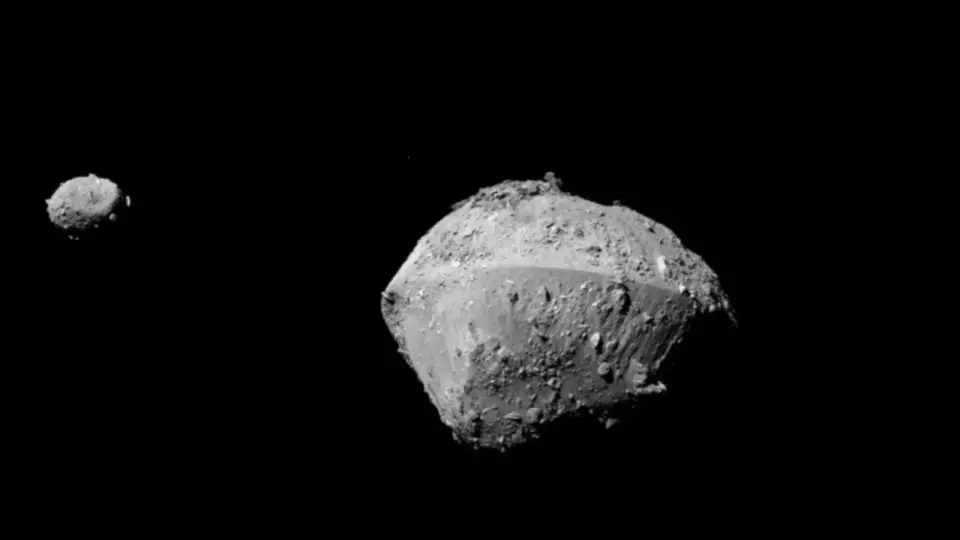
ESA's Hera spacecraft has released the first close-up images of asteroid Dimorphos, revealing a stadium-sized impact crater and chaotic tumbling motion resulting from NASA's 2022 DART collision. The images also show hundreds of previously unknown boulders orbiting the binary asteroid system, providing critical data to refine planetary defense strategies.
Key points
- Hera confirmed that DART's impact flattened one face of Dimorphos into a crater the size of a sports stadium, spanning the asteroid's entire width.
- The impact caused Dimorphos to tumble chaotically in its orbit, a change not previously detected by Earth-based telescopes.
- Hera discovered hundreds of previously unknown boulders, just a few meters in size, now orbiting the Didymos-Dimorphos binary system.
- The non-impacted regions of Dimorphos appear unchanged from 2022, with boulder fields looking identical to pre-impact images.
- Hera is currently in a rectangular orbit at 18.6 miles (30 km) from the asteroids, using thrusters to maintain position while gathering data.
Background
NASA's DART mission intentionally impacted Dimorphos on September 26, 2022, to test planetary defense capabilities. The collision shortened Dimorphos' orbit around Didymos by 33 minutes, exceeding the 73-second success benchmark. ESA's Hera mission launched in October 2024 to investigate the aftermath, arriving at the system in November 2026. Previous archive coverage noted Hera's arrival and initial surveys, but this is the first release of detailed close-up images showing the physical changes to the asteroid's surface.
How outlets are covering it
All sources agree on the key findings: the stadium-sized crater, chaotic tumbling, and new boulders. The Guardian emphasizes the scientific value for future deflection missions, noting that knowing the projectile's mass and velocity allows for precise impact physics studies. BBC highlights the 'Inspector Columbo' analogy, focusing on the investigation of the crash scene. ESA stresses the international collaboration, noting contributions from Japan's JAXA and the goal of transforming a one-off experiment into a reliable defense capability. No significant disagreements were found among the outlets.
Why it matters
These findings validate kinetic impact as a viable planetary defense method. By measuring the mass and structural changes of Dimorphos, scientists can better predict how to deflect potentially hazardous asteroids in the future. The data will help design future missions, such as the 2027 NEO Surveyor telescope and the Ramses mission to asteroid Apophis, ensuring humanity can respond to threats with greater precision and confidence.
What to watch
Hera is scheduled to approach within 13 km of the asteroids in December 2026 for higher-resolution imaging. In January 2027, it will deploy two CubeSats: Juventas, which will use radar to probe Dimorphos' interior and attempt a landing, and Milani, which will prospect asteroid materials. These missions aim to precisely determine Dimorphos' mass, crucial for refining planetary defense models.
- Hera spacecraft gets 1st up-close look at stadium-sized hole punched in asteroid by NASA DART mission Space
- Hera mission images from asteroid crash show stadium-sized crater BBC
- Stadium-sized crater left in asteroid after NASA's planetary protection test Sky News
- Nasa knocked an asteroid off course. New closeup photos shed light on aftermath The Guardian
- Hera reveals stadium-sized asteroid crater from spacecraft impact ESA
Want the full story? Read the original reporting
Read on Space