
Roman Telescope Completes Final Launch Prep Ahead of Aug. 30 Liftoff
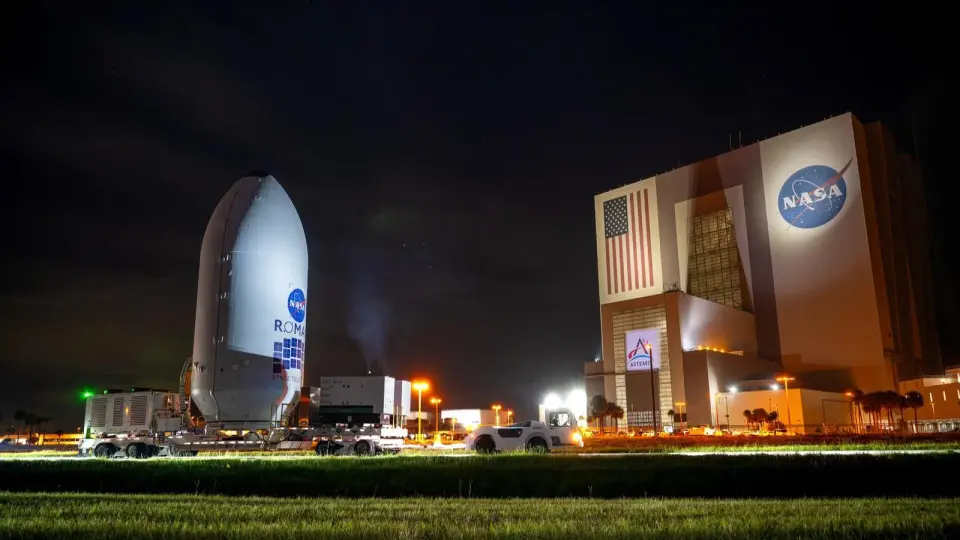
NASA’s Nancy Grace Roman Space Telescope is on track for launch on August 30, 2026, from Kennedy Space Center. The observatory, which features a field of view 100 times larger than Hubble’s, will study dark energy and exoplanets from the Sun-Earth L2 point.
Key points
- The telescope was transported to the SpaceX hangar at Launch Complex 39A on August 25, 2026, and sealed inside the Falcon Heavy payload fairing on August 24.
- Liftoff is scheduled for no earlier than 7:26 a.m. EDT on August 30, with a backup window on August 31.
- After launch, Roman will travel to the Sun-Earth L2 point, approximately 1.5 million kilometers from Earth, arriving in about 30 days.
- The mission has a five-year primary lifetime with a goal of operating for 10 years, and its science data will be publicly available after processing.
- NASA Administrator Jared Isaacman is expected to fly past the launch pad on August 29, followed by prelaunch briefings and a postlaunch news conference.
Background
The Nancy Grace Roman Space Telescope, named for NASA’s first chief astronomer, was completed in 2025 and has undergone final preparations at Kennedy Space Center since July. It is designed to complement Hubble and James Webb Space Telescopes by providing a panoramic view of the sky, surveying over 12% of the night sky compared to Hubble’s 0.1%.
How outlets are covering it
Space.com and NASA emphasize the technical readiness and schedule, noting the successful transport and fairing sealing. WBAL-TV highlights the telescope’s unique capability to capture a larger field of view than previous telescopes, describing it as a 'panoramic lens' that will allow for broader surveys. SpaceX confirms the launch site as Launch Complex 39A at Kennedy Space Center, consistent with NASA’s plans. All sources agree on the August 30 launch date and the telescope’s mission objectives, including studying dark energy and exoplanets.
Why it matters
The launch of the Roman Space Telescope marks a significant advancement in astronomical observation, offering a field of view 100 times larger than Hubble’s. This will enable scientists to survey billions of galaxies, detect exoplanets, and investigate dark energy and dark matter, potentially leading to new discoveries in cosmology and planetary science.
What to watch
A Launch Readiness Review is scheduled for August 28, 2026, to confirm final launch readiness. If successful, liftoff will proceed on August 30. Post-launch, Roman will travel to L2, undergo a three-month checkout, and begin its science operations, with data becoming publicly available after processing.
- Nancy Grace Roman Telescope live updates: NASA readies Roman for launch Space
- NASA Sets Coverage for Roman Space Telescope Launch from Florida NASA (.gov)
- Roman Space Telescope Mission SpaceX
- NASA's Roman Space Telescope will reveal the universe in a way the JWST and Hubble cannot Space
- NASA's soon-to-launch telescope will give the largest view of space ever. Here's how it works WBAL-TV
Want the full story? Read the original reporting
Read on Space