
Roman Telescope Sealed for Launch: NASA Clears Final Hurdles Ahead of Aug. 30 Liftoff
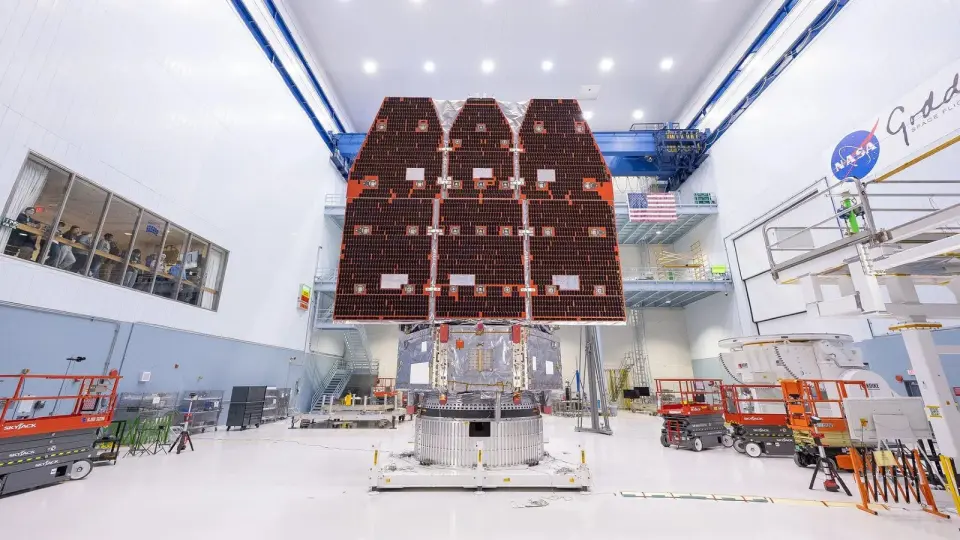
NASA and SpaceX have completed the final Flight Readiness Review for the Nancy Grace Roman Space Telescope, clearing it for launch on August 30. The observatory, encapsulated in a Falcon Heavy fairing, will travel to Launch Complex 39A in Florida. Once deployed at Lagrange Point 2, Roman will survey 100 times more sky than Hubble to map dark matter and detect up to 200,000 exoplanets.
Key points
- SpaceX sealed the Roman telescope inside the Falcon Heavy payload fairing on August 24, following a full dress rehearsal on August 20.
- NASA, SpaceX, and mission managers completed the Flight Readiness Review on August 21, formally certifying the mission for final launch preparations.
- The launch is scheduled for no earlier than 7:26 a.m. EDT on August 30 from Launch Complex 39A at Kennedy Space Center.
- After launch, Roman will take approximately 30 days to reach Lagrange Point 2, located 1.5 million kilometers from Earth, followed by a three-month checkout period.
- The telescope will use a 2.4-meter mirror and a 300-megapixel infrared camera to survey a field of view 100 times larger than Hubble's.
Background
The Nancy Grace Roman Space Telescope, named after NASA's first chief astronomer, was completed in 2025. Previous coverage noted that its development survived funding cuts during the Trump era thanks to Congressional intervention. The mission is designed to complement the James Webb Space Telescope by providing a wide-field survey rather than deep-space imaging, with Japan contributing specific instruments and ground stations for data processing.
How outlets are covering it
Space.com and NASA emphasize the logistical milestones, confirming the fairing sealing and the successful Flight Readiness Review. WIRED focuses on the scientific potential, highlighting that Roman could detect 200,000 new exoplanets and resolve tensions in dark energy measurements, such as those from the DESI instrument. While all sources agree on the August 30 launch window, WIRED notes the telescope's unique capability to detect 'rogue' planets via microlensing, a detail not emphasized in the operational updates from NASA or Space.com.
Why it matters
The launch of the Roman Space Telescope marks a critical step in resolving fundamental cosmological questions. By mapping the distribution of dark matter and measuring the expansion rate of the universe through supernovae, the mission aims to address discrepancies in current models, such as the weakening of dark energy. Its wide-field survey will also provide an unprecedented census of exoplanets, potentially revealing how common Earth-like systems are in the galaxy.
What to watch
The encapsulated telescope will be transported to SpaceX's hangar at Launch Complex 39A, attached to the Falcon Heavy rocket, and rolled out to the pad for launch on August 30. After reaching Lagrange Point 2, the telescope will undergo a three-month checkout before beginning its five-year primary mission of observing the universe.
- Nancy Grace Roman Telescope live updates: NASA readies Roman for launch Space
- Roman Space Telescope Mission SpaceX
- NASA is about to launch a powerful new eye on the universe Science Daily
- Teams Complete Flight Readiness Review for NASA’s Roman Telescope NASA Science (.gov)
- NASA’s New Space Telescope Is Poised to Discover Hidden Facets of the Universe WIRED
Want the full story? Read the original reporting
Read on Space