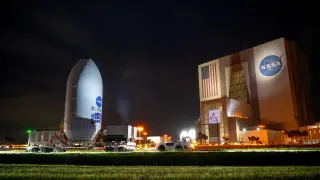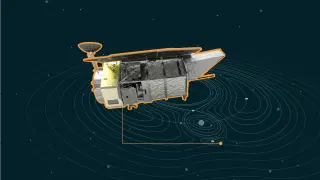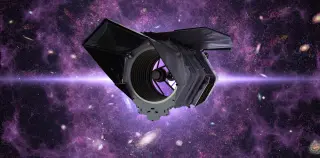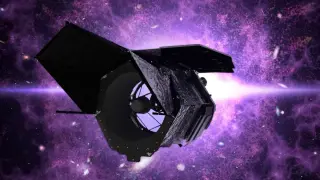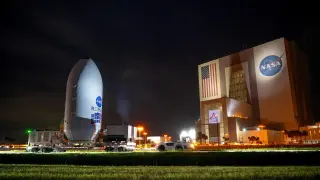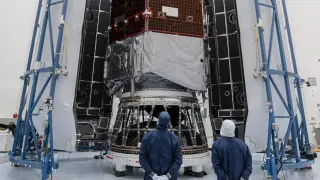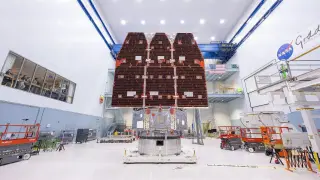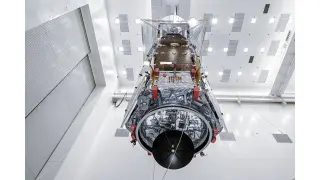
NASA’s Nancy Grace Roman Space Telescope sits in a Kennedy Space Center clean room ahead of its Aug. 30 liftoff; with a field of view at least 100 times larger than Hubble, Roman will study dark matter and dark energy while directly imaging distant exoplanets.
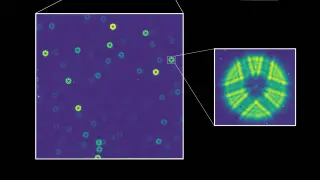
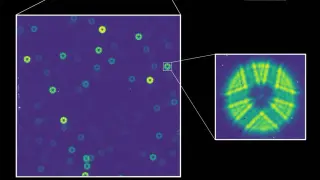
NASA’s Nancy Grace Roman Space Telescope, slated for launch on August 30, 2026, could detect tens to hundreds of thousands of exoplanet signals (roughly 60k–200k transiting planets, with ~100k often cited) via microlensing toward the Galactic bulge and high-cadence transit monitoring, creating a galaxy-wide planetary census rather than a simple list of confirmed worlds. Many detections will be planet candidates needing follow-up; the mission aims to map how planet populations vary with distance from the galactic center and environment, complementing Kepler and other missions. Roman features a 2.4-meter mirror, a wide field of view, a 300-megapixel infrared camera, and will operate from the Sun–Earth L2 point, including a coronagraph demonstration for direct-light studies.
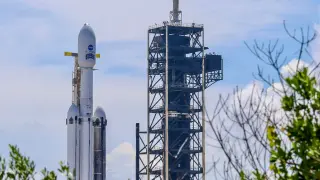
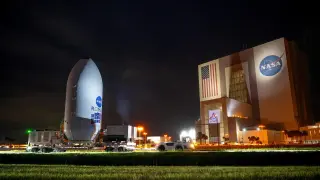
NASA’s Nancy Grace Roman Space Telescope has arrived at Kennedy Space Center, Florida, for final tests before an Aug. 30 liftoff aboard SpaceX’s Falcon Heavy—eight weeks earlier than originally planned. From Goddard, the telescope was shipped on a Pegasus barge to KSC, where it will be unpacked, decontaminated, and moved into the Payload Hazardous Servicing Facility for final checkouts, fueling, and integration in preparation for launch to Sun-Earth L2. The mission, powered by a historical 2.4-meter mirror and a 300-megapixel camera, aims to study dark energy, exoplanets, and other cosmic phenomena, with a nominal five-year primary duration and potential extensions if conditions allow.
NASA's Nancy Grace Roman Space Telescope arrived at Kennedy Space Center for a late-summer launch aboard a SpaceX Falcon Heavy, boasting a field of view 100 times larger than Hubble and aimed at studying dark energy, exoplanets, and up to a billion galaxies.
NASA’s Nancy Grace Roman Space Telescope arrived at Kennedy Space Center aboard the Pegasus barge for a ~70‑day prelaunch campaign at the Payload Hazardous Servicing Facility ahead of an Aug. 30 launch from Launch Complex 39A on a Falcon Heavy. The 43‑foot observatory, designed to operate at L2 about 1.5 million km from Earth with a 300‑megapixel Wide Field Instrument and a chronograph for exoplanets, will survey the universe far faster and wider than Hubble and is expected to last 5–10+ years with propellant after a cooling hiccup en route.
NASA's Nancy Grace Roman Space Telescope is on track for an Aug. 30 launch, promising sky surveys hundreds of times faster than Hubble to map hundreds of millions of stars and billions of galaxies, advance our understanding of dark matter and dark energy, and uncover thousands of exoplanets; first data could arrive within months after launch.
NASA’s Goddard Space Flight Center completed the final inspection of the Nancy Grace Roman Space Telescope’s 2.4-meter primary mirror, confirming no specks, proper coating, and alignment. The ultralow-expansion glass mirror is silver-coated for near-infrared light and is exceptionally smooth; it will be shipped to Kennedy Space Center for an early-September launch, with the sunshade hood deployed and the aperture cover stowed for launch preparations.
NASA has completed assembly and testing of the Nancy Grace Roman Space Telescope, a 300‑megapixel instrument with 18 4K sensors designed to image a sky patch 100 times larger than Hubble’s and observe more infrared light. It could launch as early as September 2026 on a SpaceX rocket, several months ahead of the May 2027 target, and at 42 feet tall it’s the largest telescope built at NASA’s Goddard Space Flight Center. NASA says Roman will accomplish in about a year what Hubble would take around 2,000 years, enabling deep views of hundreds of millions of stars; the project even featured a drone in the clean room to illustrate its scale.
NASA has completed the final integration of the Nancy Grace Roman Space Telescope, a next‑generation observatory designed to image vast swaths of the sky much faster than Hubble. With a 2.4‑meter mirror, a 300‑megapixel Wide Field Instrument and a coronagraph, Roman will survey areas hundreds of times larger, deliver hundreds of terabytes of data per year, and help illuminate dark matter and dark energy while enabling direct imaging of exoplanets. It is scheduled to launch on SpaceX’s Falcon Heavy to the L2 point in September 2026, eight months ahead of schedule and under budget, joining JWST, Euclid, and Hubble as a major tool for cosmic exploration.
NASA has completed assembly and prelaunch testing of the Nancy Grace Roman Space Telescope, with a launch window potentially as early as fall 2026 and a target launch by May 2027. A media briefing and on-site opportunities at NASA Goddard on April 21 will showcase the fully integrated telescope, its advanced imaging capabilities, and the collaboration with international partners before it moves to Kennedy Space Center for launch.
NASA's Nancy Grace Roman Space Telescope has reached a significant milestone with the delivery of its Optical Telescope Assembly to Goddard Space Flight Center. This assembly, featuring a state-of-the-art primary mirror and nine additional mirrors, will enable the telescope to capture faint infrared light, aiding in the study of dark matter, exoplanets, and galaxy formation. The Roman Telescope, set to launch in 2027, will surpass the Hubble Space Telescope in conducting large-scale sky surveys, thanks to its advanced technology and wide field of view.
The smallest known planet is Kepler 37-b, discovered in 2013 by scientists using data from the Kepler space telescope. It is smaller than Mercury and about the same size as Earth's moon, orbiting the star Kepler-37. While it shares some similarities with Mercury, its status as a planet is debated due to differences in the definition of a planet for exoplanets. Scientists are now looking to the Nancy Grace Roman Space Telescope, scheduled for launch by May 2027, to find even smaller exoplanets using a technique called microlensing.
NASA's Nancy Grace Roman Space Telescope, set to launch by May 2027, will be used to study rare gravitationally lensed supernovae in order to measure the expansion rate of the universe, known as the Hubble constant. These rare events will provide a unique way to explore the Hubble constant, complementing traditional methods based on brightness. The telescope's extensive surveys will cover more area than the Hubble Space Telescope, providing a wealth of data to sift through. A team is preparing for this study by creating data reduction pipelines and simulated imaging to detect these rare events, aiming to leverage the telescope's potential for cosmological research.
NASA's upcoming Nancy Grace Roman Space Telescope, set to launch by May 2027, aims to uncover the mysteries of dark matter by studying the disturbances and gaps present in streams of stars emanating from globular clusters orbiting the Andromeda galaxy. The telescope's Wide Field Instrument, with 18 detectors, is expected to revolutionize observational capabilities, providing exquisitely detailed snapshots of the Andromeda galaxy and enabling the detection of individual stars within globular cluster streams, thus expanding the current understanding of dark matter.
NASA's upcoming Nancy Grace Roman Space Telescope, in conjunction with other observatories, will provide unprecedented views of the dynamic cosmos. The telescope's broad field of view will reveal unknown objects and events, potentially leading to the discovery of new classes of cosmic phenomena. The mission's High Latitude Time-Domain Survey will focus on studying type Ia supernovae, which serve as "standard candles" for measuring cosmic distances and tracing the universe's expansion. The telescope will also capture the birth of black holes, tidal disruption events, and fluctuations in brightness of active galaxies hosting quasars. Additionally, the survey will allow scientists to explore the period of reionization and potentially make serendipitous discoveries.