
Sinai Excavations Uncover Ramesses II Lintel, Reviving Search for Biblical City of Mesen
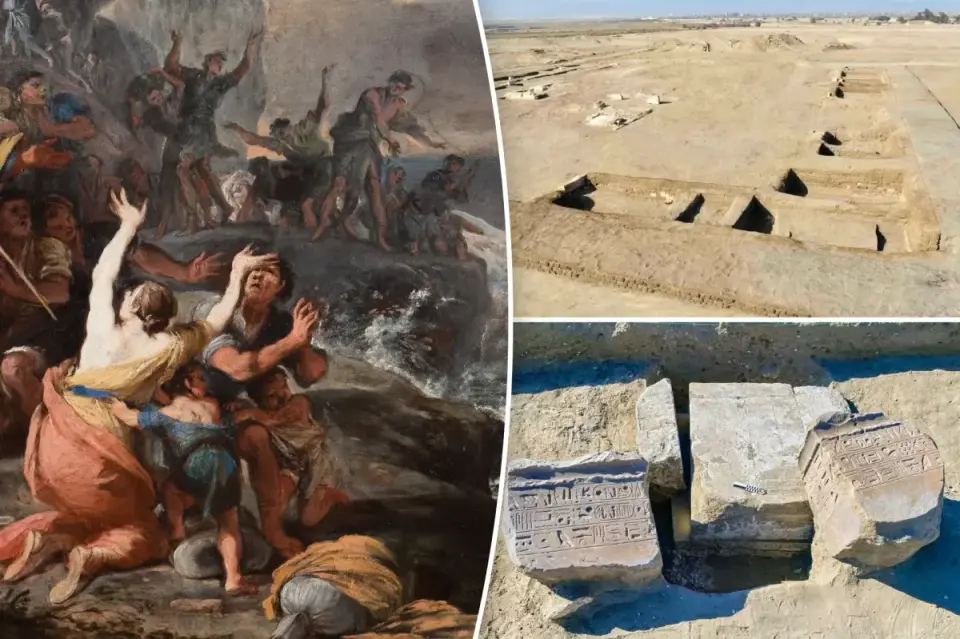
Egyptian authorities announced the discovery of a massive, inscribed sandstone lintel at Tell Abu Saifi in northern Sinai. The artifact, bearing the titles of Ramesses II and references to the deity Horus as 'Lord of Mesen,' provides strong evidence that the site may be the long-lost New Kingdom city of Mesen. This find, alongside a mudbrick temple and fortifications, supports the hypothesis that the location aligns with the 'Way of Horus,' a strategic military route historically linked to the biblical Exodus narrative.
Key points
- A broken sandstone lintel inscribed with the titles of Ramesses II and the deity Horus was unearthed at Tell Abu Saifi in northern Sinai.
- The inscription explicitly refers to Horus as the 'Lord of Mesen,' linking the site to the historically recorded but previously unlocated city of Mesen.
- Excavations also revealed a fortified temple citadel with mudbrick walls, gates, and storage rooms, suggesting a strategic military corridor.
- The site is believed to lie along the 'Way of Horus,' a route connecting the Nile Delta to the Levant, which some scholars associate with the 'way of the land of the Philistines' mentioned in the Book of Exodus.
- Egyptian officials stated that while the lintel does not definitively prove the identification, it presents a strong archaeological hypothesis linking the site to the ancient city.
Background
The city of Mesen is known from historical sources as a New Kingdom settlement but had never been definitively located. Previous archaeological efforts had struggled to pinpoint its exact coordinates, leaving its connection to the biblical Exodus narrative largely theoretical. This discovery follows a period of intensified excavation in the Sinai region, where researchers have sought to map the strategic military infrastructure used by Egyptian pharaohs to project power toward the Eastern Mediterranean.
How outlets are covering it
The New York Post emphasized the biblical implications of the find, framing the discovery as potential evidence for the Exodus narrative and highlighting the connection to the 'way of the land of the Philistines.' In contrast, Archaeology Magazine focused on the archaeological specifics, detailing the lintel’s inscriptions regarding Ramesses II’s restoration work on a statue of Horus and the structural remains of the temple. Popular Mechanics and Curly Tales reported the discovery with similar enthusiasm but lacked the detailed technical breakdown provided by Archaeology Magazine. All sources agreed that the find is significant but noted that definitive confirmation requires further excavation and scientific study.
Why it matters
This discovery bridges the gap between historical records and physical evidence for a key city in the New Kingdom era. If confirmed, it could reshape understanding of Egyptian military logistics in the Sinai and provide tangible context for ancient biblical narratives, offering a rare intersection of archaeology and religious history.
What to watch
Egyptian authorities have pledged to continue excavation and scientific study at Tell Abu Saifi to further confirm the site’s identity as Mesen. Researchers will likely focus on mapping the full extent of the temple and fortifications to understand the city’s role in the broader 'Way of Horus' corridor.
- Buried ancient city uncovered in Egypt may be linked to the Book of Exodus New York Post
- Lost city of Mesn: Ramesses II find strengthens case for its location in Egypt Archaeology News Online Magazine
- News - New Discoveries Link Sinai Site with Lost Egyptian City Archaeology Magazine
- Archaeologists May Have Just Revealed a Lost Egyptian City Popular Mechanics
- Egypt’s Lost City Of Masn May Have Been Found; Archaeologists Reveal Details curlytales.com
Want the full story? Read the original reporting
Read on New York Post