
Egyptian archaeologists uncover 2,000-year-old middle-class cemetery with gold tongues in Menoufia
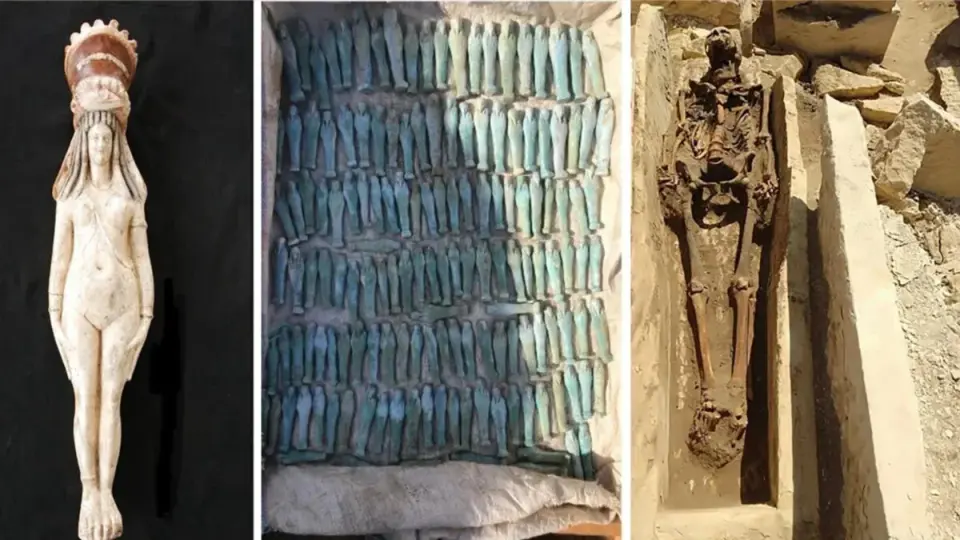
Archaeologists in Egypt’s Menoufia Governorate have uncovered a large, multi-period cemetery at the Tell Abu Bello site, associated with the ancient city of Teranothis. The discovery, announced by the Egyptian Ministry of Tourism and Antiquities, includes hundreds of stone and pottery coffins, mud-brick tombs, and diverse grave goods such as gold tongues, ushabti figurines, and Isis-Aphrodite statues. Preliminary analysis suggests the burial ground served the middle class during the Late, Ptolemaic, and early Roman periods. The find offers new insights into funerary practices and social structures in ancient Egypt, with excavation and documentation ongoing.
Key points
- The cemetery at Tell Abu Bello in Menoufia Governorate dates from the Late Period (664–332 BCE), Ptolemaic Period (332–30 BCE), and early Roman Period (30 BCE–395 CE).
- Excavators found hundreds of stone and pottery coffins, some damaged by past vandalism and quarrying, along with remains of wooden coffins and mud-brick domed tombs.
- Grave goods include gold tongues, an earring, a necklace pendant, gold strips, scarabs, offering tables, and faience ushabti figurines, some inscribed with hieroglyphs.
- Religious artifacts include terracotta statues of Isis-Aphrodite, sphinx figurines, fragments of Horus statues, and two falcon burials, reflecting worship of deities like Isis, Osiris, and Hathor.
- Preliminary studies indicate the cemetery was used by the middle class, with burial customs evolving across different historical periods in the region.
Background
Recent archaeological discoveries in Egypt have highlighted the complexity of ancient burial practices and social structures. In November 2026, researchers analyzed 131 cat skulls from Beni Hassan, revealing harsh conditions for sacred mummified cats. Earlier that month, a 17-year-old student in Israel found a 3,300-year-old Egyptian scarab at Tel Gezer. Additionally, chemical analysis confirmed the use of aloe in ancient embalming, while satellite radar uncovered a 2,600-year-old mudbrick complex in the Nile Delta. These findings, alongside the new Tell Abu Bello cemetery, underscore ongoing efforts to understand ancient Egyptian funerary customs and societal hierarchies through diverse archaeological methods.
How outlets are covering it
Gizmodo emphasizes the diversity of burial styles and the significance of the gold tongues, framing the discovery as a first of its kind for Tell Abu Bello. Archaeology News Online Magazine provides detailed insights into the dating methods, including stratigraphy and pottery analysis, and highlights the religious significance of the Isis-Aphrodite statues. Daily News Egypt focuses on the middle-class nature of the cemetery and the historical context of Teranothis, linking it to the natron salt extraction in Wadi El Natrun. All sources agree on the timeline and the variety of finds but differ in emphasis: Gizmodo highlights the novelty, Archaeology News Online Magazine focuses on methodology, and Daily News Egypt stresses social context.
Why it matters
The discovery of the Tell Abu Bello cemetery provides crucial insights into the funerary practices and social structures of ancient Egypt’s middle class during the Late, Ptolemaic, and early Roman periods. The variety of coffins, grave goods, and religious artifacts reveals how burial customs evolved over time and reflect the influence of both Egyptian and Greek deities. The site’s location near Wadi El Natron, known for natron salt used in mummification, further connects it to broader regional practices. Ongoing excavation and analysis will deepen understanding of ancient Egyptian society and its cultural transitions.
What to watch
Archaeologists will continue excavating and documenting the Tell Abu Bello site to uncover more details about the individuals buried there and the evolution of burial practices. Further analysis of the grave goods and human remains may reveal more about the social status, religious beliefs, and daily lives of the middle class in ancient Egypt. The findings will also contribute to broader studies of the Ptolemaic and Roman periods in the region.
- Archaeologists Discover an Ancient Egyptian Cemetery for the Middle Class—Gold Tongues Included Gizmodo
- Hundreds of ancient coffins found in a Ptolemaic cemetery at Tell Abu Billou, Egypt Archaeology News Online Magazine
- News - Ancient Cemetery Discovered in Northern Egypt Archaeology Magazine
- Egyptian archaeologists uncover cemetery with hundreds of coffins at Kom Abu Billo in Menoufia Daily News Egypt
- Hundreds of Coffins and Golden Tongues Uncovered at Ancient Terenouthis Ancient Origins
Want the full story? Read the original reporting
Read on Gizmodo