
Satellite radar reveals 2,600-year-old Egyptian complex buried under Nile mud
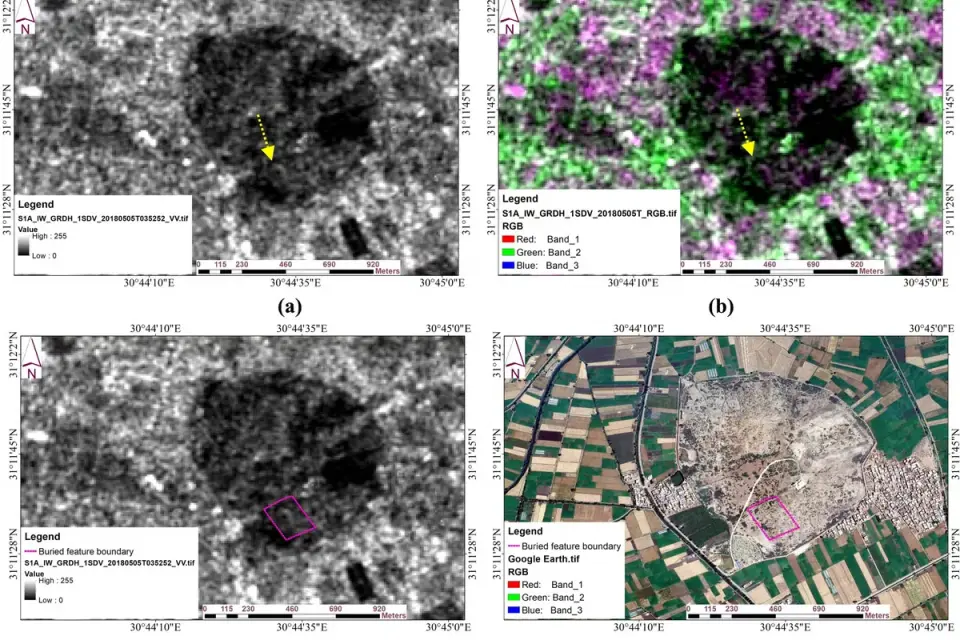
Researchers used satellite radar and electrical resistivity to uncover a massive 2,600-year-old mudbrick complex buried beneath the ancient city of Buto in Egypt's Nile Delta. The structure, dating to the Saite period, rests on an artificial sand foundation designed to stabilize it against the region's unstable clay and high water table. Excavations confirmed the presence of religious artifacts, including a limestone altar and baboon figurines, suggesting the site served a sacred function. This non-invasive approach allows scientists to map deep archaeological layers without the cost and risk of traditional digging.
Key points
- The discovery was made at Buto (Tell el-Fara'in), a sacred city in the northwestern Nile Delta associated with the cobra goddess Wadjet.
- The buried complex dates to the Saite period (26th Dynasty, 688–525 BC) and measures approximately 128 by 62 meters.
- A thick layer of clean sand was found beneath the structure, acting as an engineered foundation to distribute weight and prevent groundwater from dissolving the mudbrick walls.
- Excavations confirmed the geophysical findings, yielding artifacts such as ushabti figurines, a limestone altar with blood residues, and a faience baboon statue linked to the god Thoth.
- The study, published in Acta Geophysica, demonstrates how combining Sentinel-1 satellite data with electrical resistivity tomography can map deep archaeological sites inaccessible to traditional methods.
Background
Recent archaeological breakthroughs in Egypt have highlighted the Nile Delta's potential for hidden history. In October 2026, a farmer in Gharbia province accidentally uncovered colossal statues of Ramses II, underscoring the region's rich but often buried heritage. This new discovery at Buto complements those finds by using advanced remote sensing to access layers that previous excavations could not reach due to groundwater and thick mud deposits. The site has been occupied since 3800 BC, with layers from the Ptolemaic and Roman periods previously identified, but deeper Saite-era structures remained hidden until now.
How outlets are covering it
The Independent emphasizes the technical innovation, highlighting how satellite radar and soil electrical resistivity overcame the challenges of groundwater and mud deposits that hindered traditional digs. Live Science focuses on the engineering aspect, describing the sand foundation as a 'brilliant, deliberate tactic' that mirrors modern load-distributing foundations, and notes the structure's size is comparable to a football field. HeritageDaily provides a more cautious interpretation of the structure's purpose, noting that while artifacts suggest a religious or funerary function, the exact role remains uncertain. All sources agree on the significance of the Saite period's cultural revival in the Delta, but Live Science and HeritageDaily offer more detail on the specific artifacts found, such as the baboon figurine and blood-stained altar, which the Independent mentions only briefly.
Why it matters
This discovery demonstrates the effectiveness of non-invasive geophysical methods in archaeology, allowing researchers to map deep, inaccessible layers without the expense and risk of traditional excavation. The engineered sand foundation reveals ancient Egyptian understanding of soil mechanics and environmental adaptation, offering insights into how they preserved structures in unstable delta environments. Furthermore, it highlights the potential for similar discoveries at other layered sites, where satellite data could guide targeted excavations and preserve fragile remains.
What to watch
Researchers plan to expand their surveys using larger equipment to reach deeper, older layers beneath the current findings. They also intend to study ancient plants and the changing geology of the Nile Delta to reconstruct the landscape as it existed when the Saite complex was built. Further electrical resistivity surveys with wider electrode spacing will be conducted to investigate levels deeper than the current 6-7 meter depth, potentially revealing additional structures or a second temple buried under thick clay.
- Massive 2,600-year-old Egyptian complex under Nile discovered from space The Independent
- Huge Ancient Egyptian Structure Buried for 2,600 Years Discovered from Space People.com
- Mysterious 2,600-year-old Egyptian building discovered from space — and it could be an ancient tomb or shrine Live Science
- 2,600-year-old Egyptian complex discovered beneath ancient Buto HeritageDaily
- Satellite surveys reveal ancient Egyptian complex buried beneath the Nile The Independent
Want the full story? Read the original reporting
Read on The Independent