
COP31 brinkmanship: Third draft risks collapse as fossil fuel and funding disputes persist
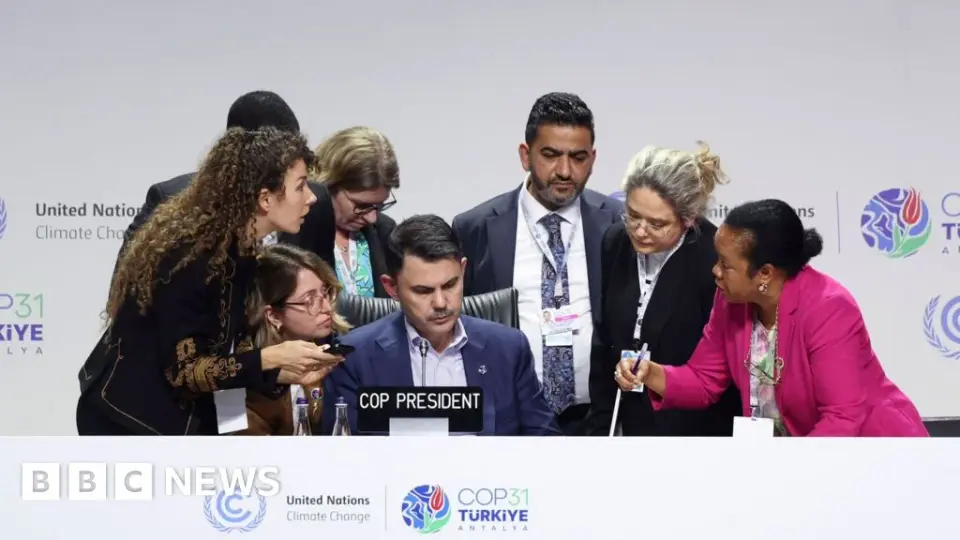
A third draft agreement at the COP31 climate summit in Antalya, Turkey, failed to resolve critical disputes over fossil fuel phase-outs and climate finance, leaving talks on the verge of collapse. While the text acknowledges the missed 1.5C warming target and references past commitments to reduce fossil fuels, it lacks explicit language on phasing them out and specific funding figures for adaptation. Co-hosts Turkey and Australia hope the compromise will bridge divides, but developing nations and the EU remain dissatisfied, with the risk of negotiations suspending until next year if consensus is not reached by Sunday morning.
Key points
- A third draft of the COP31 agreement was released in the early hours of Sunday, attempting to bridge divides between nations but failing to include explicit language on transitioning away from fossil fuels.
- The draft acknowledges that the world is on track to miss the 1.5C warming goal, a first for a COP agreement, but omits specific financial commitments for adaptation, deferring those decisions to future meetings.
- Developing nations, particularly the Africa Group, are dissatisfied with the lack of specific funding figures, while the EU and Pacific states oppose the removal of fossil fuel references, with some threatening to walk out.
- Co-hosts Turkey and Australia expressed hope that the new draft would address outlying concerns, but the EU has not yet reacted, and the UK’s chief negotiator remains hopeful but cautious.
- If consensus is not reached by Sunday morning, the negotiations could be suspended until next year, a scenario that has only occurred once since COP began in 1995.
Background
COP31, held in Antalya, Turkey, is the first UN climate summit with a dual presidency, shared by Turkey and Australia. Previous drafts of the final agreement had included explicit language on phasing out fossil fuels, but a pared-down version released on Thursday removed all mentions of coal, oil, and gas, sparking threats of walkouts. The summit had already blown past its original Friday deadline, with delegates rescheduling flights and the risk of losing quorum as teams prepare to leave. The United States is absent from the negotiations, and the summit faces criticism for failing to address the financial needs of vulnerable developing nations.
How outlets are covering it
The BBC reports that the third draft acknowledges the missed 1.5C warming goal and references past commitments to reduce fossil fuels, but lacks explicit language on phasing them out and specific funding figures. The EU and Pacific states are dissatisfied with the removal of fossil fuel references, while the Africa Group is disappointed by the lack of specific funding commitments. The Guardian highlights that a loose coalition of about 130 countries insists on including a reference to the 'transition away from fossil fuels,' while Saudi Arabia and other oil-rich nations oppose explicit statements on fossil fuel use. The Guardian also notes that campaigners blame the fossil fuel industry and rich countries for failing to deliver on financial promises, with some suggesting that an open meeting could force Saudi Arabia to publicly state its opposition. The BBC and Guardian both report that co-hosts Turkey and Australia hope the third draft will bridge divides, but the EU has not yet reacted, and the UK’s chief negotiator remains cautious.
Why it matters
The outcome of COP31 will determine whether the world can maintain momentum on climate action or risk a significant setback. The failure to reach consensus on fossil fuel phase-outs and climate finance could undermine the Paris Agreement’s goals and leave vulnerable nations without the support they need to adapt to climate impacts. The risk of negotiations suspending until next year highlights the fragility of international climate diplomacy and the need for stronger leadership and compromise.
What to watch
Countries are expected to reconvene at 09:00 local time on Sunday to decide whether to approve the new deal. If consensus is not reached, the negotiations could be suspended until next year. The EU and other dissatisfied nations may continue to push for stronger language on fossil fuels and climate finance, while co-hosts Turkey and Australia will likely seek to maintain momentum and avoid a collapse of talks.
- Fossil fuel dispute threatens to derail COP31 climate deal BBC
- Climate talks in overtime as nations wrestle with response to worsening global warming PBS
- COP31 climate talks close to final deal, says summit president Reuters
- Climate talks stall as countries mull showdown with Saudi Arabia over fossil fuel phaseout | Cop31 The Guardian
- COP31: UN Climate summit runs into second day of overtime DW.com
Want the full story? Read the original reporting
Read on BBC