
Nepal Flood: A Two-Stage Disaster Triggered by Ice, Rock, and Climate-Driven Instability
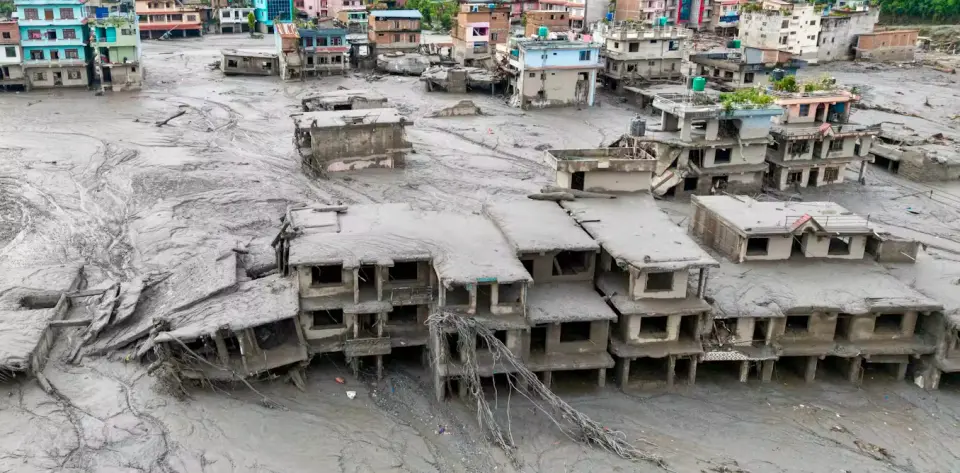
A massive rock and ice collapse near Langtang Lirung, Nepal, on Aug. 26, 2026, triggered a catastrophic flood that killed hundreds and left many missing. The disaster unfolded in two stages: an initial surge from the landslide, followed by a second wave when a newly formed 'barrier lake' burst two days later. Scientists link the event to climate change, which is accelerating glacier melt and destabilizing permafrost in the Himalayas, while highlighting gaps in early warning systems and the need for transboundary cooperation.
Key points
- A magnitude 5.2 seismic event confirmed by the USGS marked a massive rock and ice collapse from a slope north of Langtang Lirung, sending debris 1,200 meters into the valley below.
- The initial flood surge was followed by a second wave on Aug. 28, when a 'barrier lake' holding millions of cubic meters of water, formed by debris, burst its banks.
- The disaster destroyed infrastructure, including about a dozen hydropower facilities and the Gyirong Port border crossing between Nepal and China.
- Climate change is a key driver, with Himalayan ice loss rates doubling since 2000 and thawing permafrost weakening mountain slopes, according to ICIMOD.
- Experts call for improved early warning systems, including seismic sensors and satellite-based alerts, and greater regional cooperation for transboundary hazards.
Background
This event follows a pattern of increasing glacial hazards in the Himalayas. In 2021, a similar rock and ice avalanche in India's Uttarakhand killed about 200 people. In 2023, thawing permafrost in Sikkim, India, triggered a massive outburst flood from a glacial lake. ICIMOD reports from March 2026 had already warned of accelerating glacier melt in the region, with up to 27 meters of ice lost since 1975. The current disaster underscores the growing risk from a combination of warming, high-altitude rainfall, and inadequate monitoring.
How outlets are covering it
The Conversation, a scientific outlet, emphasizes the two-stage nature of the disaster and the role of climate change in destabilizing permafrost and glaciers. It highlights the need for advanced warning systems and transboundary cooperation. The Stimson Center, a policy think tank, frames the event as a 'cascading disaster' on the Nepal-China border, focusing on the immediate humanitarian and infrastructure impact 72 hours after the event. Yahoo News, in a broader context, links the event to a 'supercharged El Niño' and other global weather anomalies, suggesting a wider pattern of climate-driven extreme events. The sources agree on the severity and the climate link but differ in emphasis: The Conversation focuses on the scientific mechanism and long-term risk, Stimson on the immediate crisis, and Yahoo on the global weather context.
Why it matters
The Nepal flood is a stark example of how climate change is increasing the frequency and severity of geohazards in the Himalayas. The two-stage nature of the disaster, with a delayed second wave, highlights the inadequacy of current monitoring systems, which are often designed for monsoon floods, not rapid, debris-driven surges. The destruction of critical infrastructure, including hydropower plants and a major border crossing, has significant economic and geopolitical implications. The event underscores the urgent need for improved early warning systems, international cooperation, and a re-evaluation of development in high-hazard mountain corridors.
What to watch
Rescue and recovery operations will continue, with a focus on finding the missing and assessing the damage to infrastructure. Nepal's electricity authority will work to restore power to the affected regions. International scientific teams will continue to analyze the event to improve understanding of glacial collapse mechanisms. There will be increased pressure on governments to invest in more robust, multi-sensor early warning systems and to strengthen transboundary cooperation for disaster management. Long-term, the event will likely influence future permit decisions for hydropower dams and other infrastructure in high-hazard areas.
- When a mountain falls: How ice and rock triggered Nepal’s catastrophic flood – and why climate change is raising the risks The Conversation
- Nepal's collapsing glacier. L.A.'s humid heat wave. A supercharged El Niño. Why does the weather suddenly feel so weird? Yahoo
- Nepal’s Glaciers Will Flood Again. Can Scientists Predict the Next One? National Geographic
- A Cascading Disaster on the China–Nepal Border: What to Know About the August 2026 Rasuwa Flood, 72 Hours Later Stimson Center
- Nepal disaster exposes threat of living on shifting ground ABC News & Headlines – Australian Broadcasting Corporation
Want the full story? Read the original reporting
Read on The Conversation