
BRICS Leaders in New Delhi Push for Trade Autonomy Amid Sanctions and Energy Crisis
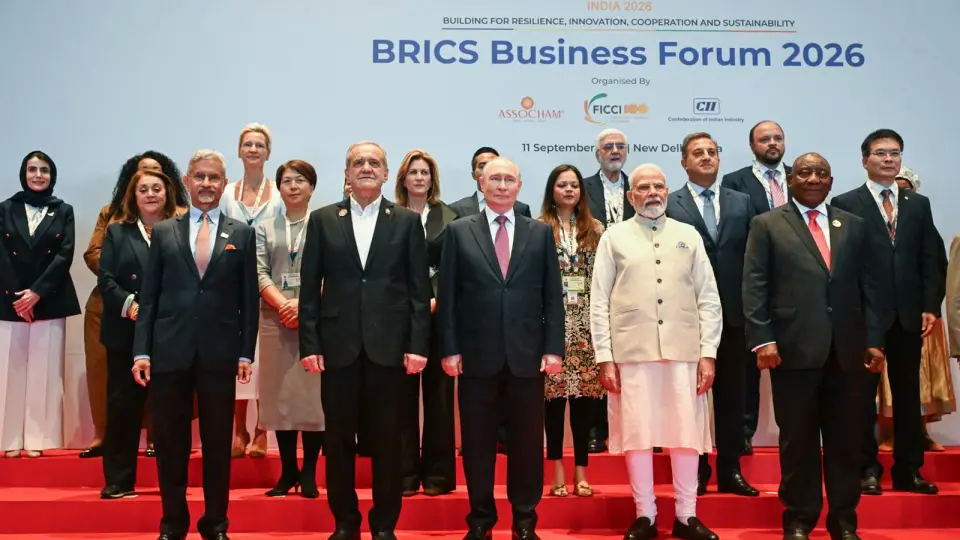
Iranian and Russian leaders at the BRICS Business Forum in New Delhi criticized Western sanctions, urging the bloc to expand trade in national currencies to bypass financial monopolies. The summit highlights growing tensions as the U.S.-Iran conflict disrupts global energy markets, pushing U.S. diesel prices to $6 per gallon and crude above $100 per barrel. While India seeks to balance relations with Washington, Moscow, and Beijing, the bloc faces internal divisions over how to respond to ongoing military conflicts and economic pressure.
Key points
- Iranian President Masoud Pezeshkian stated that pressure on Tehran has entered a 'dangerous phase,' shifting from sanctions to military aggression by the U.S. and Israel.
- Russian President Vladimir Putin claimed over 30,000 sanctions have been imposed on Russia, arguing that Western powers are protecting their competitive edge against industrial decline.
- Pezeshkian urged BRICS to create an environment where no country can disrupt trade via financial instruments, advocating for the use of national currencies among members.
- U.S. diesel prices reached $6 per gallon for the first time, and crude oil futures topped $100 per barrel, driven by supply disruptions from the Strait of Hormuz and the Ukraine war.
- India’s Prime Minister Narendra Modi is hosting the summit, balancing diplomatic ties with the U.S., China, Russia, and Iran while attempting to maintain BRICS unity despite regional rivalries.
Background
This summit follows the Shanghai Cooperation Organization meeting in Bishkek, where members condemned unilateral coercive measures and urged diplomatic de-escalation regarding Iran. Earlier coverage noted India’s efforts to position itself as a neutral mediator, emphasizing dialogue over sanctions in the Russia-Ukraine conflict. The current gathering in New Delhi represents a critical test for the expanded BRICS bloc, which has faced challenges in maintaining cohesion due to diverging geopolitical interests among its members.
How outlets are covering it
CNBC emphasizes the economic and security dimensions, highlighting the direct impact of sanctions on energy prices and the push for financial independence within BRICS. Fox News focuses on India’s diplomatic balancing act, noting the complexity of managing relationships with Washington, Beijing, and Moscow while addressing internal bloc divisions. While both sources agree on the significance of the summit, CNBC frames the event as a response to Western pressure, whereas Fox News highlights the risk of BRICS becoming an arena for great-power rivalry rather than a platform for Global South cooperation.
Why it matters
The summit underscores the growing fragmentation of the global economic order, with BRICS nations seeking alternatives to Western-dominated financial systems. The energy crisis, exacerbated by conflicts in the Middle East and Ukraine, has heightened the urgency for developing nations to secure stable supply chains and reduce dependence on volatile markets. India’s role as host is pivotal in determining whether BRICS can maintain unity and influence in a polarized world.
What to watch
Observers will watch for any joint statements or concrete agreements on trade and energy cooperation from the BRICS summit. India’s ability to mediate between conflicting member interests, particularly regarding Iran and the Ukraine war, will be a key indicator of the bloc’s future cohesion. Additionally, the impact of U.S. sanctions on Iran’s trading partners and the potential for new diplomatic breakthroughs in the Middle East will be closely monitored.
- Iran, Russia condemn Western economic sanctions and urge BRICS bloc to deepen economic ties CNBC
- Modi, Putin seek stronger ties as Russia calls for BRICS to counter West Reuters
- Watch Why India Won’t Break Up With Russia Bloomberg.com
- Putin, Xi and Iran's Pezeshkian descend on India for high-stakes BRICS summit amid escalating global tensions Fox News
- Why Emerging Powers Keep Joining BRICS, Even When They Disagree The New York Times
Want the full story? Read the original reporting
Read on CNBC