
Kremlin Sends Medieval Prince’s Relics to Ukrainian Front to Boost Morale
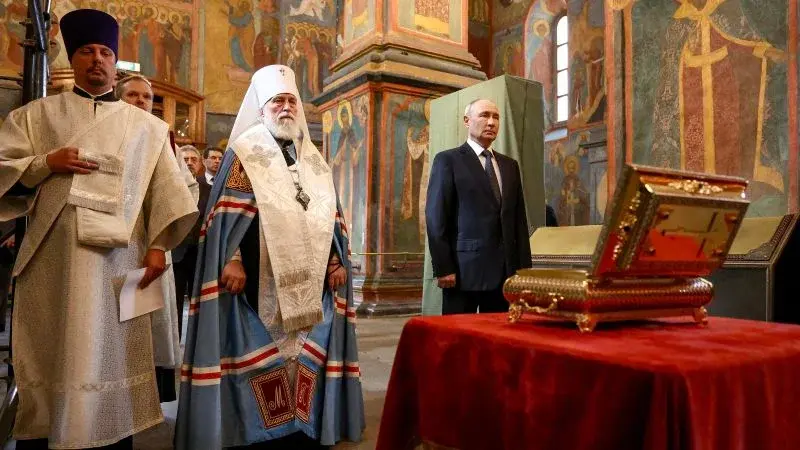
Russian military authorities have dispatched a fragment of the remains of Prince Dmitry Donskoy, a 14th-century warrior saint, to troops in occupied Ukraine. The relic, uncovered during Kremlin restoration work in August, is being circulated among bases to provide spiritual support. This move reflects the deepening integration between the Russian state and the Orthodox Church, which frames the war as a defensive, righteous cause. While some soldiers find comfort in the relic, critics argue it is cynical propaganda, and overall religious practice in Russia remains low despite state-backed events.
Key points
- A fragment of the right hand of Prince Dmitry Donskoy, a medieval Russian ruler celebrated for the 1380 Battle of Kulikovo, was sent to Russian front lines in early September 2026.
- The relic was discovered during restoration work at the Kremlin’s Archangel Cathedral in August 2026, shortly after reports suggested relics of Prince Alexander Nevsky had been lost.
- The Moscow Patriarchate’s military department stated the relic would 'invisibly stand shoulder to shoulder' with soldiers, aiming to mobilize their spiritual and physical strength.
- President Vladimir Putin described the discovery as 'absolutely unique' and a 'marvelous discovery,' while Patriarch Kirill called it a sign of divine providence.
- Religious scholar Sergei Chapnin noted that the church and state have become 'indistinguishable,' using religious symbolism to portray Russia as a defender rather than an aggressor.
- A 2026 VCIOM survey found that about two-thirds of Russians identify as Orthodox, but only roughly 2% of baptized believers regularly practice their faith.
Background
This development follows a broader trend of the Russian Orthodox Church aligning with state narratives since the 2022 invasion of Ukraine. In 2019, Ukraine formally split from the Russian Orthodox Church, a move recognized by the head of the global Orthodox church. The Kremlin has increasingly relied on religious symbolism to legitimize its military actions, a strategy that has intensified as the war enters its fifth year. Recent parliamentary elections in September 2026, which the Kremlin framed as a mandate for the war, further illustrate the state’s effort to consolidate support through controlled narratives, including religious ones.
Why it matters
The deployment of religious relics to the front lines underscores the Kremlin’s strategy of blending state power with religious authority to sustain morale in a protracted conflict. It highlights how the Russian Orthodox Church has become a tool for propaganda, framing the war as a defensive, divinely sanctioned mission. This move also reveals the tension between state-backed religious events and the reality of low religious practice among the Russian population, suggesting that the state is using religion more for political mobilization than for genuine spiritual engagement.
What to watch
The relic is expected to continue circulating among military bases in Russian-occupied Ukraine. The Russian Orthodox Church may further integrate religious symbolism into its support for the military, potentially expanding the role of chaplains on the front lines. Critics within the church may continue to debate the ethical implications of blessing soldiers who may be involved in offensive actions. The state may leverage such events to reinforce its narrative of a 'righteous' war, while international observers will likely scrutinize the growing entanglement between the Russian state and the Orthodox Church.
Want the full story? Read the original reporting
Read on CNN